

Welcome to the latest edition of Human Capital Intelligence, your weekly brief synthesizing over 250 leadership, HR, and people sources to filter out the noise. As always, we would love to hear from you at ken@reyvism.com with questions you’d like answered or topics covered.
Sent this by a friend? Sign up here to receive HCI in your inbox every week.
By Ken Stibler; Powered by Reyvism Analytics
Humans (increasingly) no longer required
Corporate restructuring is accelerating as more companies move from pilot AI projects to full-scale adoption. Amazon is planning to replace 600,000 workers by 2027, Goldman Sachs has begun a full AI-driven reorganization, and similar stories are becoming a daily reality. Across sectors, the same pattern is emerging: efficiency gains from AI are actually replacing the need for large teams of people. Even in startups hiring is rapidly falling, leaving small and medium sized businesses the human-dependent businesses in an increasingly automated world.
Executives say the future workforce will look less like a triangle and more like a barbell, with more individual contributors, fewer middle managers, and a handful of leaders overseeing increasingly technical teams. Companies like Moderna are merging HR and IT functions entirely, while banks such as Citi and JPMorgan Chase are embedding AI into every process from client onboarding to code reviews. JPMorgan alone reports over one million AI-automated code reviews this year, freeing 100,000 developer hours each week.
But the human cost is real. Entry-level roles are disappearing, and organizations that skip retraining risk hollowing out their own talent pipelines. Surveys show nearly half of executives see AI primarily as a headcount-reduction tool rather than an enabler of skills development. As more companies turn to agentic AI systems to execute multistep tasks, the workforce itself is being rewritten: leaner, faster, and more dependent on machines.
The strategic question for leaders is starting to shift from how to add AI to how few humans are still needed to make it work. For smaller businesses: make sure you’re studying and stealing from the expensive and hard-won tactics of big companies’ AI efforts.
… yet companies struggle to land AI skills
Even as they cut staff, companies are racing to hire the few people who can make AI actually deliver. Former Apple CEO John Sculley admits the company’s failure to adopt AI has created its first competitive challenge in decades.
Ralph Lauren has elevated AI to the C-suite, and Citi now requires prompt training for most employees. Yet demand far outpaces supply: Indeed’s latest research finds 41% of all job skills are now exposed to AI transformation, but only 13% of organizations have mature governance and deployment standards in place.
Banks have led the way. Evident Insights reports AI headcounts at major financial institutions grew five times faster than total hiring last year. Capital One alone added over 2,000 AI professionals, while JPMorgan continues to recruit aggressively from Big Tech. Still, 35 percent of tech workers fear AI could replace their roles, and many say they’re not getting the training they need to adapt.
The result is a paradox: firms have the tools to automate, but not the talent to deploy them safely or effectively. AI can transform work, but without human fluency and governance, transformation is just turbulence.
Quote of the Week: Success with AI is dependent on people
“AI represents an enormous opportunity for businesses globally, but as they chase greater productivity and efficiency, we must not lose sight of the fact that it is ultimately people who power progress.”
— Susan Taylor Martin, CEO of the British Standards Institution
Reading List:
Pockets of shortages prompt teenager training pipelines
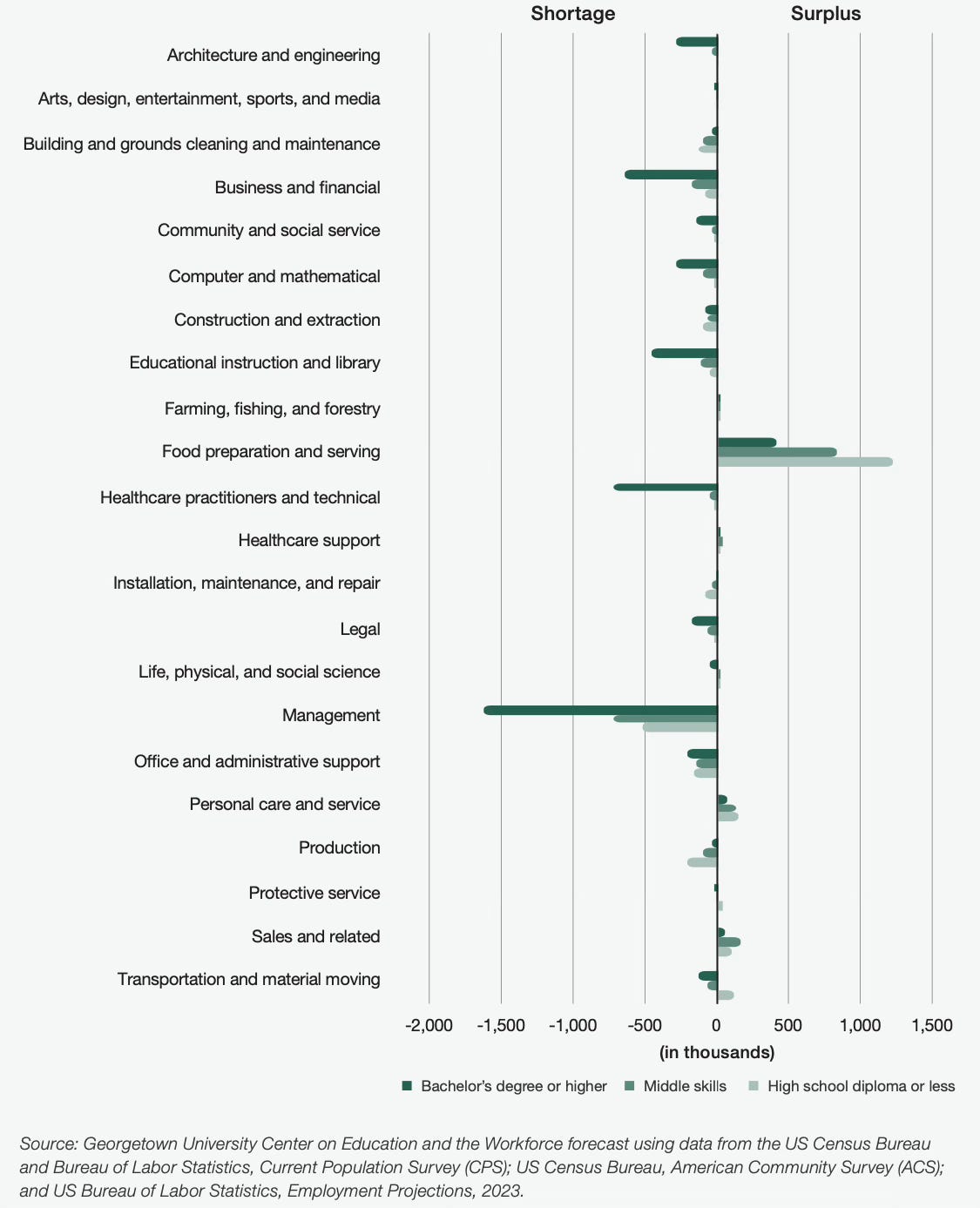
Labor shortages are prompting companies to look further down the age curve, the WSJ reports. Across the U.S. and Europe, manufacturers and logistics firms are launching high school apprenticeship programs to fill technical roles before they disappear entirely. Germany’s dual-education model is now being studied by U.S. policymakers as a template for bridging skill gaps in advanced manufacturing and robotics.
Simple fixes to be better at complex management
Complex management problems often have simple human fixes. A ten-year study of 200,000 employees and 30,000 managers found that the best leaders were those who placed people in roles that matched their strengths, not those who managed the most projects or meetings. Employees who worked under top managers were 40% more likely to move laterally within seven years, earned 13% more, and achieved 16% higher performance. These leaders spent more time in one-on-one meetings, spotting talent and coaching, while poor managers defaulted to micromanaging and drained morale.
Revisiting the value of culture hires and “glue” employees
As organizations flatten and automate, “glue people” who connect teams are becoming both rarer and more valuable, the Wall Street Journal reports. These employees (often informal communicators or cross-functional coordinators) carry much of the social load that keeps hybrid teams aligned. But they are also the first to be overlooked in data-driven talent reviews. Replacing them with tools erodes trust faster than leaders realize. The lesson: what AI optimizes, culture must still sustain.
Data Point: Pools of Reality Amid a Sea of Hype
52%
Number of survey respondents that reported worker reassignment due to AI adoption, while 26% said talent was laid off due to AI.
— Indeed 2025 survey on workforce transformation
In Other News
The New Executive Challenge: Conquering White Space. (Arte Coach)
Learning leaders need to know how to pick tech, report says: “If we don’t develop the adjacent IT skills to help make those decisions, someone else will make those decisions for us,” one learning officer said. (HR Dive)
The hidden risks of AI in training. (HR Mag)
Furloughed Federal Workers Turn to Side Hustles to Survive Shutdown. (Wall Street Journal)
Nearly all workers believe in title inflation — and most say it’s on the rise. (HR Dive)
Forcing employees to return to the office often backfires, research shows. In this video, learn four better approaches to bringing teams together. (Sloan MIT Review)
6 things HR leaders must know about agentic AI before investing. (HR Executive)
Deloitte AI debacle seen as wake-up call for corporate finance. (CFO Dive)