

Welcome to the latest edition of Human Capital Intelligence. As always, we would love to hear from you at ken@stibler.me with news ideas, feedback and anything else you find interesting.
Sent this by a friend? Sign up here to receive HCI in your inbox every week.
By Ken Stibler; Powered by Reyvism Analytics
What’s Working:

Building lifelong learners as a competitive advantage
In an era of continued and compounding disruptions, the ability to learn and adapt has emerged as perhaps the most critical organizational capability. The World Economic Forum's stark projection that 44% of core skills will transform by 2027 underscores a fundamental shift in how businesses must approach talent development.
This reality, coupled with PwC's finding that 79% of CEOs view skills shortages as a growth impediment, signals that traditional approaches to workforce development are no longer sufficient in today's rapidly evolving landscape.
The transition from "one life, one career" to "portfolio careers" demands a fundamental reimagining of professional development. Recent EY research indicates that only 32% of employers possess the strategic capabilities to build what they term a "Talent Advantage," highlighting a critical gap between necessity and readiness. Organizations must shift from viewing learning as a periodic event, to treating it as a continuous process integrated into daily operations.
“You lose your curiosity, and you are on your way out…this approach reflects a broader truth about organizational survival in today's business environment.”
— Bank of America CEO Brian Moynihan’s moto on learning agility as a driver sustained leadership success.
Research on learning agility reveals four crucial elements: purpose-linked learning, creating learning-rich environments, meta-learning practices, and team-based learning approaches. This framework offers organizations a roadmap for developing the adaptive capabilities needed to navigate uncertain times where standard operating procedures may no longer apply. The data suggests that companies that successfully implement these elements see improved productivity and business outcomes, even in challenging economic conditions.
As we advance into an era where 38% of employees anticipate changing jobs within the year, organizations that prioritize learning agility and continuous skill development will likely emerge as winners in the talent marketplace. The evidence suggests that success will increasingly favor those organizations that can create environments where continuous learning is not just encouraged but embedded in their cultural DNA, supported by flexible work arrangements and personalized development pathways that acknowledge the evolving nature of work itself.
How can companies and employees be desperate at the same time?
A peculiar paradox has emerged in today's labor market: while CEOs are widely concerned about growing skills shortages, job seekers are resorting to desperate measures, including adopting pink "#Desperate" banners on LinkedIn, to signal their availability.
This disconnect is particularly evident in the data, with LinkedIn reporting 2.5 job applicants for every open position, up from 1.5 in 2022, yet qualified candidates and suitable opportunities often fail to connect. The labor market's efficiency in matching talent with opportunities appears to be deteriorating, creating a costly dysfunction for both sides of the employment equation.

The fragmentation of the labor market helps explain this apparent contradiction. As Sanford Rose Associates' CEO Jeff Kaye notes, while some sectors like commercial construction in the Southwest face talent shortages, others such as marketing and brand management have cooled significantly. The result is a labor market that simultaneously contains both desperate employers and desperate employees, operating in parallel but seemingly unable to bridge the gap between them.
This persistent mismatch signals a fundamental shift in how companies must approach talent acquisition and retention. The traditional model of posting positions and waiting for qualified candidates to appear is proving increasingly inadequate in a market where “talent health” depends on more nuanced factors.
As the labor market returns to pre-pandemic norms in terms of overall employment levels, this inefficiency in matching talent with opportunities suggests that businesses need to fundamentally rethink their approach to talent acquisition, moving beyond passive recruitment to more proactive, targeted strategies that can bridge the growing gap between available talent and open positions.
Overlooking, and overworking, high performers risks organizational burnout
Organizations are increasingly reliant on their high performers, who are already 400-800% more productive than average employees, to shoulder an ever-growing burden of organizational responsibilities. This dynamic is particularly evident in the experiences of the quietly productive Gen X cohort, who are 30% less likely to feel meaningfully recognized at work, and 27% less likely to report adequate support for their well-being compared to other generations.
The data suggests a systemic pattern where high performers, especially those in management positions, are becoming victims of their own success – their demonstrated capability leading to continuously increasing workloads, without corresponding increases in support or recognition.
This pattern is creating what could be termed "organizational burnout" – a systemic degradation of corporate performance driven by the overreliance on high performers to compensate for broader organizational inefficiencies.
As these key employees become overwhelmed, their engagement drops, creating a cascade effect where their reduced capacity to support and develop others leads to broader team underperformance. This, in turn, creates additional pressure on remaining high performers to pick up the slack, accelerating the burnout cycle and potentially triggering attrition among the very employees organizations can least afford to lose.
When high performers, who drive innovation and excellence, become disengaged or depart, organizations lose not just their direct contributions but also their positive influence on team performance and culture. Research indicates that recognizing these employees' contributions has powerful spillover effects on team motivation, suggesting that failing to properly support and engage high performers doesn't just affect individuals – it undermines the fundamental mechanisms of organizational performance improvement, creating a downward spiral that becomes increasingly difficult to reverse.
Quote of the Week:
Employers are starting to worry that sponsoring MBA programs for their employees will push them to start their own companies instead of seek internal promotions - and cutting such programs in turn. 30% of MBA grads use the degree to start their own business and employers are growing keen to the path.
— Financial Times
Reading List:
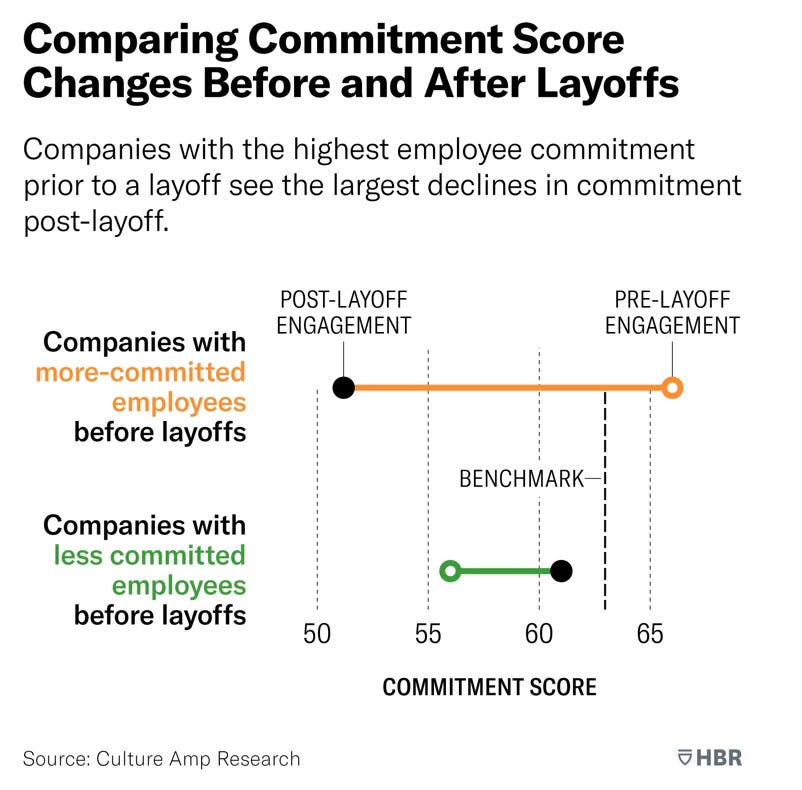
Layoffs cost more than many leaders think
Research reveals the mounting costs of return-to-office mandates and associated layoffs, with companies experiencing unprecedented drops in engagement metrics: company confidence falling 16.9 percentage points and career opportunity confidence declining 12.1 percentage points. Recovery periods have extended from 12-18 months to 18-24 months following 2023 layoffs, while RTO mandates are triggering mass exodus threats, exemplified by Amazon where 73% of workers began job searching following new attendance requirements.
The financial impact extends well beyond immediate cost savings, as high-performing employees show a 16% drop in retention intent under RTO mandates. Research indicates that low morale can reduce the value obtained from each dollar spent to just 25 cents, transforming short-term labor cost reductions into long-term value destruction through decreased productivity, lost institutional knowledge, and rising recruitment costs – particularly as companies struggle to attract talent with inflexible work policies.
Read more at the Harvard Business Review.
TikTok becomes the new water coolers for employees under 30
HCI has repeatedly used examples from 'TikTok’ as a window on younger employees as such social media platforms are the new “water cooler conversation.” Over one-third of workers, and approximately half of Gen Z employees, acknowledge they've posted negative content about their employers online. This is challenging in multiple ways for older employers, who must balance protecting their corporate interests with employees' rights to discuss working conditions online – a form of protected concerted activity under federal law. HR professionals are advised to address this shift by creating more productive internal channels for employee feedback and grievances, recognizing that online workplace discourse is an inevitable feature of the modern work environment rather than a problem to be eliminated.
Read more in WorkLife.
Why are we so bad at taking care of what we have?
In both human psychology and corporate strategy, there's a persistent bias toward the novel and external over the familiar and internal – a tendency that helps explain why organizations often prioritize new talent acquisition over developing existing talent. Offering up to 20% higher salaries to new hires willing to work in-office without engaging remote employees risks engagement and productivity across the board. This pattern mirrors a broader human tendency to undervalue and under-maintain existing assets, whether they're relationships, possessions, or employees.
Read more at Kenstibler.com.
Data Point:
41%
of employees report feeling a lack of job security due to their skills gaps, and just 25% think their company’s L&D programs are helping them fill their gaps, according to a survey by e-learning platform Skillsoft.
In Other News:
Why employers are getting more transparent about interview process in job postings. (WorkLife)
Workers say debt is influencing career decisions. (HR Dive)
Teens Need Real Jobs, Not Elite Internships. (Wall Street Journal)
How Recruiters Can Handle a Deluge of Applications, According to 4 Talent Leaders. (Linkedin Talent Blog)
20 Ways To Strengthen Career Pathways And Inspire Employee Growth. (Forbes)
Research: Pay-for-Performance Doesn’t Have to Stress Workers Out. (Harvard Business Review)
Female CFOs, CEOs at big companies outearn male counterparts. (HR Dive)