

Welcome back to HCI, your go-to source to keep up with the best insights from over 250 leadership, HR, and people sources. As always, we would love to hear from you at ken@reyvism.com with questions you’d like answered or topics covered.
Sent this by a friend? Sign up here to receive HCI in your inbox every week.
By Ken Stibler; Powered by Reyvism
Gen Z may be telling you what everyone else won’t

Gen Z is by far the workplace’s favorite management problem. They ask why (a lot), push back on office rituals, want more feedback and are less willing to pretend to care about things that they determine unimportant. That makes them a frequent pain, but also potentially useful in an unexpected way.
Leadership expert Dan Rust argues that Gen Z isn’t necessarily more disengaged than everyone else; they’re just worse at hiding it. Gallup’s engagement data points in the same direction. Younger workers have posted some of the largest declines in engagement since 2020, particularly in feeling cared about by a manager, having opportunities to grow and knowing what is expected of them. Those are basic management problems rather than especially Gen Z issues.
The same way a new employee can shed valuable light on different ways of doing things, Gen Z is often calling out expectations nobody has explained and manager relationships that were never particularly strong. An employee questioning a recurring report might be pointing to work nobody has reconsidered in years. Requests for more feedback or clearer expectations may reflect frustrations that older colleagues have simply learned to tolerate.
While many need coaching in how to bring up the issues they see, effective leaders can harness Gen Z to be a canary in the coal mine for quietly common problems; fix those and you likely will have generated engagement far beyond the bottom of the pyramid.
Your army of AI agents still needs a manager
One recruiter spent months writing nearly 200 documents to teach four AI agents how to run pieces of her business. They now watch for hiring signals, produce market intelligence, nurture candidates and run searches. She still reviews their work and steps in when the judgment gets difficult.
Claude maker Anthropic is seeing the same issue at much larger scale. By August, its AI agents were working six hours for every human hour, yet roughly 80% of elapsed time in interactive sessions was spent waiting for people to respond. Human attention has become the bottleneck, while employees spend more time reviewing agents, building ways to manage them and making the decisions they still can’t.
The one-person company may therefore involve considerably more management than the name suggests. As AI gets better at doing the work, more of the human job moves toward setting rules, supplying context, reviewing exceptions and deciding what happens next.
Before deciding to build an army of agents, make sure you know who’s going to manage it.
Quote of the Week: The job comes with a warning label
“If you need predictable hours, a defined playbook, or frequent direction, this isn’t for you.”
— Ryan Batra, vice president of talent at Khosla Ventures, in a posting for a chief of staff role
Reading List:
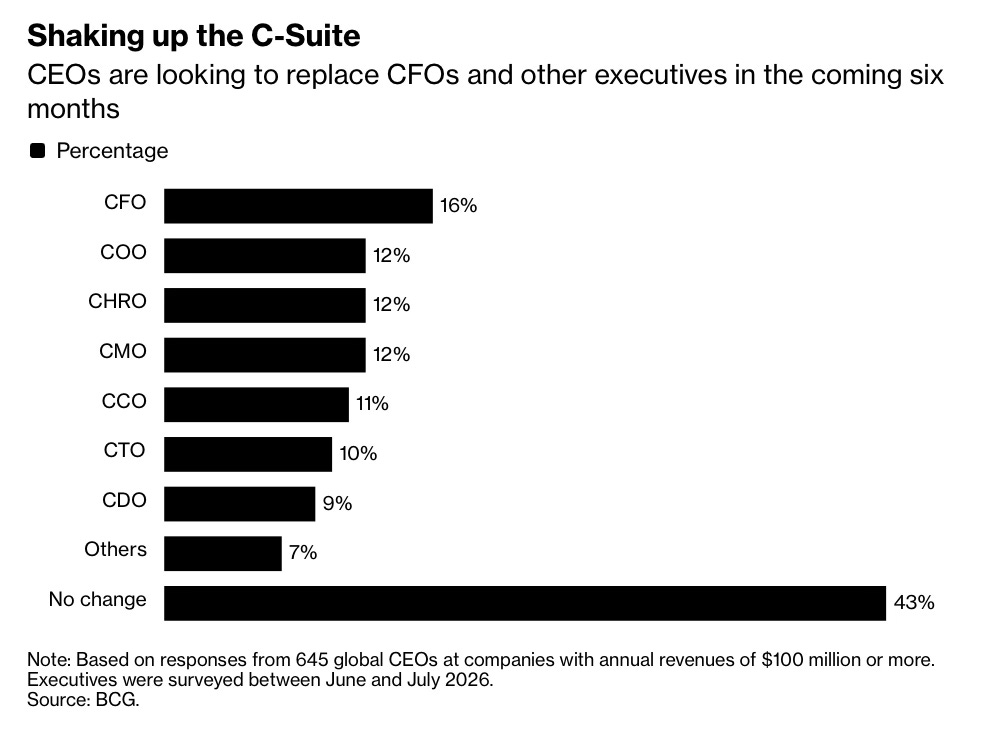
CFOs are first in line for a C-suite shake-up
Nearly 60% of CEOs expect to replace a senior leader within six months, with CFOs the most frequently named target at 16%. CEOs are under pressure to move faster while also complaining about capability gaps and competing agendas on their teams. Yesterday’s reliable executive can become tomorrow’s mismatch surprisingly quickly when the business changes faster than the job description.
Small raise budgets make scarce skills more valuable
Employers expect average merit raises of just 3.2% next year, leaving little room for generous increases across the board. Marsh recommends directing more of those dollars toward high performers, critical roles and scarce skills rather than spreading them evenly. When the market value of skills is moving faster than the overall pay budget, equal raises can quietly become unequal retention risk.
The 80-hour job is saying so upfront
Khosla Ventures drew attention for a chief of staff opening built around intense hours, constant availability and several years of unusually demanding work; the firm still expects more than 1,000 applicants. Some candidates will reasonably run from that deal and others will see access, learning and future opportunities worth the cost. There is something useful about employers getting explicit about that bargain before someone takes the job.
Data Point: Family coverage crush
$7.4k
The average amount workers now pay each year toward employer-sponsored family health coverage, up 9% from 2025. Total family premiums reached $28,303, up 5%, while wages rose 3.7%.
In Other News
AI agents are joining the workforce, so it’s time to rethink the business plan. (CIO)
When even the hiring manager’s resume gets rejected. (Linkedin)
IBM talent exec says it’s better to be a specialist, not a generalist, in the AI era. (Business Insider)
PE Firms Are Holding Investments Longer—and Changing Leaders More. (Wall Street Journal)
A Princeton Ph.D. Applied to 2,300 Jobs. He Still Can’t Get One: There’s a deep freeze paralyzing the labor market—and it’s hitting college-educated workers hard. (Wall Street Journal)
Texas Court Gives Employers More Flexibility to Encourage Employees Not to Compete: 5 Things to Know. (Fisher Phillips)