

Welcome to the latest edition of Human Capital Intelligence, your weekly brief synthesizing over 250 leadership, HR, and people sources to filter out the noise. As always, we would love to hear from you at ken@reyvism.com with questions you’d like answered or topics covered.
Sent this by a friend? Sign up here to receive HCI in your inbox every week.
By Ken Stibler; Powered by Reyvism Analytics
Are we leaving our employees behind?

The pace of change has outstripped human wiring. Brené Brown warned last week that “people are not okay,” describing how workers’ brains simply aren’t built for nonstop disruption. Her comments echo new findings from Adecco and HR Dive: while most executives are confident about AI adoption, barely a third of individual contributors use AI at all, and even fewer understand how it affects their jobs.
The gap is growing. Executives say they are “future ready,” but 65% of front-line workers are unsure what that even means. Adecco found that only 37% of employees qualify as future, yet almost three in four say AI is already changing the skills they need. Perceptyx found that fewer than half of individual contributors trust their organizations’ AI decisions, and most report little training or communication about how automation will reshape their roles.
Brown’s point was simple: instability, political, technological, and economic, is testing the limits of mental resilience. Workers are looking for certainty in a world that no longer offers it. Research from i4cp and HR Executive shows that only a third of organizations view change as manageable, while another third describe it as threatening or overwhelming. The difference between low and high performers, said i4cp’s Kevin Oakes, is mindset: strong companies treat disruption as normal, not existential.
Agility is quickly becoming a key predictor of performance. But agility requires clarity, skill-building, and trust, three things in short supply. Leaders who ignore these gaps risk leaving their people behind in the very transformation they are trying to lead.
A jobs crisis is brewing
Automation is moving faster than policy or training can keep up. Amazon is now planning to replace more than half a million workers with robots by 2033, automating 75% of its operations and saving roughly $12.6 billion over two years. Tesla and PharmAGRI are already deploying 10,000 humanoid robots in manufacturing and pharmaceuticals, while Uber is paying drivers to train the AI models that may one day replace them.
Meanwhile, Gallup reports that only 4 in 10 American workers hold what it defines as a “quality job,” one offering fair pay, stable schedules, and a path for advancement. Those with quality jobs are twice as likely to report high satisfaction and better health, yet half of U.S. employees say they have received no training or development opportunities in the past year. The convergence of automation and underinvestment in skills is creating a quiet crisis: more technology, but fewer good jobs.
While this may sound like a problem for policymakers, everyone is going to bear the brunt as government toppling protests led by unemployed GenZ in Nepal, Madagascar, Peru and an increasing number of countries.
Quote of the Week: A new need for leaders
“People are emotionally dysregulated, distrustful, and disconnected. If you’re leading people, you probably know they’re not okay.”
— Brené Brown, speaking at Fortune’s Most Powerful Women Summit
Reading List:
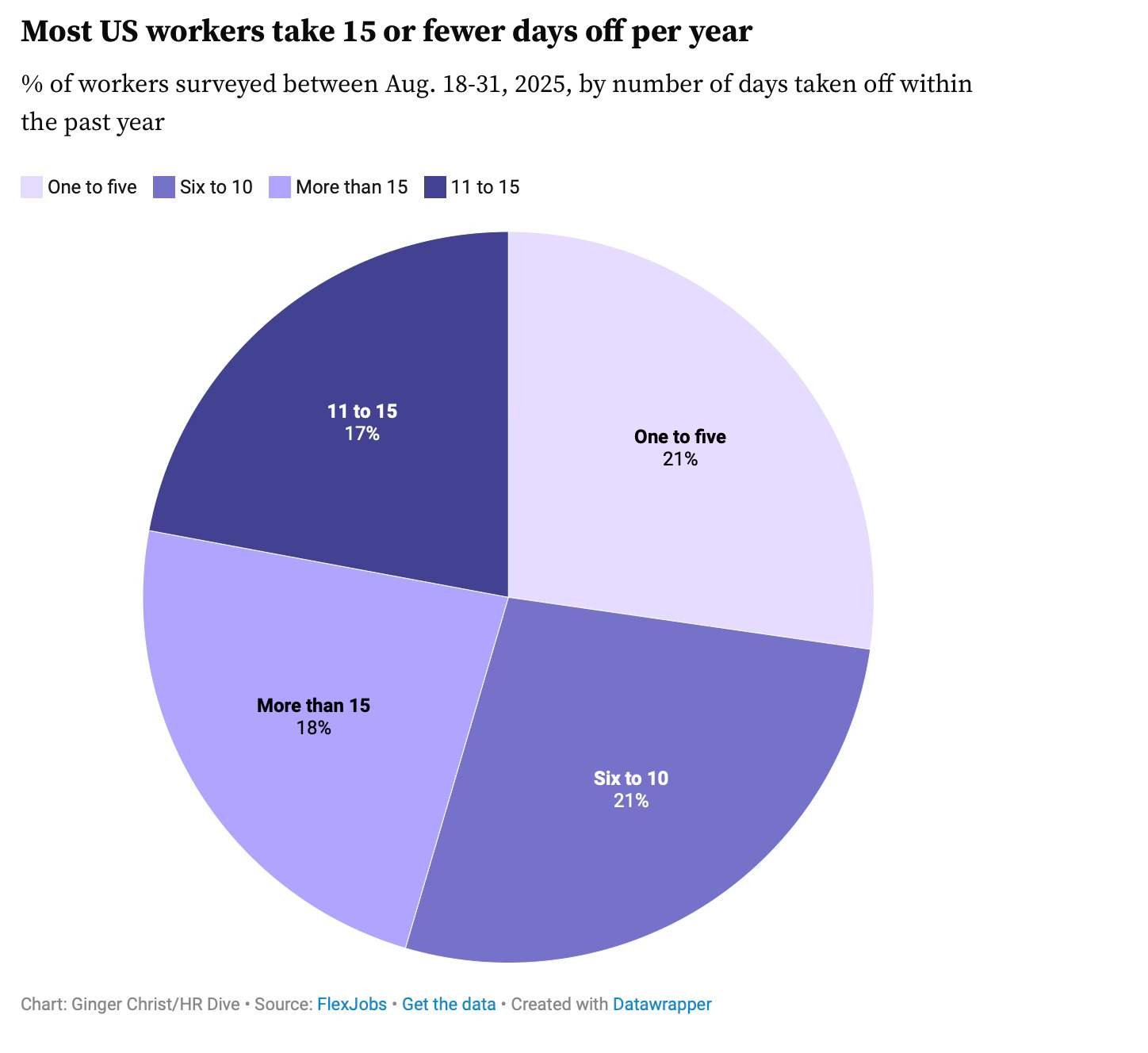
Employees increasingly avoid taking vacation days
Eighty-two percent of U.S. workers have paid time off, but nearly one in four did not take a single vacation day last year. Surveys show heavy workloads and unsupportive managers are keeping people from resting. One in four say their manager discourages full weeks off, and many fear that unplugging signals a lack of commitment. Companies that treat PTO as a formality, rather than recovery, are seeing higher burnout and lower retention.
Active laziness as a management skill
Top executives are learning that real productivity requires intentional rest. The best leaders, says a Fortune coach, practice “active laziness,” short breaks, breath work, naps, and time outdoors that restore focus instead of draining it through mindless passive recovery. Learning to recover as deliberately as you work can raise energy, creativity, and resilience. Stress management, it turns out, is now a leadership skill.
Small businesses set to struggle with runup in healthcare costs
Obamacare subsidies are once again at the center of a political standoff in the current shutdown. If temporary pandemic-era expansions expire, premiums for small business owners and the self-employed could more than double. Roughly half of adults covered by the ACA are freelancers or small employers. KFF estimates that a 60-year-old couple earning $85,000 would see annual premiums rise by $22,600 in 2026. With margins already thin, many small firms say higher health costs could force layoffs or closures
Data Point:
37%
The share of workers considered “future ready” in 2025, up from just 11 percent last year, according to Adecco.
In Other News
How can we avoid being scammed? As chief financial officer of a family business, I feel we are at risk. (Financial Times)
Middle Managers Feel the Least Psychological Safety at Work. (Harvard Business Review)
Trump immigration plan may wipe out 15M jobs by 2035, study claims. (Axios)
How Americans are feeling about their chances on the job market, according to an AP-NORC poll. (AP)
‘My Employees Can’t Take Feedback Without Getting Defensive’. (The New Yorker)
US Chamber sues White House to block ‘plainly unlawful’ H-1B visa fee. (HR Dive)