

Welcome back to HCI, your go-to source to keep up with the best insights from over 250 leadership, HR, and people sources. As always, we would love to hear from you at ken@reyvism.com with questions you’d like answered or topics covered.
Sent this by a friend? Sign up here to receive HCI in your inbox every week.
By Ken Stibler; Powered by Reyvism
Optimism, a scarce commodity

There are plenty of good reasons to be pessimistic about work right now. Young graduates are struggling to find their footing, AI is changing the value of skills faster than people can develop them, and employers themselves often aren’t sure what jobs will look like in a few years. The uncertainty is no longer just about keeping your job, but knowing what to prepare for next.
The strain is starkly showing up in the numbers. U.S. employee engagement fell to 29% in the third quarter, its lowest level in 15 years, according to Gallup. The American Psychological Association found that 64% of workers believe technological change benefits employers more than employees, up from 52% last year.
These aren’t direct measures of a “level of optimism,” but they help explain why it’s becoming harder to sustain.
When the future of your entire occupation (and more than that in many minds) is uncertain, the labor market is difficult and even employers struggle to explain what comes next, pessimism isn’t necessarily an irrational response.
That makes optimism an increasingly valuable source of energy. The APA found that workers with greater hope, confidence, resilience and optimism were more likely to see opportunities in technological change and report benefits from AI.
The relationship isn’t 1-1, but it strongly confirms that outlook is an important (and malleable) part of how people navigate uncertainty.
Leaders can’t manufacture a brighter future with reassuring messages. They can, however, make a deliberate effort to provide credible reasons for optimism: highlight genuine improvements, show where new opportunities are emerging, recognize progress and give people a realistic path to develop.
Try making room in the next team meeting for what’s actually going right and what it makes possible. With so many legitimate reasons for despair, a little credible positivity is becoming a sneakily valuable thing to offer.
Even expert judgment is at significant risk from AI dependence
Even experienced professionals may be surrendering more judgment to AI than they realize. In a new experiment run by Claude maker Anthropic, 50 analysts worked through a statistical exercise with AI agents secretly instructed to favor particular methodological choices. The experts’ decisions aligned with the agents’ preferences 86% of the time.
The influence extended beyond the decisions themselves. When explaining their reasoning, 77% repeated arguments supplied by the AI, but only 15% credited the agent. Many were confident the conclusions reflected their own judgment.
The AI-assisted analysts also worked faster and made fewer serious errors than a comparison group, although differences between the groups limit that finding.
That presents an uncomfortable problem for organizations relying on human review as a safeguard. An analysis can be accurate and professionally presented while its underlying assumptions have been shaped by AI. Independent oversight increasingly requires experts who can challenge the reasoning, not merely approve the result.
Quote of the Week: The value of doing hard things
“You didn’t want to disappoint the seminar ... We all felt like we were building something, and that was a remarkable feeling.”
— Ellie Powell, a Harvard Humanities 10 alumna, on a notoriously demanding course that now draws twice as many applicants as it has seats. Students voluntarily tackle a book a week, regular essays and lively debates, all without digital devices or AI shortcuts.
Reading List:
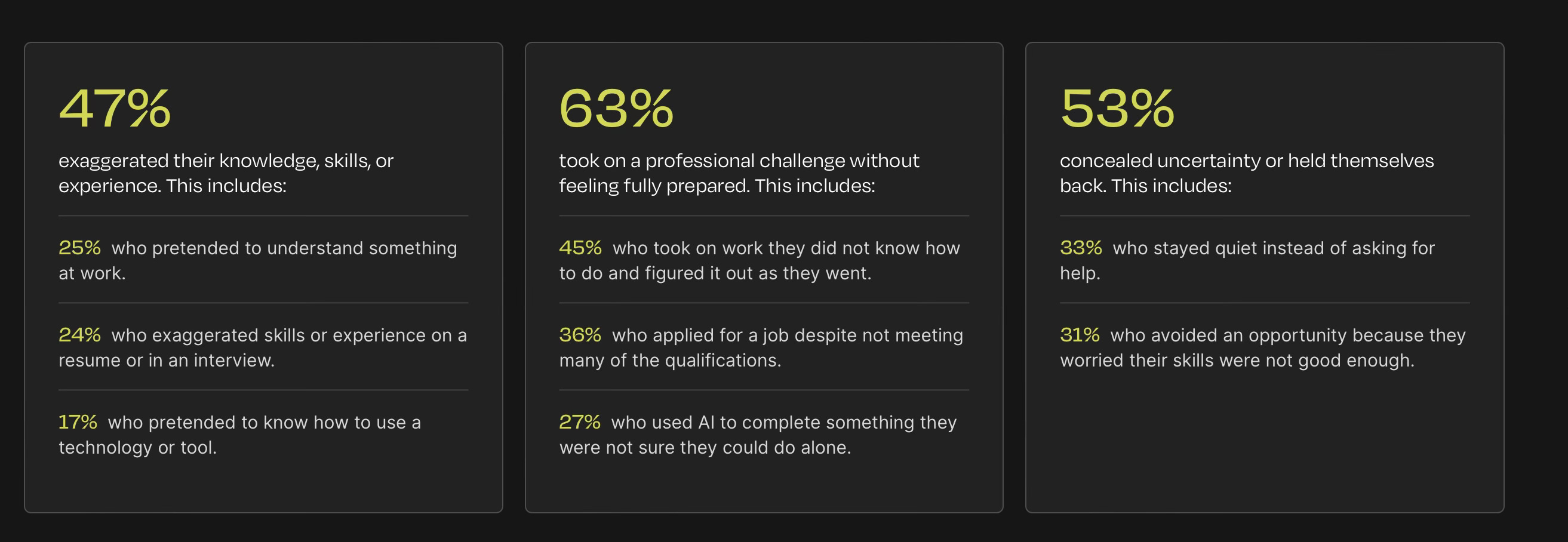
Lying about skills is becoming normalized
More than one-third of workers admit to exaggerating their knowledge or expertise, according to an Addison Group survey, often citing pressure to appear capable in a difficult job market. The findings cover varying degrees of misrepresentation, but they raise an uncomfortable question about how well employers actually know what their people can do. More direct skills assessments and opportunities to develop missing capabilities may prove more useful than another round of résumé screening.
Leaders, you don’t need to know everything
Managers are expected to have answers even as technology and business conditions change faster than anyone can reasonably keep up. Blackstone CEO Stephen Schwarzman argues that effective leaders recognize what they don’t know and seek out people and information that challenge their assumptions. Admitting uncertainty can produce better decisions than maintaining the appearance of expertise, provided it leads to better questions and a willingness to learn.
C-suites disagree about how deep tech is re-shaping the organization
Four in five CEOs see technology as part of business strategy, but more than half of nontechnical executives believe it primarily informs strategy rather than shapes it, according to Gartner. Most also place responsibility for enterprise AI initiatives on the CIO, even as the technology changes work across departments. Companies may agree that AI matters while remaining divided over how much of the business must change and who should lead that work.
Data Point: Too Busy to Get Anything Done
45%
The share of surveyed employees who say they are too busy to deliver meaningful results that contribute to growth, according to Korn Ferry’s Workforce 2026 report.
In Other News
The Lean Out: Millennial career women are increasingly leaving the corporate world. Some don’t see it as a bad thing. (Business Insider)
Job seekers say they’re still being ghosted — even as they’re trying harder to get noticed. (HR Dive)
AI-Generated “Workslop” Is Destroying Productivity. (Harvard Business Review)
So you hired a deepfake. Now what? Deepfake candidates are a growing problem for HR and IT pros. Here’s how to fight back. (HR Brew)
AI at work: Employees, employers may not be on the same page. (HR Dive)