

Welcome back to Human Capital Intelligence! Welcome to your go to 2026 source to keep up with the best insights from over 250 leadership, HR, and people sources. As always, we would love to hear from you at ken@reyvism.com with questions you’d like answered or topics covered.
Sent this by a friend? Sign up here to receive HCI in your inbox every week.
By Ken Stibler; Powered by Reyvism Analytics
Skills create the organizational speed limit for AI success
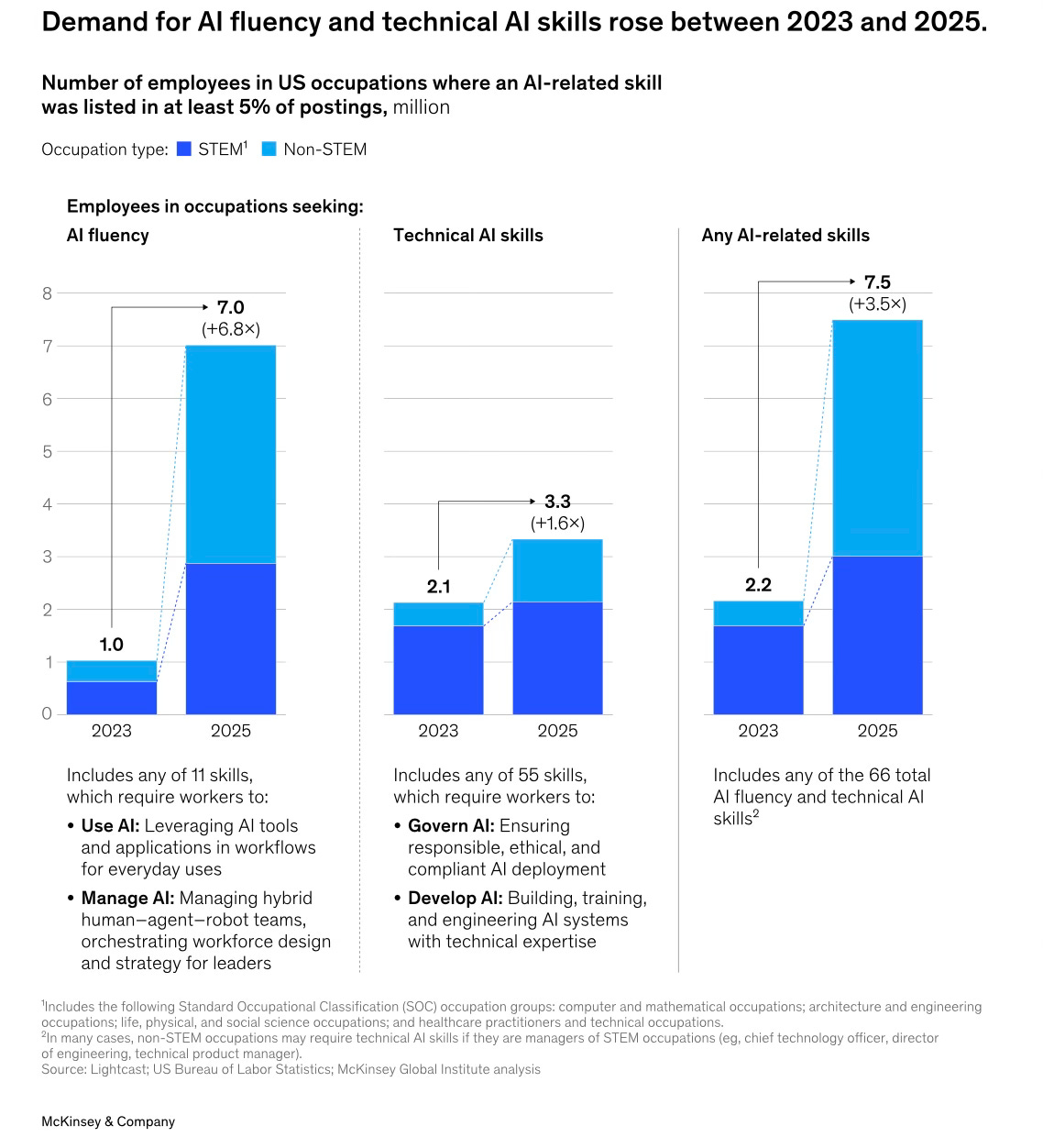
AI adoption is accelerating, but capability gaps are starting to dictate the pace. Companies are realizing that infrastructure, security, and model access are no longer the primary bottlenecks. Execution now depends on how quickly teams can learn, adapt, and apply AI in real workflows.
That shift has exposed a silent constraint: skill mismatches buried inside functions and roles. Early adopter teams hit a wall when employees can’t bridge the gap between tool and task. Training is often generic, adoption is uneven, and leaders assume that basic AI literacy will scale into measurable returns. But without high-slope learners who can map use cases, test edge cases, and teach others, AI slows down rather than speeds up.
Productivity will be defined not by how much AI a company uses, but by how much its people can handle. Systems can be bought. Skills have to be built.
Adapt or build, the 2026 mandate for leadership
Nearly half of all executives report their businesses were highly disrupted over the past year. While pressures from regulation and supply chains have moderated, relentless challenges from energy prices, geopolitics, and cybersecurity persist. In this environment, AI has become the great divider, with 80% of executives expressing optimism.
The fastest-growing companies are converting this disruption into an advantage, yet it is their leaders who feel the most anxiety, making the corner office both the command center and the hot seat. 45% of executives considered quitting last year, amid a growing gap between the pace of change and leader’s ability to keep up.
CEOs now feel twice as likely to feel they are personally falling behind in knowledge and skills. In an era where disruption has eclipsed economic cycles as the primary driver of change, the burden of navigation falls squarely on their shoulders.
Quote of the Week: Adjusting to ongoing change
“The tweaks or changes [companies] are making now are just to adjust and to be more flexible and more agile given the changes to the global order. But they don’t see a reason to wholesale upend everything.”
— Dana M. Peterson chief economist at the Conference Board
Reading List:
Decline in early career jobs creates a talent cliff
Entry-level roles are quietly disappearing as automation, AI, and leaner org models shrink the number of true development positions. Without early reps, fewer workers build the experience and judgment needed to move into mid-level and leadership roles. The result is a growing talent cliff that will hit harder as internal pipelines dry up.
Middle management is being reinvented as more critical than ever
While job postings for middle managers have declined, the role itself is not disappearing but rather being reinvented. As organizations flatten, the need for middle managers to act as the connective tissue between strategy and execution has intensified. They are uniquely positioned to translate high-level directives into actionable steps, manage cross-functional collaboration, and serve as guardians of institutional knowledge.
Burnout begins to rise the ranks of human capital problems?
Burnout has become an operational concern, not an individual issue. Many organizations treat it with wellness apps and resilience workshops, but these are reactive measures that fail to address the root causes: challenging stakeholders, toxic leadership, and inefficient workflows. This “carewashing” shifts the burden to employees while absolving leadership of its responsibility to fix the systemic problems.
Data Point: Employees are too tired to switch
43%
Number of US workers say they’re planning to look for a new job—93% of workers said the same in 2025 according to Monster
In Other News
Lockheed Martin CIO Says AI Is Remaking Her Role: ‘It’s got to come from a central place,’ Maria Demaree says. ‘And they’re looking to the CIO.’ (Wall Street Journal)
Recruiters are doing more ‘legwork’ to find candidates, Glassdoor finds. (HR Dive)
Meta is changing its performance review to reward output over effort, taking a page from Amazon and X. (Fortune)
Approaching AI risk as the staffing industry evolves. (Staffing Industry Analysts)
EY Study: Curious how AI will change HR? These Big Tech HR leaders have some thoughts about what to expect. (HR Brew)
McKinsey CEO Bob Sternfels says the firm now has 60,000 employees: 25,000 of them are AI agents. (Business Insider)
Is Your Lunch Break Now Run by AI? How Corporate-Mandated Wellness Is a Slippery Slope to Mandatory Meal Plans. (Entrepreneur)