

Welcome to the latest edition of Human Capital Intelligence. As always, we would love to hear from you at ken@stibler.me with news ideas, feedback and anything else you find interesting.
Sent this by a friend? Sign up here to receive HCI in your inbox every week.
By Ken Stibler; Powered by Reyvism Analytics
What’s Working:

Leaders struggle to accept the changing demands of their positions
Corporate leadership finds itself at a critical inflection point, with nearly 40% of CEOs telling Orgvue they would rather quit than lead large-scale workforce transformations, highlighting a growing crisis of confidence in the executive suite. This reluctance comes as leaders face unprecedented pressure to navigate complex economic headwinds while simultaneously managing heightened employee expectations in an increasingly demanding context.
Example: This CEO fired 90% of his staff for missing a morning meeting. (Fortune)
Many leaders also lack the fundamental skills now considered critical for success, with Deloitte reporting that large companies are three times more likely to struggle with gaining stakeholder buy-in for new talent initiatives. This skills gap is particularly concerning as organizations attempt to implement strategic changes like skills-first hiring and AI integration, requiring leaders to master both technical understanding and enhanced emotional intelligence.
The generational dynamics add another layer of complexity, with leaders struggling to adapt to changing workforce expectations. As Gen Z enters the workforce with markedly different priorities than their predecessors - prioritizing work-life balance over traditional career advancement - many managers appear overwhelmed, with 18% reporting they've considered quitting due to challenges managing younger workers.
The financial implications of this leadership crisis are becoming increasingly apparent. While BetterManager reports that effective leadership development can yield a $7 return for every $1 invested, many organizations are failing to make these investments, with only 13% spending more than $3,000 annually on leadership training. This underinvestment comes at a critical time when 60% of CEOs admit their transformation decisions are driven by emotion rather than rational analysis, suggesting a dangerous gap in strategic capability at the executive level.
Perhaps most tellingly, the resistance to change appears to be creating a self-reinforcing cycle of leadership paralysis. As leaders struggle with what Orgvue's CEO describes as "transformation fatigue," their hesitation to embrace necessary changes is creating additional pressure points throughout their organizations. With only 23% of transformation projects succeeding, and many organizations being forced into crisis-response modes, the data suggests a growing number of leaders are finding themselves trapped between the mounting pressures of organizational change and their own reluctance or inability to effectively lead through it.
Automation rewrites the risks and drivers of competitiveness
The automation revolution is rewriting the rules of business competitiveness, not through direct job displacement but by creating a widening gap between organizations that effectively integrate AI and those that don't. New data from Slack's Workforce Lab shows AI adoption plateauing after initial enthusiasm, with trust emerging as the critical differentiator - organizations that successfully build employee confidence in AI usage see 67% higher tool adoption rates, suggesting that cultural infrastructure, rather than technical capability, may be the key competitive advantage in the automation era.
Read More: Four Tips for Staying Ahead of AI Disruption. (MIT Sloan Review)
While 62% of Gen Z workers fear job displacement, their more experienced millennial colleagues are actively leveraging AI to enhance decision-making and creativity, pointing to a potential experience advantage in understanding how to complement rather than compete with automation. This dynamic suggests that competitive advantage may increasingly flow to workers and organizations that can effectively balance human and machine capabilities.
The shifting landscape has prompted a fundamental rethinking of career development and competitive strategy, with universities and employers increasingly emphasizing "moderate misfit" qualities - workers who combine technical competence with distinctly human capabilities like project management and cross-functional collaboration.
Quote of the Week:
The one-on-one model is flawed. It’s a recurring one-hour one-on-one meeting where the employee owns the agenda. And what happens is that they often don’t talk about the things you want to talk about, and you become like their therapist.
—Brian Chesky, CEO and founder of Airbnb, on why he doesn’t have one-on-one meetings with his team
Reading List:
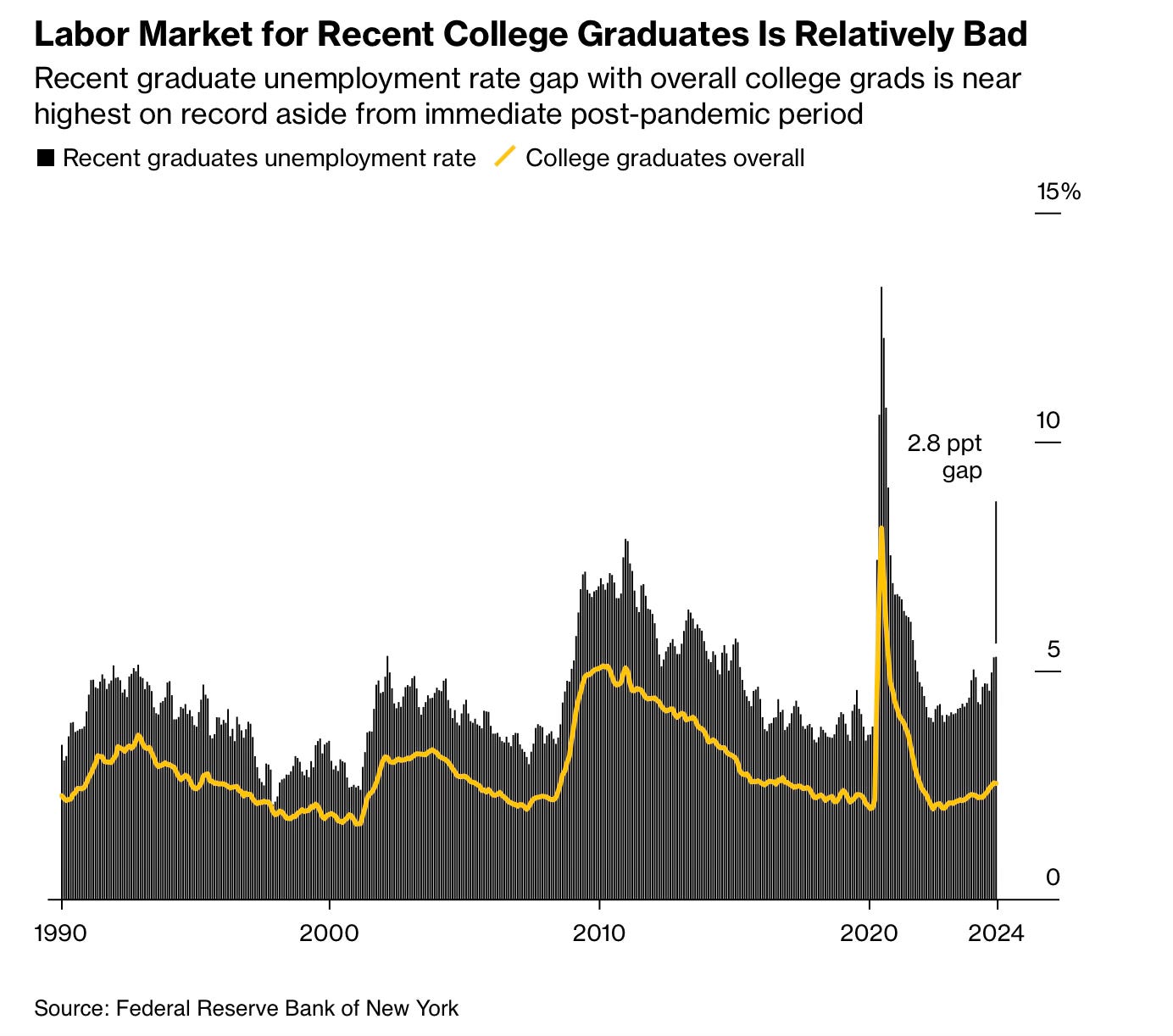
A chill comes over the labor market
The labor market is see structural changes that are quietly decimating job seekers' prospects, with recent data showing nearly half of applications in 2024 failing to get a single interview. This widespread ghosting of candidates reflects a calculated shift in hiring practices: Resume Builder reports 40% of firms deliberately posting fake job listings, while ADP data shows 32% of mid-sized companies actively planning to shift recruitment overseas in search of cheaper talent. AI screening tools have further amplified these effects, creating an increasingly opaque barrier between job seekers and actual opportunities.
Recent college graduates now face the widest unemployment gap compared to overall degree holders since 1990 (excluding the pandemic), while the hiring ratio in technical fields has plummeted from 0.75 hires per posting in 2018 to just 0.5 in 2023. This isn't merely a temporary market correction – it represents a fundamental restructuring of the American job market, where the traditional relationship between job postings and actual hiring intentions has broken down as job seekers are unwittingly participating in what amounts to a sophisticated illusion of opportunity.
Read more on Ghost Jobs, Expectations Divides, and Outsourcing.
Winds change on progressivism in the workplace
A dramatic reversal in corporate diversity initiatives is sweeping through American business, with prominent companies like Tractor Supply, Deere, and Harley-Davidson explicitly abandoning their DEI commitments in the face of coordinated activist pressure and legal threats. The shift reflects both declining public support - with Pew Research showing opposition to workplace DEI climbing from 16% to 21% in the past year - and a growing fear of "reverse discrimination" lawsuits in the wake of recent Supreme Court decisions on affirmative action.
The corporate retreat appears to signal a broader cultural inflection point, as businesses rush to rebrand diversity programs under the more neutral language of "workplace culture" and scrub ESG messaging from their public communications. Law firm Gibson, Dunn & Crutcher reports clients are seeking to minimize exposure to what one activist calls a "referendum on wokeness" while attempting to preserve elements of their talent development strategies.
Read more in the Wall Street Journal.
Human biases get even more dominant as AI gives a ‘data-driven” veneer
AI in decision-making appears to be amplifying rather than mitigating existing human prejudices, creating a dangerous illusion of objectivity. Recent data shows that while organizations rush to implement AI systems for everything from hiring to performance evaluation, these tools are often serving as a sophisticated veneer for traditional biases. The trend is especially concerning given that nearly 50% of executives cite insufficient trust as the primary obstacle to expanding AI use, even as "shadow AI" proliferates throughout organizations without proper governance or oversight.
Without robust governance frameworks, organizations risk not only perpetuating existing prejudices but potentially amplifying them through automated systems that lack transparency and accountability, all while maintaining the illusion of objective, data-driven decision-making.
Read more about the importance of EQ and the rise in “lookism”.
Why are we still talking about RTO?
The persistent debate over return-to-office mandates has evolved into what analysts increasingly identify as a manifestation of "executive nostalgia" - a potentially costly misalignment between C-suite sentiments and market realities. Recent moves by Amazon, Apple, and The Washington Post to mandate five-day office attendance appear driven less by data-backed productivity concerns and more by leadership's rose-tinted memories of pre-pandemic workplace dynamics, with Stanford research actually showing hybrid arrangements boost corporate profits and employee satisfaction.
The most concerning aspect of this nostalgia-driven policy shift is its potential to trigger a targeted brain drain, effectively daring the most valuable employees to seek opportunities elsewhere. Those most likely to quit in response to strict RTO policies are precisely the employees companies can least afford to lose - highly educated, mid-career professionals whose work isn't location-dependent.
Read more in Bloomberg.
Data Point:
-28%
The decline in HR hiring since 2018 according to Business Insider
In Other News:
Why 25% of High-Potential Leaders Fail: The Year-End Leadership Test. (Missfit Coaching)
The high cost of silos: Trillions lost when HR, company goals are out of sync. (WorkLife)
1 in 5 workers would turn down a job without unlimited PTO, survey finds: Only 16% of employees reported having unlimited paid time off, the survey said. (HR Dive)
What is ‘time to hire,’ and why does it matter? (HR Dive)
Read this before firing an employee for having an Only Fans account. (The Employee Handbook)
Feds fine logistics company for failing to include bonuses in workers’ overtime rates. (HR Dive)
5 critical opportunities to leverage people analytics in 2025. (HR Executive)
How companies can deal with in-work sickness: High levels of post-pandemic absenteeism are creating problems for employers. (Financial Times)
Elon Musk’s first order of business in Trump administration: Kill remote work. (Fortune)
AI’s early adopters are disproportionately men, a disconnect that could exacerbate the gender pay gap. (Bloomberg)
How we view women in charge, especially at work, is shifting as more come into power. (Wall Street Journal)