

Welcome to the latest edition of Human Capital Intelligence, your weekly brief synthesizing over 250 leadership, HR, and people sources to filter out the noise. As always, we would love to hear from you at ken@reyvism.com with questions you’d like answered or topics covered.
Sent this by a friend? Sign up here to receive HCI in your inbox every week.
By Ken Stibler; Powered by Reyvism Analytics
What does putting people at the center of modern organizations look like?
Most companies talk about being people centered, but very few operate that way when real decisions are on the line. As many CEOs push back against the incessant drag of “AI-ifying” everything, several conversations lately have centered around what people-focused organizations look like at this point.
BCG has done good work here: their research finds that people-centered orgs starts by placing their people lead at the center of strategy, instead of treating HR as the cleanup crew for decisions already made. When the CPO helps design how AI is introduced, how jobs are restructured, and how trust is protected, people become the starting point for transformation rather than an afterthought.
In practice, this means managing change with clarity and consistency. Employees need to understand why new tech is being used, what its guardrails are, and how their roles will evolve. Organizations that communicate this clearly and build real capability around new tools generate enthusiasm instead of anxiety. The result is a workforce that can adapt quickly because people know how they fit into the future.
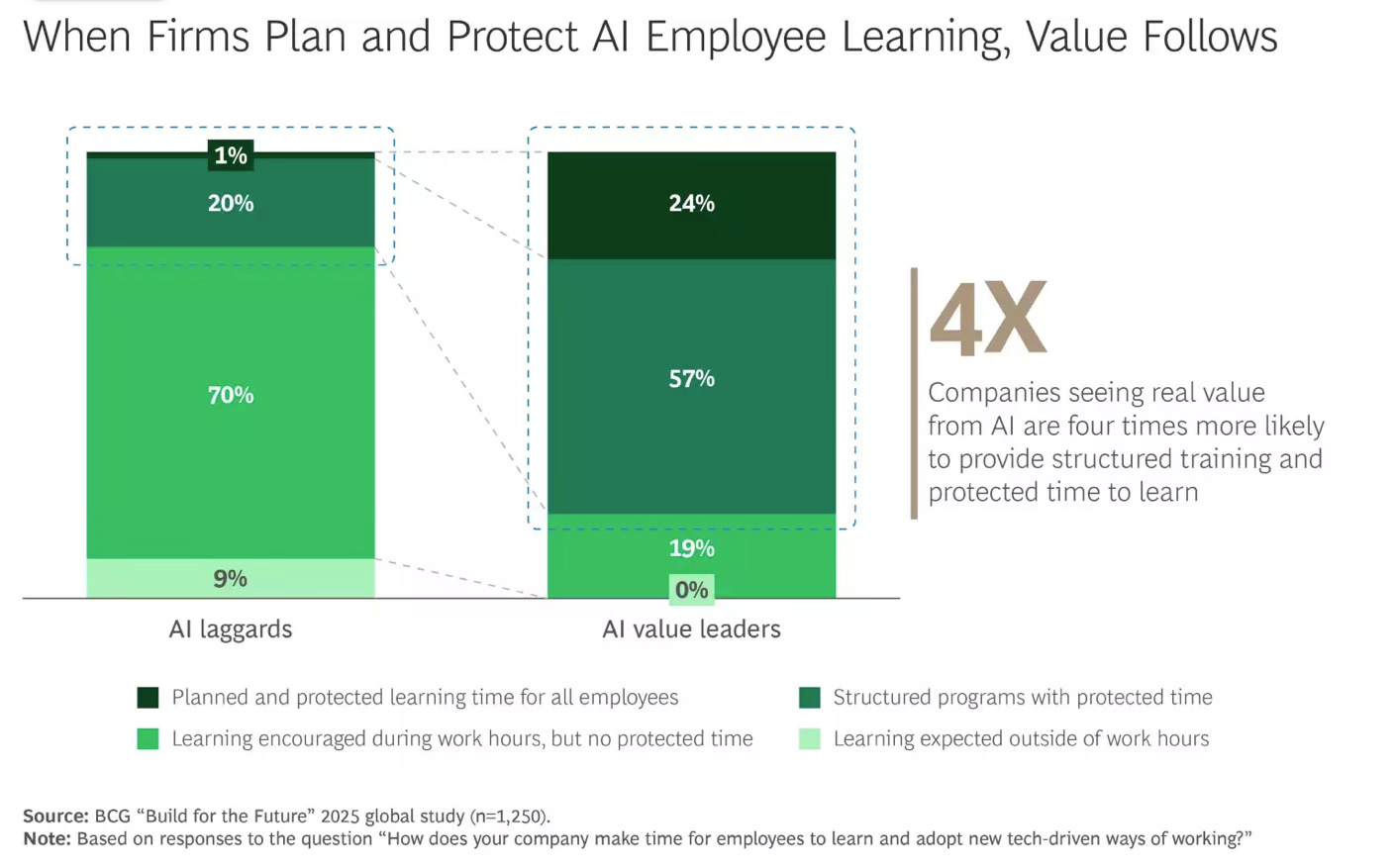
True people centricity also requires cultures that can sense and respond to change without waiting for disruption. Cross-functional collaboration, protected learning time, and bottom-up problem solving create the conditions for continuous adaptation. Leaders who build these systems show that people are not a risk to be contained but an asset to be developed, and that is what makes the organization modern.
Adapting to continuous change is driving more leaders to call it quits
CEO departures are rising sharply regardless of company success, the causes are many but the underlying driver is that the job is increasingly defined by nonstop reinvention. After years of managing through the pandemic, supply shocks, political volatility, and the rapid arrival of AI, many long-serving CEOs have exhausted the runway. Many now see uncertainty as permanent, and are turning over leadership to execs better suited to handle continuous change.
Continuous adaptation: Why organizations must think beyond ‘resilience’ and ‘agility’. (World Economic Forum)
For many CEOs, the personal signals that their hearts aren’t in it arrive before the formal ones. Leaders find themselves avoiding new technologies, feeling detached from the work, or dreading the weekly reset that used to energize them. When the role demands constant adaptation and the prospect of stability never returns, stepping aside becomes a rational choice rather than a retreat.
Quote of the Week: Transformation is more than change
“Business transformation is about changing how we all as humans are doing our work, and therefore HR is an incredibly important enabler to create the flexibility to learn and evolve, but also to chart the course.”
—Katy George, VP of workforce transformation at Microsoft, on the evolving partnership between IT and HR amid the AI transformation of business
Reading List:
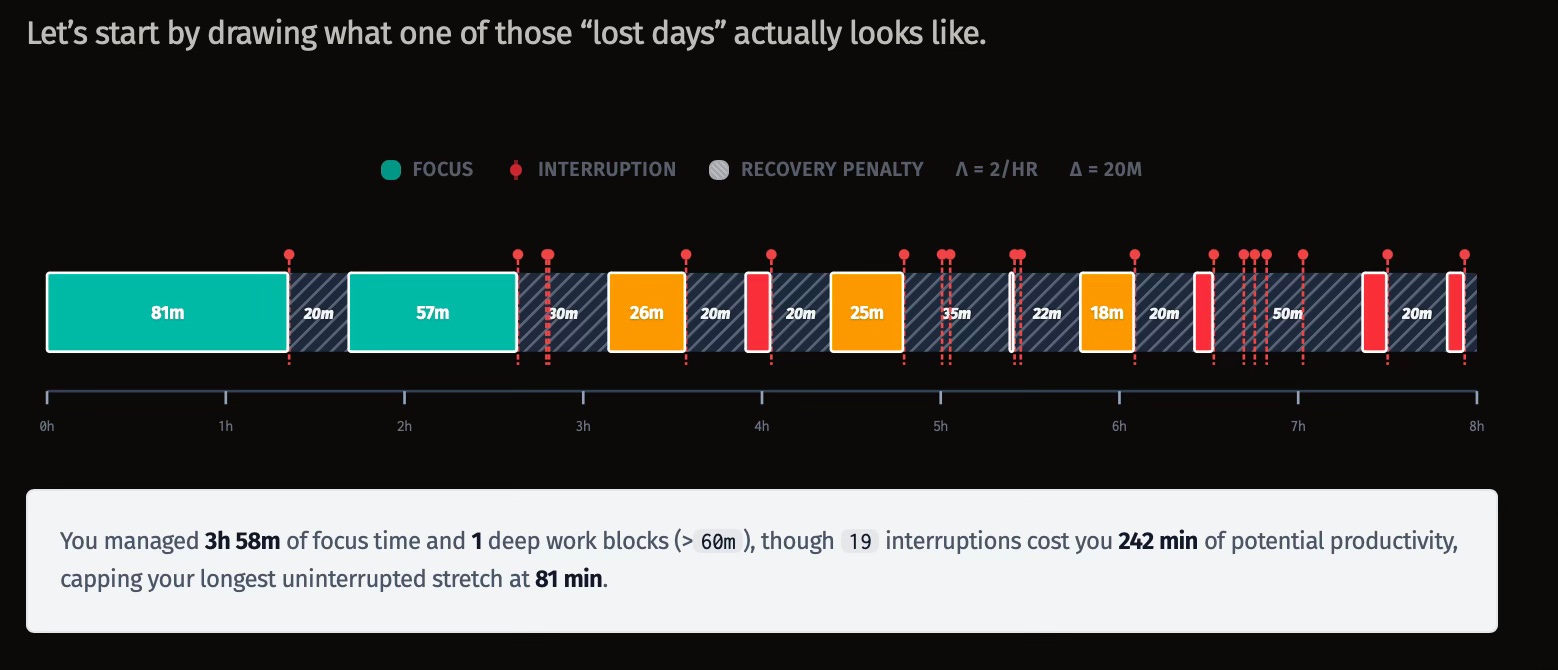
The math of why you can’t focus
Your workday is defined by three factors: how often you are interrupted, how long it takes to recover, and how much uninterrupted time your work requires, new research finds. Even small increases in interruptions or recovery time can collapse your capacity for deep work. In most workplaces, this math is stacked against employees. Focus is not a matter of discipline. It is a function of system design, and many environments are engineered to destroy it.
Leadership and employees are diverging on AI, that matters for all employee’ engagement
Executives assume their people are excited about AI, but employee sentiment tells a different story, Harvard Business Review. Surveys show 76% of leaders believe workers are enthusiastic about AI adoption, while only 31% of employees agree. This gap matters because trust drives adoption. Workers embrace AI when it makes their jobs more secure and more capable, not when it feels like a replacement strategy. Transparent communication about how AI is designed, governed, and used is now a prerequisite for engagement.
A free tool for a leadership boost: appreciation
One of the most effective leadership tools costs nothing. Genuine appreciation increases engagement, strengthens trust, and improves performance far more reliably than incentives or perks. People interpret appreciation as evidence that their work is seen and valued. In environments overloaded with change, attention, recognition, and small acknowledgments have disproportionate impact. Leaders who practice consistent appreciation build teams that stay motivated when the pace intensifies.
Data Point: 40 hours a week?
53%
The number of employees working more than the standard 40 hours a week, while 40% work less than that.
In Other News
Blended teams: From stopgap to strategic advantage. (WorkLife)
Big law firms risk losing talented staff over ‘unmanageable’ stress: Two in five plan to leave jobs within five years. (Financial Times)
Work-life balance finally outranks pay as a top motivator for job seekers, but CEOs aren’t sold. (Fortune)
Slack cofounder says workers and CEOs can get stuck doing ‘fake’ work like pre-meetings and slide shows. (Fortune)
MIT study finds AI can already replace 11.7% of U.S. workforce. (CNBC)
AI Is Writing Performance Reviews. What Could Go Wrong? JPMorgan Chase & Co. has blessed the practice. (Bloomberg)