

Welcome to the latest edition of Human Capital Intelligence. As always, we would love to hear from you at ken@stibler.me with news ideas, feedback and anything else you find interesting.
Sent this by a friend? Sign up here to receive HCI in your inbox every week.
By Ken Stibler; Powered by Reyvism Analytics
The long shadow of narrow authority
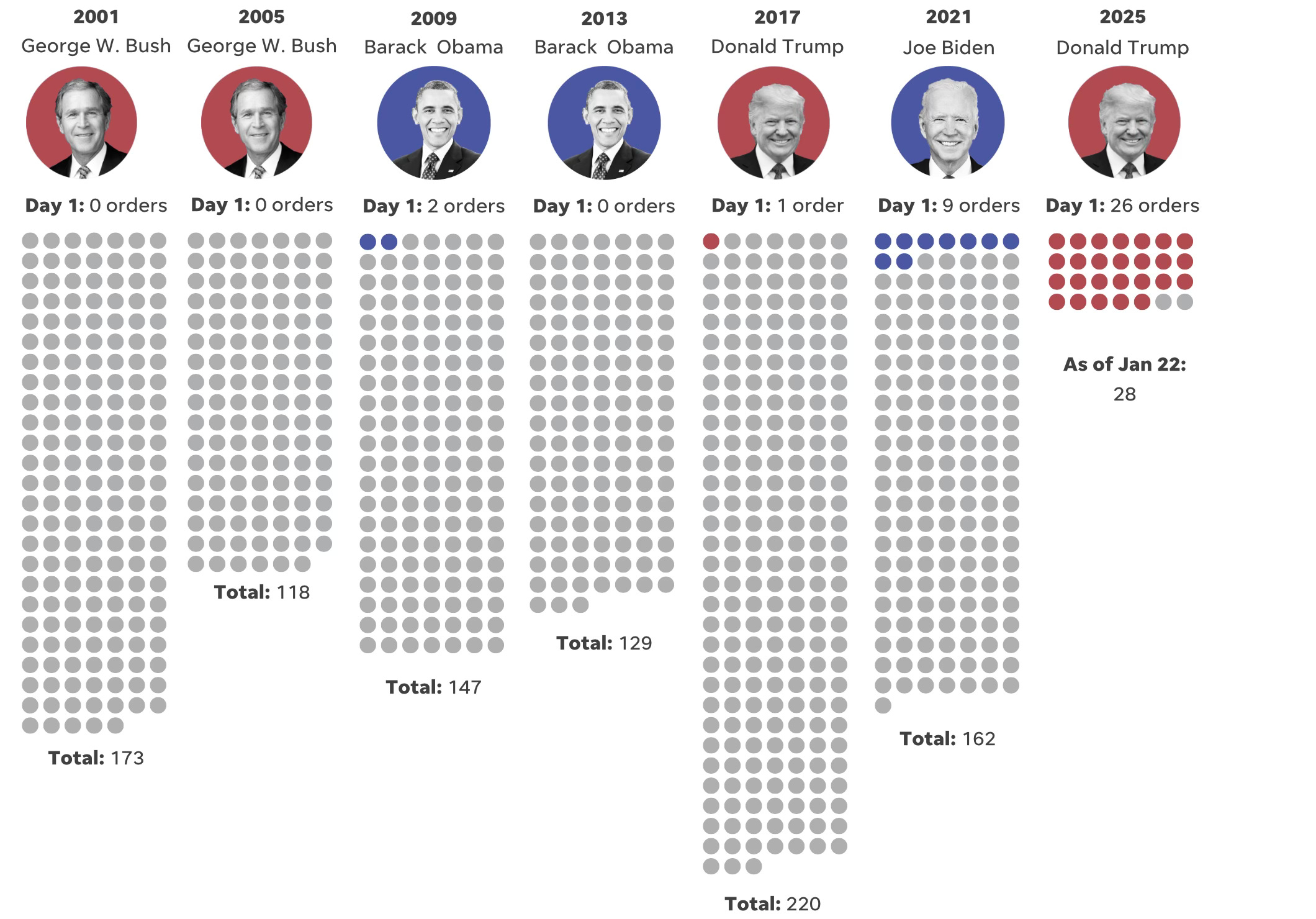
Corporate America is rapidly recalibrating to Trump's return, with Meta eliminating its chief diversity officer position, Amazon scaling back inclusion programs, and Resume.org reporting one in eight companies planning to reduce DEI initiatives in 2025. This swift response to early executive actions reflects a broader pattern from Trump's first term, where his policy priorities often shaped private sector behavior well beyond his direct authority - from reshaping supply chains during the China trade war to influencing social media content policies.
The administration's ambitions to reshape private sector behavior are expansive, with executive orders now targeting everything from corporate DEI practices to remote work policies. However, market analysts note crucial limitations to this authority - Trump's first administration lost 93% of court challenges to executive actions. Legal experts suggest many current executive orders may face similar judicial constraints.
“Presidents love issuing executive orders. It’s easy to do, and many people will credit the president with major accomplishments. But really, as someone recently said, an executive order is ‘just a memo on fancy letterhead.”
— Dan Farber, faculty director at the Center for Law, Energy and the Environment at the University of California, Berkeley.
Yet while the direct legal impact may prove limited, broader policy shifts could pose material risks to corporate performance. Proposed immigration restrictions threaten to exacerbate already acute labor shortages, particularly in sectors like construction and agriculture. Morgan Stanley estimates these constraints could drive wage inflation up 2-3 percentage points above baseline, potentially forcing the Federal Reserve to maintain higher interest rates.
The most significant business impact may come from proposed tariffs, with Goldman Sachs projecting a 10% levy on imports could reduce S&P 500 earnings by up to 8% through higher input costs and disrupted supply chains. Market data suggests non-service sectors would bear the brunt of these effects, with industrial and consumer discretionary companies facing potential margin compression of 2-3%.
HCI View: I’d be more focused on identifying any upstream exposure from sanctions or resurgent inflation than anything around DEI.
Bad news leaders, operating environment chaos is the new normal
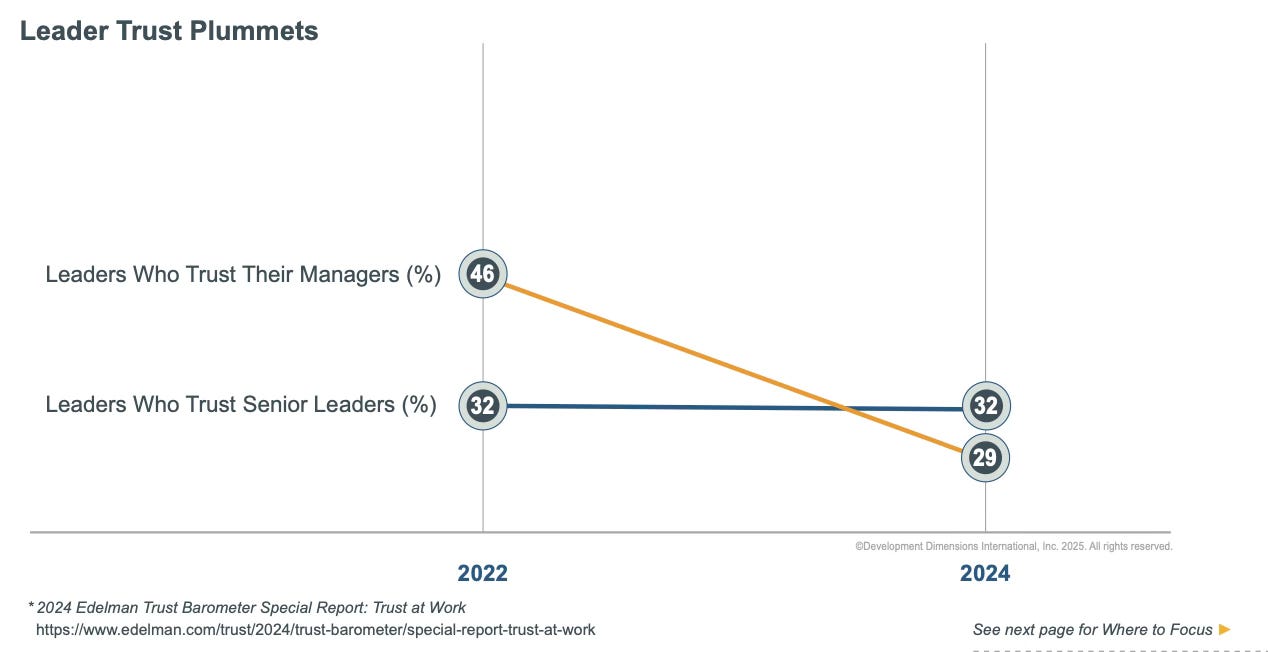
40% of senior executives are considering abandoning their leadership positions, as traditional leadership models buckle under unprecedented market volatility, according to DDI's latest Global Leadership Forecast. This exodus reflects a fundamental shift in the operating environment, where conventional executive skillsets focused on stability and cost management are proving increasingly inadequate for navigating persistent disruption.
Market data from McKinsey reveals the depth of this leadership paralysis, with only 29% of senior executives dedicating meaningful time to long-term strategic initiatives. Meanwhile, corporate trust metrics have plummeted, with Edelman reporting business competence and ethics ratings falling below 50% since 2020. This deterioration in confidence comes as organizations face mounting pressure from technological disruption, demographic shifts, and geopolitical tensions.
“A businessman’s job isn’t to change the world but to cope with it.”
— Wilbur Ross, private equity billionaire and Trump’s first commerce secretary
Analysis suggests companies showing superior market performance are those actively reimagining leadership development, with significant investment in adaptive capabilities and strategic agility. However, PwC reports that a third of CEOs still question their business model's viability within the decade, indicating a growing divide between organizations successfully adapting to chaos as the new normal and those clinging to increasingly obsolete management frameworks.
HCI View: Rather than waiting for a new normal to settle, start getting comfortable with continuous change. As much as we all hate it, that creates a potential competitive driver for companies and leaders which see disruption as opportunity and turn adaptation into a core skill.
Quote of the Week: Quack quack, you’re not coming back

Layoffs are a sensitive time for company culture in addition to the redundant employees themselves. I.e. not the time for the auto generated duck accidentally appeared in Stripe’s termination email to 300 employees which has gone viral.
There’s an understandable instinct to just get it over with, but deft intentional communication during layoffs is a cheap insurance policy against anger, lawsuits, and PR problems of any scale.
Reading List:

A simple explanation of your long-term skills shortages
Less than 36% of job applicants are meeting basic job requirements according to a new survey of hiring managers. While the labor market is increasingly divided by a blue collar shortage and white collar glut. Yet beneath this divergence lies a common thread - both sectors report significant concerns about skill quality and workforce readiness.
A combination of changing values around work and an education system divorced from business demand makes the calculus for businesses very simple: either increase compensation to compete for the dwindling pool of highly qualified workers, or commit to extensive internal training programs to develop needed capabilities.
HCI View: With traditional training systems showing limited ability to adapt, companies will be forced to see skill development as a core operational cost rather than an optional investment.
‘Over-management’ is increasingly unproductive
Traditional top-down management approaches are becoming increasingly ineffective as rapid “business climate change” is making more fluid, adaptive approaches more productive. The rise of decentralized work models and emergent innovation patterns indicate that strict organizational control mechanisms, once considered best practice, may now be actively hampering productivity and market adaptation from media to sports.
Financial data increasingly supports the hypothesis that over-engineered corporate structures are underperforming against more adaptable competitors. The evidence suggests that excessive standardization of processes and strict hierarchical control are becoming material risks to shareholder value, as they impede the rapid iteration and bottom-up innovation necessary for competitive advantage in contemporary markets.
HCI View: Rigid systematization is giving way to more fluid, adaptive approaches. An easy experiment would be to test the performance of a manager-led team vs a manager-less team in figuring out ways to use AI to improve efficiency in your company.
Small steps to boost engagement
We don’t need to tell you the engagement data is down again, you can feel it in your own organizations. And the answers “training program development” “raise wages” “increasingly exotic benefits” “mentorship” appear to expensive in time or money that isn’t there.
But a new exercise by Flimp, a benefits communications platform, showed that employees have seen bumps to 70% engagement by utilizing brief, digestible content formats including videos, digital postcards, or QR codes to inform employees about their current but often unused benefits. Separately with Gallup reporting only 37% of U.S. employees feeling strongly respected at work in 2024, down from 44% in 2021, simply not adding a duck to layoff messages could also help stem the tide.
HCI View: A great idea I heard in a Vistage meeting was embedding a “total compensation review” as part of yearly reviews to show each employee how much they receive. Also re-explaining the benefits they have access to creates a simple add-on with apparently direct effects. Boosting engagement doesn’t have to be difficult, but ignoring it definitely will be.
Data Point:
80%
The percentage of workers afraid they will lose their jobs this year according to a survey by MyPerfectResume.
In Other News:
AI offers a rare look inside the minds of CEOs—and can tell if they’re depressed just based on how they sound on earnings calls. (Fortune)
A Middle Manager’s Guide to Executing Strategy: How to handle resistance from your team, and what to do if the new strategy isn’t working. (Harvard Business Review)
HR pros report difficulty selling the C-suite on child care benefits. (HR Dive)
Women are officially the economy’s power players—outpacing men in both income and spending growth, BofA report says. (Fortune)
On the regulatory horizon: Businesses would be required to report AI-related WARN layoffs under New York proposal. (HR Dive)
Gen Z Americans are leaving their European cousins in the dust: Millennials across the west were united in their economic malaise. Their successors not so much. (Financial Times)
Dangerous idea I see quietly being accepted - “No one” cares if you roll in on time anymore, but here are the behaviors coworkers do mind. (Fortune)