

Happy New Year! Welcome to the latest edition of Human Capital Intelligence. As always, we would love to hear from you at ken@stibler.me with news ideas, feedback and anything else you find interesting.
Sent this by a friend? Sign up here to receive HCI in your inbox every week.
By Ken Stibler; Powered by Reyvism Analytics

Human Capital in 2025: It’s not just you, leadership is getting harder
Welcome to 2025, a year where leadership has reached a critical inflection point. After the organizational adrenaline rush of the end of Covid in ‘22 and ‘23, 2024 saw a comedown for many of you. Over and over I heard of how many previously engaged leaders were quietly fighting rapidly multiplying problems with less effective tools. And from the early conversations I've had, many executives feel like they are limping to the starting line tired, more than exciting and optimistic.
The stress felt by line-level employees seems to have fully percolated to the top, with 2024 seeing executive turnover hit multi-decade highs. Middle manager burnout also went mainstream with historic disengagement levels (while being tasked with more leadership responsibilities amid organizational restructuring and AI integration pressures). As the Department of Defense would say, we’re working in a VUCA (Volatile, Uncertain, Complex, and Ambiguous) operating environment.
Volatility is seen across the economy, as the labor markets swings between "stunning" hiring figures and subsequent "meltdowns;” compensation strategies also oscillate between traditional salary boosts and new "total rewards" models; and AI adoption cycles accelerate as innovations compound each other.
Uncertainty has also become pervasive, as abstract long-term shifts like demographic declines are compounded by declines in the trustworthiness and accuracy of the data we consume. Despite their best effort, policymakers are making it worse, with federal inaction and increasingly interventionist courts creating surprise policy shifts across the country. Most importantly, the social scars of Covid have left communications dimmed and many workers more uncertain about their role, their future, and your goals.
Complexity has become the new normal as leaders must now navigate a six-generation workforce, deal with the integration of "AI coworkers," and tackle emerging challenges from a distorted economic to cybersecurity needs.
Finally, ambiguity has permeated every aspect of leadership: performance metrics struggle to capture "fauxductivity" in hybrid environments; traditional career paths break down as fewer employees aspire to C-suite roles; and skills-based hiring remains "more rhetoric than reality.”
Phew, it’s hard to read about yet alone work through. But for executives that want to conquer the VUCA, Human Capital Intel remains committed to cutting through the noise. Our mission to aggregate the news, filter out the noise, and provide the most clear and comprehensive overview of “everything employee” remains as strong, and as important, as last year when we started.
For the growing challenges of 2025, we’re continuing to develop our intelligence platform to help leaders stay ahead of the curve without drowning in information. This means proactively identifying emerging workplace trends and disruptions in the state legislatures, TikTok channels, and sectors where it happens. As you’ll soon see here on HIC, one major change will be our core focus on “action-add’: each trend tied to a pre-selected template, tool, or tactic for you to take action. In today's environment, the key to effective leadership isn't more information – it's better insight.
Employees feel stuck, here's how to make that work for you
Employee satisfaction has hit a historic low, with Gallup reporting only 50% of U.S. workers thriving in their overall lives - the lowest level since measurements began in 2009. This "Great Detachment" era is characterized by unprecedented workforce disruption, with 73% of employees experiencing organizational changes in the past year while facing increased customer demands, shifting workplace expectations, and broken performance management systems.
Unlike the "Great Resignation," however, economic uncertainty is keeping dissatisfied workers from leaving their positions. Yet the grey of employees’ outlooks can be a silver lining for companies as Gallup also finds that organizations can achieve up to 9% increased profitability and 11% improved work quality by enhancing role clarity, which has fallen to 45% among employees.
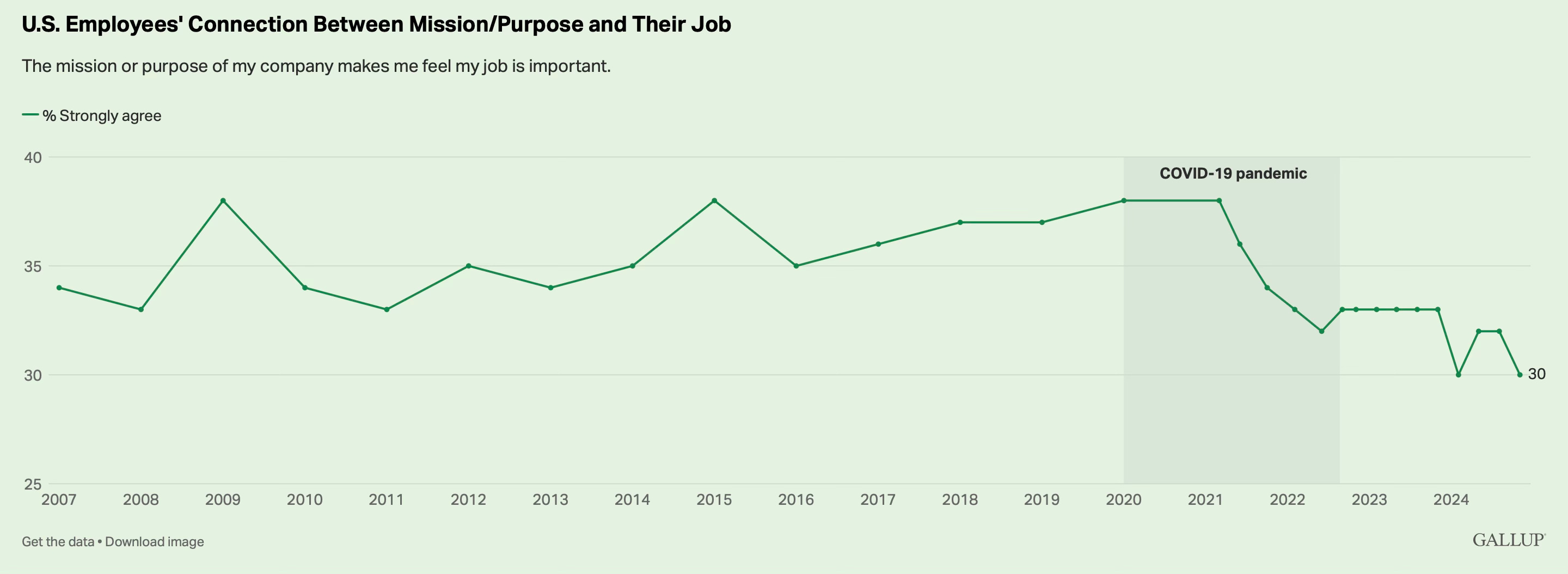
Additionally, strengthening employees' connection to company mission - currently at a record low of 30% - could reduce turnover by 32% and boost productivity by 15%. While employees may feel trapped, companies have a unique opportunity to convert this captive workforce into an engaged, productive asset through targeted management.
Quote of the Week:
“30% of employees are actually avoiding more people at work than they did two years ago, and of course that’s not going to have a very positive effect on the quality of collaboration. Clearly, physical proximity and co-location is not a silver bullet to solve the collaboration challenge.” — Jessica Knight, VP of Research at Gartner
As I’ve been saying for the last 5 years, the levers that leaders use, like RTO, are neither a magic bullet nor an exception to this rule.
Reading List:

PIPs rise as higher layoffs and stricter laws conflict
Performance Improvement Plans (PIPs) have emerged as an increasingly prevalent management tool in 2023, with 43.6 workers per 1,000 facing formal performance procedures, up from 33.4 in 2020, according to HR Acuity data. While ostensibly designed to enhance employee performance, industry executives and HR professionals report that PIPs frequently serve as legal protection against wrongful termination suits and a mechanism for workforce reduction without formal layoffs.
The surge in PIP usage coincides with growing scrutiny of alternative termination methods, as major corporations face criticism for leveraging minor policy infractions to reduce headcount. HR experts warn that such practices risk damaging organizational trust and employer branding. Some companies are responding by offering direct severance packages as an alternative to PIPs, with industry data suggesting success rates for PIP completion hovering between 10% and 25%, leading many employees to view PIPs as a prelude to inevitable termination rather than a genuine development opportunity.
Employee loyalty doesn't make sense as job hopping delivers better returns than promotions
Job hoppers are advancing their careers at nearly twice the pace of loyal employees, with workers who switch companies moving up every 17 months compared to internal promotees who wait 28 months, according to a new Kickresume analysis. The stark disparity is reflected in broader workforce behavior, as 58% of Americans have opted to change employers rather than wait for internal advancement in the past five years, while only 17% received promotions at their current companies.
The data exposes the diminishing returns of company loyalty in the modern U.S. job market, where at-will employment and traditional corporate structures continue to limit internal mobility. Remote work arrangements may be further tilting the scales against loyal employees, with over 25% of hybrid workers reporting missed promotion opportunities due to their work arrangement, suggesting that the career advancement equation increasingly favors those willing to switch employers.
Being kind in the office reduces your stress
Workers would take a pay cut to work under more emotionally intelligent leadership, according to new HP research, while a separate study demonstrates that workplace kindness creates measurable improvements in well-being, stress levels, and institutional connection. The research established that specific metrics for kindness - including trust, autonomy, and fair treatment - deliver demonstrable increases on those displaying kindness.
The study moves beyond traditional workplace satisfaction research by demonstrating a virtuous cycle where recipients of kindness are more likely to extend similar considerations to others, creating a rippling effect throughout organizations.
Data Point:
163
The number of unique sources - consultancies, think tanks, tech providers, business schools, and more - sourced in HCI throughout 2024.
In Other News:
Corporate bond issuance surged in 2024, fueled by spreads that hit historically low levels. (Wall Street Journal)
US chief executives are leaving the corner office in record numbers. (Financial Times)
HR leaders brace for January ‘resignation rush’. (WorkLife)
The coming American labour market shock: Ignore the Fed’s flip-flop and focus on immigration labour dynamics to understand the economy (Financial Times)
As Gen X Nears Retirement, Many Fear They Can’t Afford It — Now or Ever. (Bloomberg)
3 in 4 employers aren’t prepared for coming rush of pay transparency laws. (HR Dive)
When HR uses engagement data, productivity and retention increase, McLean says. (HR Dive)
Workers are being punished for ignoring AI advice – even when they know better. (Tech Radar)
Share of jobless searching for at least 15 weeks is above 40%. (Bloomberg) with 40% of job seekers say they haven’t had a single job interview this year. (Fortune)