

Welcome back to Human Capital Intelligence! Welcome to your go to 2026 source to keep up with the best insights from over 250 leadership, HR, and people sources. As always, we would love to hear from you at ken@reyvism.com with questions you’d like answered or topics covered.
Sent this by a friend? Sign up here to receive HCI in your inbox every week.
By Ken Stibler; Powered by Reyvism Analytics
Focus and intentional decision making become scarce resources in the “AI-ed” organization
AI’s rapid advancement has ignited enthusiasm about its potential to revolutionize corporate decision-making by substituting for expensive, fallible humans. But it’s naïve to believe that by gathering ever more data and feeding it to ever more powerful algorithms alone, businesses can uncover the truth.
This false belief, what researchers call “dataism,” overlooks the nuanced human elements that remain irreplaceable. Workers now report getting only 2-3 hours of daily focus time, and Gartner predicts that overreliance on AI will cause worse decision-making in 30% of organizations by 2030.
Decisions are not simple exercises in data aggregation though. They involve selecting trustworthy sources, employing imagination to envision possibilities, and judging feasibility. These are areas where humans have innate advantages.
As AI automates routine tasks, it creates a vacuum in experience-building for early-career professionals. Without on-the-job learning, critical judgment cannot develop. Organizations must now explicitly cultivate human decision-making by rejecting simplistic “dataism”, ensuring leaders stay grounded in real-world phenomena, and making skills like intuition and imagination an explicit part of development. The future isn’t about choosing between humans and AI, but building hybrid systems where each plays to its strengths.
Breakdown of traditional organizational structures increase dependence on HR and middle management
The traditional organizational chart is dying. In its place, a new structure is emerging, one inspired by the octopus. An octopus operates according to what needs to be done, with a distributed intelligence system where work, not hierarchy, determines action. This is precisely the approach organizations need as AI reshapes work.
For decades, we’ve relied on hierarchical boxes and lines. But those charts are from an era when authority mattered more than agility. AI is obliterating these assumptions. Companies clinging to org-chart thinking are trying to fit AI into existing structures rather than reimagining how work gets done.
As companies flatten and AI automates administrative work, middle management and HR are being reinvented. Middle managers now oversee an average of 12.1 direct reports, up from 10.9 in 2024. Their effectiveness depends less on control and more on acting as translator-coaches.
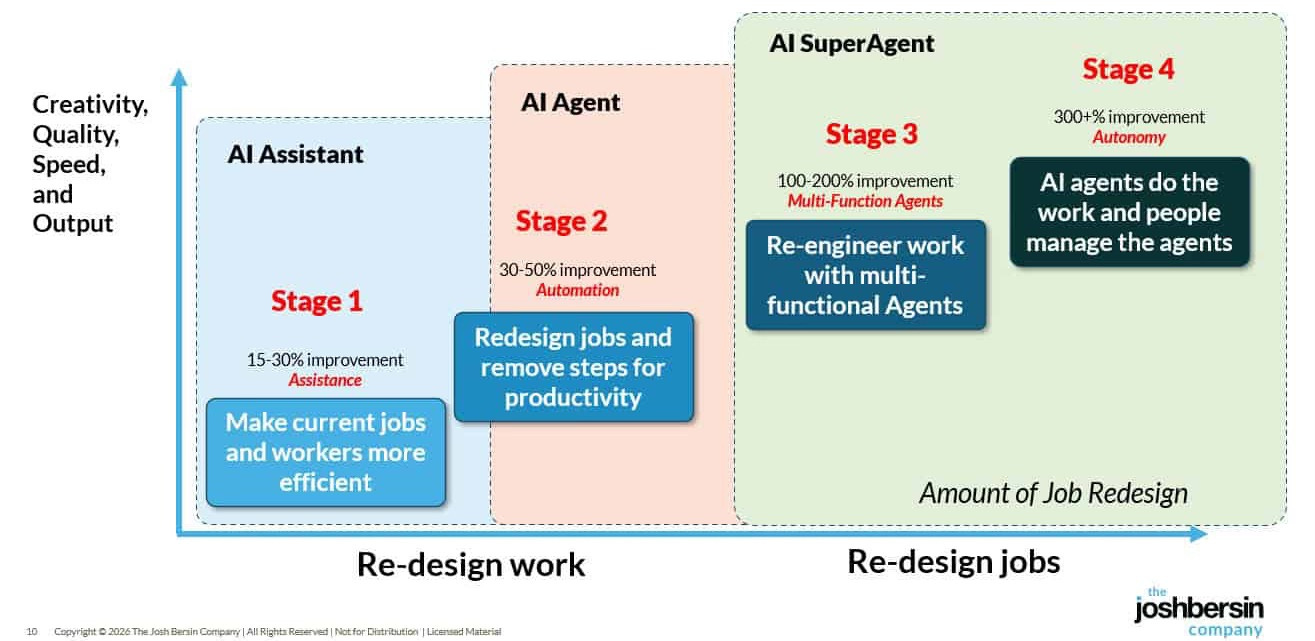
Meanwhile, HR is undergoing what Josh Bersin calls “the great reinvention,” shifting from compliance to strategic work focused on talent architecture, culture, and AI orchestration. With AI expected to automate 30-40% of existing HR jobs, the profession is transforming, not shrinking.
Quote of the Week:
“Many of my students are concerned that the convenience of tech will stop them from developing the nuanced judgment they aspire to have. A little bit like a controlling parent, it makes life easier for you, then you don’t know how to manage life on your own.”
—Gianpiero Petriglieri, an associate professor of organisational behaviour on the risk of “cognitive atrophy” from over-relying on AI.
Reading List:
Workers vs companies on AI
As large public companies signal that AI will drive future efficiency and workforce reductions, some workers are pushing back by “friction-maxxing” (a newly popular GenZ-ism). This is the intentional choice to do things the harder way: opting for in-person meetings, reading full documents instead of AI summaries, and learning skills from scratch. It is a quiet rebellion against the “tyranny of convenience,” born from a desire to cultivate deep thinking and protect the human qualities that frictionless tech threatens to erode.
Automated applications creating hiring stress for talent acquisition
The hiring market is under “unprecedented strain,” with 90% of U.S. companies missing their 2025 hiring goals. While recruiters spend nearly 40% of their time on scheduling, the rise of AI-assisted and fraudulent applications has become the most anticipated challenge for 2026. This creates a paradox: while AI is seen as a solution for efficiency, it is also fueling a crisis of trust and a deluge of low-quality applications, forcing a reevaluation of how to find the best candidates in a sea of automated noise.
How top companies are bucking the engagement decline
While overall employee engagement continues its downward spiral, particularly among younger workers, a few top companies are bucking the trend via transparent leadership, meaningful recognition, and clear communication. With burnout’s influence on engagement growing, these companies prove that strong leadership can break the cycle. The small sliver of engagement winners show that a well-defined culture and a clear path for growth are the simply effective engagement tools in a world of increasingly complex problems.
Data Point: The Disappearing (Deep) Work Day
2-3 hours
The average amount of daily focus time a worker gets, defined as uninterrupted work periods without meetings, messages or tool switching, according to the Hubstaff 2026 Global Benchmarks Report.
In Other News
The Trade Shortage Crisis: How Data Centers Are Exposing America’s Skills Gap. (Forbes)
Highly educated but under pressure: The paradox facing L&D pros. (HR Executive)
The US is headed for mass unemployment, and no one is prepared. (The Hill)
Layoffs are piling up, heightening worker anxiety. Here are some of the biggest recent job cuts. (AP)
Job seekers optimize resumes amid ATS ‘anxiety’. (HR Dive)
Teaching employees to use AI could add up to $6.6T to US economy. (HR Dive)
The Rise of Workslop — and 4 Ways to Counter the Negative Effects of AI. (HR Morning)
Quantifying the Productivity Gains from AI. (Apollo)