Organizational AI takes hold | Structural work shifts | Declining service quality | Hybrid hierarchy | Demographic cliff
Welcome to the latest edition of Human Capital Intelligence. As always, we would love to hear from you at ken@stibler.me with news ideas, feedback and anything else you find interesting.
Sent this by a friend? Sign up here to receive HCI in your inbox every week.
By Ken Stibler; Powered by Reyvism Analytics
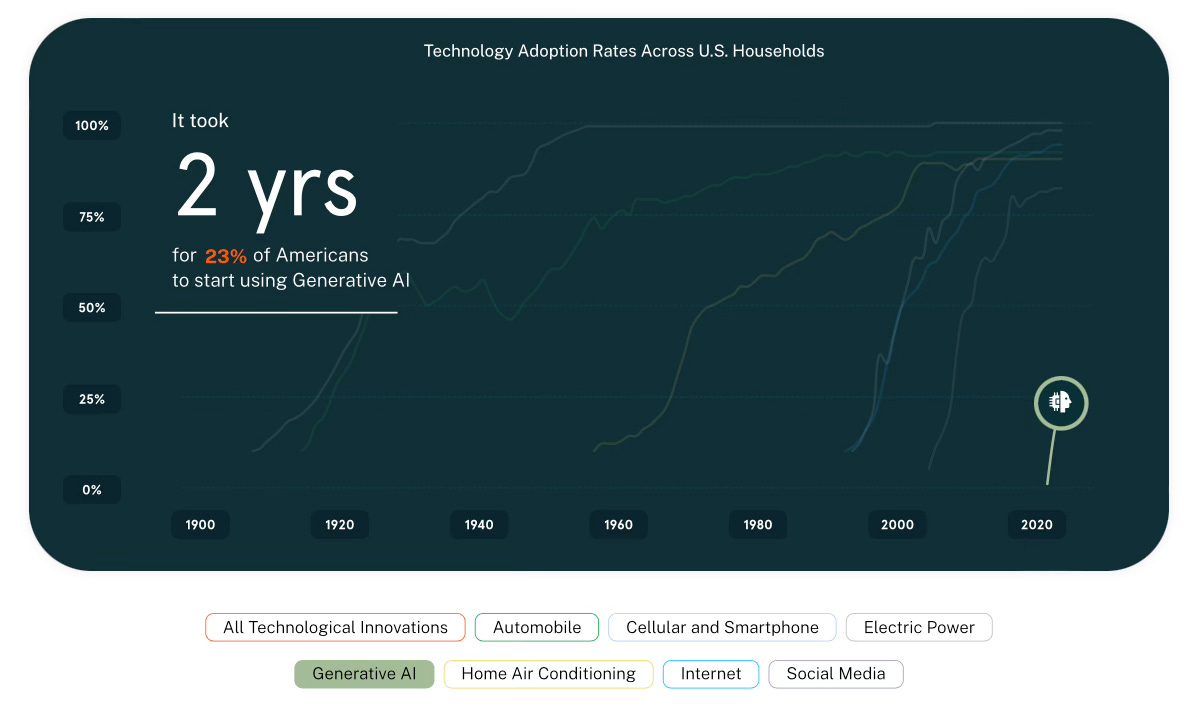
Compared to around 6 years for mobile phone adoption, a clear indicator of technological accelerating
AI gets real in the workplace as companies quietly boost competitiveness and reduce headcount
The transition from AI speculation to tangible business impact is accelerating, with industry leaders reporting substantial productivity gains from strategic AI deployment. JPMorgan Chase executives anticipate $2 billion in value creation (sic: headcount reductions) from their LLM Suite; the World Economic Forum indicating that 41% of global employers plan to reduce headcount as AI automation streamlines operations.
Read More: Salesforce CEO Marc Benioff says that from now on CEOs will no longer lead all-human workforces—enter the new era of AI coworkers. (Fortune)
Early adopters are already demonstrating the competitive advantages of comprehensive AI integration. Citigroup has equipped 30,000 developers with generative AI coding tools, while Goldman Sachs is on track for company-wide AI assistant deployment by year-end. According to research firm i4cp, organizations that have successfully embedded AI into their workflows are experiencing "massive productivity gains" and accelerated strategy execution, though only 11% of companies have reached this level of AI readiness.
The economics of AI implementation are becoming increasingly favorable, driven by plummeting infrastructure costs and the emergence of open-source alternatives like DeepSeek-R1. Analysis by consulting firm Accenture reports a dramatic 74% cost reduction for ChatGPT-style implementations between 2021 and 2024 as cloud providers continue massive infrastructure investments and further cost reductions.
However, nearly 9 in 10 companies report difficulties in executing and scaling AI initiatives, with budget constraints, skill gaps, and computing resource limitations serving as primary obstacles. The talent equation remains particularly problematic, with 80% of organizations reporting their workforce is unprepared for generative AI adoption.
While AI tools become more accessible and cost-effective, they paradoxically increase organizational complexity and create critical dependencies on a small pool of highly specialized technical workers who can manage these sophisticated systems. This concentration of essential expertise introduces new risks and potential bottlenecks in the AI adoption.
“The CEO role is becoming less attractive. The pressure globally is growing all the time, scrutiny on them is higher and so we are seeing fewer serial CEOs.”
— Laura Sanderson, who oversees the Russell Reynolds board and CEO advisory team on why over 2,000 CEOs left their jobs last year
HCI View: Change and complexity tolerance are becoming key drivers of competitiveness as the economy shifts. Most businesses don’t need a “coder” to adopt the thousands of “no code” AI tools available for free. Even adopting these open source tools effectively can drastically increase efficiency…if you have someone that is comfortable enough to lead implementation.
Thanks for reading Human Capital Intelligence! Subscribe for HCI in your inbox every week
A changing society brings structural shifts in work
A mix of technological acceleration and economic disruption are putting traditional job and hiring practices under stress. The rise of AI-powered tools has severely compromised the reliability of conventional hiring methods, with companies struggling to differentiate between genuinely qualified candidates and those who have simply leveraged artificial intelligence to optimize their applications. This structural shift is forcing organizations to completely rethink everything from cover letters and resumes as useful tools to what they can expect of average talent quality.
The concept of stable, bundled job roles is also beginning to give way to more dynamic, task-based work arrangements. Harvard Business Review finds that companies are increasingly adopting "job deconstruction," where employee skills are flexibly matched to specific projects rather than fixed positions.
While this transition creates significant disruption across industries, it also presents compelling opportunities for businesses to streamline their operations and reduce inefficiencies. The shift toward evidence-based hiring and skills-focused assessment methods promises to dramatically reduce the time and resources wasted on traditional resume screening and interviewing processes.
Forward-thinking organizations that embrace these changes can gain competitive advantages through more systematic talent acquisition, reduced hiring costs, and better skill-to-task matching capabilities. Though the adjustment period may be challenging, companies that successfully adapt to this new paradigm stand to capture significant value from a more efficient and dynamic labor market.
HCI View: With hundreds of new labor laws, the economics of contractors is becoming even more attractive, but only if your strategy is clear and communicable.
Not a good culture or motivation move for the tens of thousands of employees left. Wonder how free they will feel to challenge bad orthodoxies, bring new ideas up, or support internal initiatives given the flippant risk of such “outward promotions.”
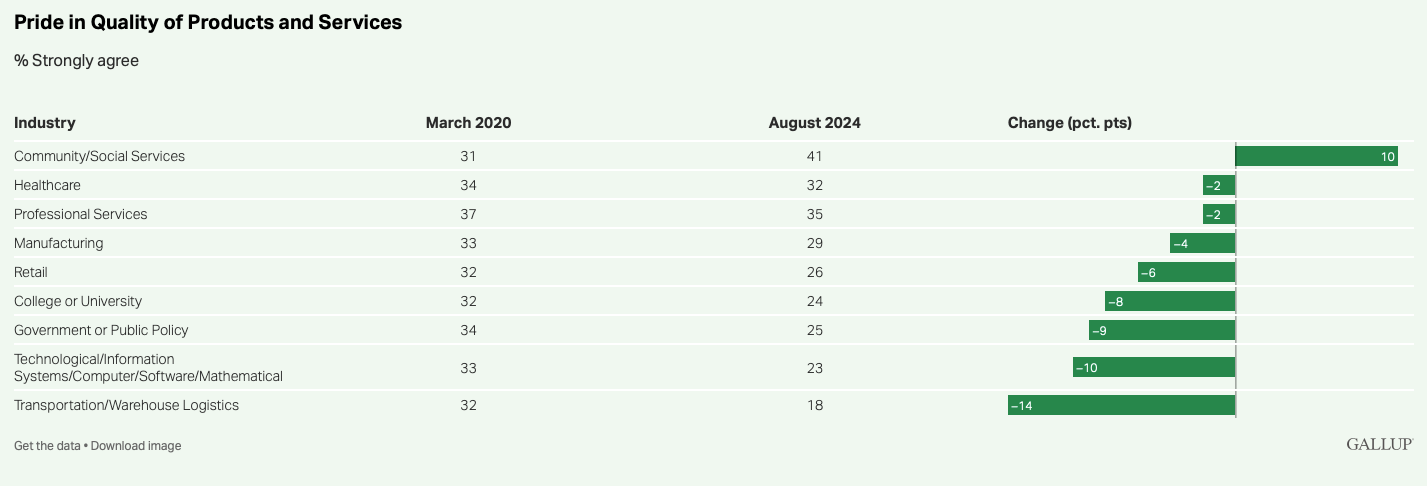
Organizations are increasingly turning to artificial intelligence as a potential solution, with 24% of U.S. companies now deploying AI in customer interactions. Among employees who directly use AI for customer engagement, 68% report positive outcomes, suggesting technology may help bridge the growing disconnect between disengaged workers and service delivery. However, significant skepticism remains among the 76% of workers not yet using AI in customer interactions.
HCI View: Disengagement is filtering into client relations and becoming a concern in some revenue/custom success teams that HCI has spoken with; not proactively engaging employees is not just a nice to have, it can quietly sink the bottom line.
GenZ workers and baby boomer managers grow further apart
The disconnect between Generation Z employees and their managers is reaching critical levels, with 60% of employers reporting firing fresh graduate hires due to performance issues. According to Gallup data, the decline in workforce engagement to a decade low 31% is driven primarily by above average dissatisfaction among workers under 35. Management cites lack of motivation, unprofessionalism, and poor communication skills as primary concerns, while 50% of hiring managers now view recent college graduates as unprepared for workplace demands.
This generational divide appears rooted in fundamentally different perspectives on work itself, rather than mere behavioral differences. While previous generations entered the workforce with expectations of job security, career advancement, or meaningful impact, Gen Z approaches employment with markedly more skepticism, having witnessed precarious job markets and widespread corporate restructuring. This mindset shift is costing companies an estimated $9 trillion annually in lost productivity, forcing organizations to reconsider traditional workplace structures and management approaches.
HCI View: With demographic deficits and management shortages on the horizon, firing is a short-term solution to a long-term problem with the way younger people approach work. Clearly the tight job market hasn’t changed much so the decision becomes train better, hire more intentionally, or fight over the small pool of qualified candidates.
Remote work becomes a benefit for key employees
Despite broad pushes from major employers like Amazon, AT&T, and JPMorgan Chase for full-time office attendance, companies are quietly making exceptions for top talent and key skillsets they're eager to retain, the WSJ reports. This selective flexibility, dubbed the "new hybrid hierarchy" by Korn Ferry, represents a shift from remote work as a pandemic-era necessity to a valuable perk in the talent retention arsenal.
The disparate treatment is creating workplace tensions and accelerating employee turnover, with some professionals reporting up to 40% pay cuts when switching jobs to maintain work flexibility.
HCI View: Another item which makes sense in the short-term but can do real damage to culture. Unless there’s an abundance of motivated talent in your sector (if there is drop me a line so we can talk) hybrid work is better as a necessary operating model, rather than an unequal perk.
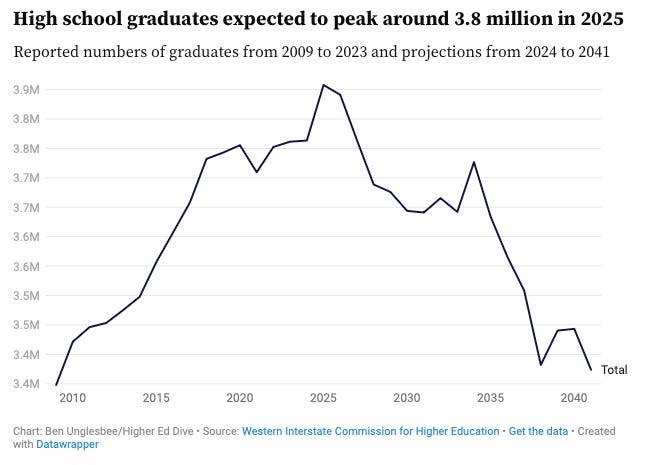
Data Point: Coming Demographic Deficit
This May, the U.S. will graduate its largest ever high school graduating class, with falling fertility rates driving the number down every year going forward. Over the coming decade the shortfall in new entrants to the labor market will create structural labor shortfalls which either force companies to automate or compete more for the declining talent pool.
In Other News:
90 days, dozens of interviews, billions on the line: Inside Blackstone’s CEO search process for its 250 companies. (Fortune)
Record number of CEOs leave roles amid activist pressure, research shows. (Financial Times)
Hiring reached its lowest point in 5 years, report finds: Hiring declined across all industries, both in the U.S. and worldwide, BambooHR data shows. (HR Dive)
Tiffany Workers Mock Forced 'Joy' That Exacerbated Staff Exits. (Bloomberg)
Nearly half of employees say they’re subject to an NDA. (HR Dive)