

Welcome to the latest edition of Human Capital Intelligence, your weekly brief synthesizing over 250 leadership, HR, and people sources to filter out the noise. As always, we would love to hear from you at ken@reyvism.com with questions you’d like answered or topics covered.
Sent this by a friend? Sign up here to receive HCI in your inbox every week.
By Ken Stibler; Powered by Reyvism Analytics
“Machines talking to Machines” - AI generates the largest ever change in communication, with trust suffering in turn
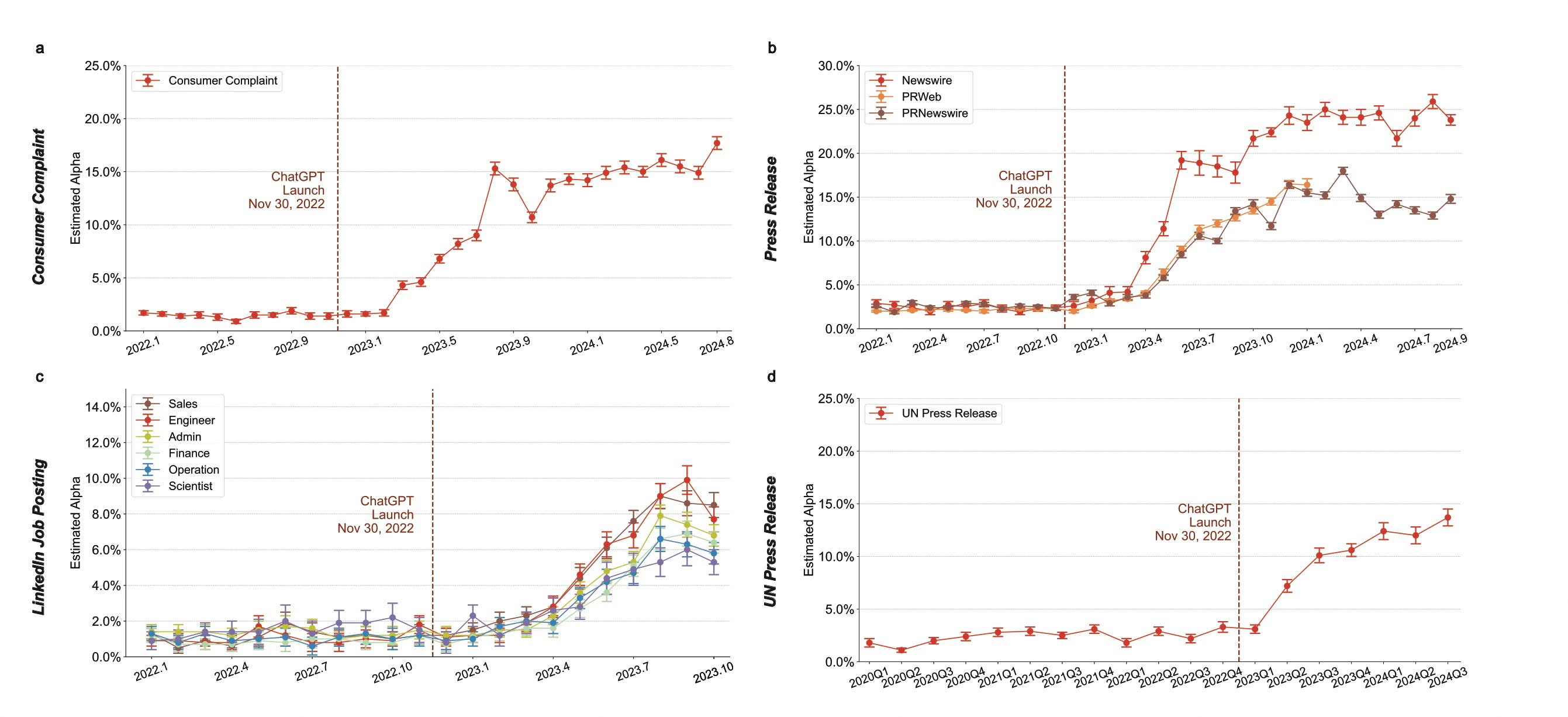
One-quarter of corporate press releases are now AI-generated, with consumer complaints (18%), UN communications (14%), and job postings (up to 15%) not far behind, according to groundbreaking Stanford research analyzing over 1.5 million documents. This explosive adoption - occurring in just 18 months following ChatGPT's release - represents the most rapid transformation of written communication in history, fundamentally altering how organizations and individuals interact. The magnitude and speed of this shift exceed even the adoption rates of the internet and personal computers, creating a new reality where a significant portion of professional writing no longer comes directly from human authors.
AI writing tools are upending traditional power dynamics in communication. Surprisingly, areas with lower educational attainment show higher AI adoption in consumer complaints, while smaller, younger companies use AI at rates 2-3 times higher than established firms. This "democratization effect" enables resource-constrained entities to produce polished, professional-quality messaging that previously required dedicated communications staff.
Now, competitors of all sizes can now project sophisticated market positioning regardless of their actual capabilities - creating both opportunities for smaller players and challenges in differentiating authentic expertise.
Read More on Declining Trust: A Student Who Didn’t Know How to Code Used AI to Beat Amazon’s Brutal Technical Interview. He Got an Offer and Someone Tattled to His University: Roy Lee built an AI system that bypasses FAANG's brutal technical interviews and says that the work of most programmers will be obsolete in two years. (Gizmodo)
The stabilization of adoption rates by mid-2023 signals AI writing has already transitioned from novelty to standard business practice. This new communication landscape fundamentally undermines trust, as audiences can no longer distinguish between human and machine-generated content. The research reveals businesses are navigating a critical trade-off: using AI delivers cost-effective, professional communications, but risks creating generic, potentially less credible messaging that may erode brand authenticity.
What’s Next: As these tools become increasingly embedded in corporate workflows, the findings suggest business leaders must reconsider how they establish trust and authenticity in an environment where machines are increasingly talking to machines.
Economic struggles materialize - what does it mean for you?
Last week HCI led with a stark warning that economic indicators were turning, and to expect a lot of negative talk around the economy. But even HCI was surprised by the speed and depth of doom around the U.S. economy - still the most innovative, productive, and largest in the world.
While certainly odd and policy-driven, the U.S. hasn’t had a normal business-cycle dip in 12 years, leaving equity valuations, consumer spending, and capex exposed to a correction. Some on Wall Street are speculating that this may be the point of Trump’s tariffs, to create a shallow recession early in the administration and to benefit from a 2026 recovery. Either way, it’s time to dust off the garden-variety recession playbooks (unless you’re exposed to Canada/Mexico trade, at which point get a war room).
For any businesses dependent on imported materials that aren't actively mapping second order supply chain risks, there’s no time like the present. Marginally higher costs from alternative sources can be managed, sudden 10%, 25%, 50% tariff driven spikes, less so.
A good start is cleaning up cash management, negotiating longer payment terms with nervous suppliers while accelerating collections from customers. Pricing strategy is also worth a revisit, implementing smaller, more frequent price adjustments rather than dramatic increases to avoid spooking uncertain and cost-sensitive buyers. For many business, it’s also worth exploring areas of your business model for fixed-to-variable cost conversion opportunities that allow greater flexibility during contraction.
Current volatility also creates outsized opportunities for the bold businesses to capture market share. Without the complex decision-making structures that are making multinationals more exposed to “insurgent brands,” firms can accelerate new technology adoption to increase quality and lower operating costs. The bloated tech adoption and short-term moves of large companies also mean rising consumer sensitivity to quality offers opportunities for inroads in certain markets.
What’s Next: Tech adoption is the highest ROI recession response. A recession in 2025 is the perfect time to test tech’s ability to lower costs, with venture capital still funding billions in new tools, the capacities needed are out there, and either free or very low cost.
Tough week? At least you didn’t lose $81 trillion
A Citi Bank employee accidentally transferred $81tn, rather than the intended $280. The transfer was missed by both a payments employee and a second official assigned to check transactions.
While the problem was reversed a couple hours later, I imagine the employee’s week didn’t improve from there - talk about a loss of trust and confidence.
Reading List:
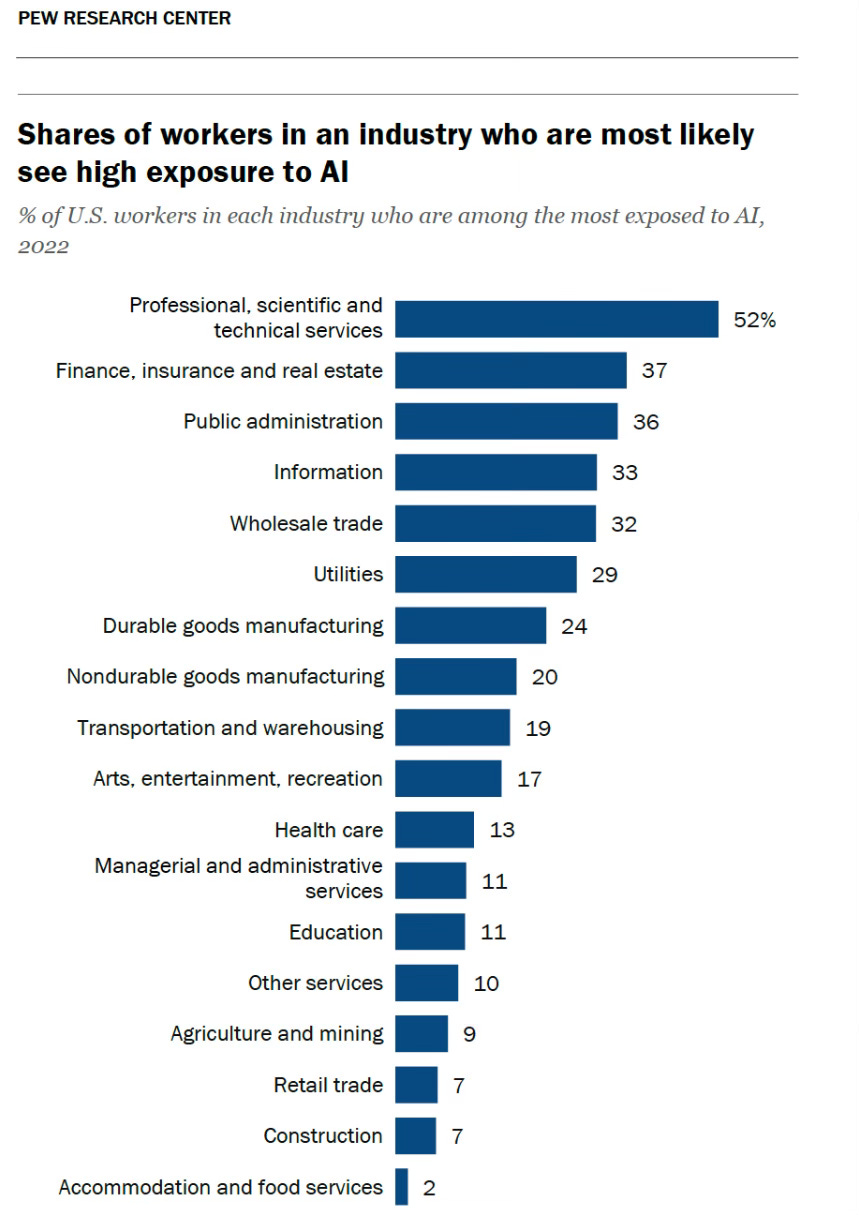
AI generates 33% higher productivity for every hour used
Workers are 33% more productive in each hour they use generative AI, saving four or more hours per week on average, according to new research from Federal Reserve Bank and Harvard. The technology has immense potential, yet only 9% of U.S. workers are using it daily and 14% using it weekly.
Gartner Predicts Agentic AI Will Autonomously Resolve 80% of Common Customer Service Issues Without Human Intervention by 2029. (Gartner)
Experts suggest organizations may be undervaluing AI's potential by treating it as conventional technology rather than a talent multiplier that enhances employee efficiency at the task level.
What’s Next: The best way to learn AI is just to play around with a tool. Start an organic conversation with ChatGPT, try and fail to make your day easier, any type of start is useful given that uncertainty and ambiguity, rather than difficulty, are the primary barriers to adoption.
Enough talking about the “GenZ problem”
Another week, another new report about Gen Z struggling. But rather than update the stats, it’s time to put up, or “shut up” about the problem of this newer, odd generation. Businesses increasingly agree, putting more time and money into etiquette classes, onboarding, and mentorship programs. Luckily, the traits needed for today's uncertain environment—optimism, continuous learning, resilience, and stewardship—are precisely what Gen Z brings when properly channeled.
As these young professionals increasingly assume management positions (projected to be one in ten managers by the end of the year ) and serve as connectors to Generation Alpha, organizations that invest in understanding their values and communication styles won't just be accommodating differences—they'll be leveraging them as competitive advantages in tomorrow's leadership pipeline.
What’s Next: Step 1: move from generational judgement to curiosity about your new managers, leaders, and contributors. Step 2: learn the language, each generation cares about similar things just in different ways with different framings.
GenZ wants to know the “why” behind their work, making it a habit has been shown to drastically boost their engagement. These “why’s” don’t have to be saving the world, they just want to see how their work fits into something bigger…and with workplace social media and gossip surging, they’re going to get it one way or another. Step 3: Check the basics, absence of a clear strategy or strong culture affects all employees, just most visibly the new ones.
Executive struggles come to the forefront
CEO departures reached a 20+ year high in January, with 222 executives stepping down. Increasingly, the C-suite has become a pressure cooker of competing demands: navigating post-election policy shifts, managing market volatility, and implementing emerging technologies like AI while simultaneously addressing workforce expectations.
The leaders who have held on in the face of 5-years of crises have started to lose confidence, with 33% of new executives doubting their ability to succeed and 31% lacking faith in their leadership teams. Team cohesion has emerged as the primary channel from external disruption to internal chaos, with leaders trapped in a vicious cycle where high turnover tanks engagement, further accelerates departures, and adds to the number of fires. In turn, our leaders are burning out, with 75% of C-Suite executives seeking some form of assistant for the professional and personal toll of their work.
What’s Next: Take the time to step back and target the root causes of declining confidence rather than just running around to address the symptoms. The Navy Seals have a saying: slow is steady, and steady is fast. As much as it may feel counter-intuitive when you have a long list of fires to put out, the instability of a struggling leader bleeds through the entire organization - even if you’re naive enough to think you can hide it. Turning to your teams, your peers, and Vistage groups for deeper and broader is a sign of wisdom, not weakness.
Data Point:
33%
The per hour boost in productivity from using generative AI, according to new research from economists at the Federal Reserve Bank of St. Louis. Worth highlighting again for the AI-skeptics given the real potential of available tools
In Other News:
3 Ways Employee Career Development Boosts Your Bottom Line. (Linkedin Talent Blog)
What does a (real) continuous learning culture look like? (HR Executive)
Trump wants the private sector to absorb displaced federal workers. Easier said than done: Federal workers are entering a tough labor market, and could create challenges for some cities and industries. (HR Brew)
The Job Market Is Frozen: Unemployment is low, but workers aren’t quitting and businesses aren’t hiring. What’s going on? (The Atlantic)
Most job seekers say they’re ‘uncomfortable’ with employers using AI for resume review, decision-making. (HR Dive)
This company publishes 360-degree feedback. Is it working? (HR Executive)
Goldman Sachs to Target Vice Presidents in Next Round of Cuts: Employees likely to be laid off in annual culling were given hints in the form of small bonuses. (Wall Street Journal)
Don't let pay transparency requirements catch you by surprise in 2025. (Employee Benefits News)
Companies are betting that robots can teach humans how to be better managers. (Fortune)