

Welcome back to Human Capital Intelligence! Your go-to source to keep up with the best insights from over 250 leadership, HR, and people sources. As always, we would love to hear from you at ken@reyvism.com with questions you’d like answered or topics covered.
Sent this by a friend? Sign up here to receive HCI in your inbox every week.
By Ken Stibler; Powered by Reyvism Analytics
Intelligence offers keys to win in an accelerating world

The world is moving faster than ever, but most companies…aren't. The rise of AI, shifting market structures, and a flood of information create a fog of uncertainty that leaves many leaders paralyzed. Winners in this new environment are those with the clearest and most compressed ‘informational supply chain.’ Accurate and complete information, delivered faster, means decision makers can avoid noise and act decisively while competitors are still trying to figure out what’s going on.
In most companies, intelligence is scattered. Market research lives in marketing, competitive analysis in strategy, and financial forecasting in finance. Each function provides a partial view, but nobody owns the full picture. This leads to rework, thin accountability, and a chronic inability to see the whole board. A true intelligence capability centralizes this function, giving leaders a single, unvarnished view of the competitive landscape.
Building this capability is a leadership imperative. It requires a relentless focus on what matters, a willingness to challenge your own assumptions, and the courage to make bets with incomplete information. The alternative is to watch from the sidelines as others build the future.
The key to making AI work? ‘Old school’ leadership
The hardest part of AI adoption isn’t the technology; it’s the people. The tools are here and they work (some better than others, granted). The bottleneck is the messy, human work of getting your team to actually use them. The companies that are seeing real ROI have better managers, not better models. They understand that AI adoption is a change management problem, not a technology problem.
This isn’t about hype or cash prizes for “innovation.” It’s about the unglamorous, day-to-day work of leadership: setting clear expectations, providing the right training, and holding people accountable. It’s the reason Accenture’s CEO has made AI skills required for promotion. It’s what Gartner is getting at when they say managers, not HR, are the key to company-wide adoption. And it’s about recognizing that employee resistance isn’t irrational; it’s a predictable response to a poorly managed change process.
Quote of the Week: Valid or not, why broadcast this?
“Part of working hard is sending emails to the team on a Saturday. And if I don’t get a response on Saturday, sending them an email on Sunday with a question mark. What’s going on?”
—Dara Khosrowshahi, CEO of Uber
Reading List:
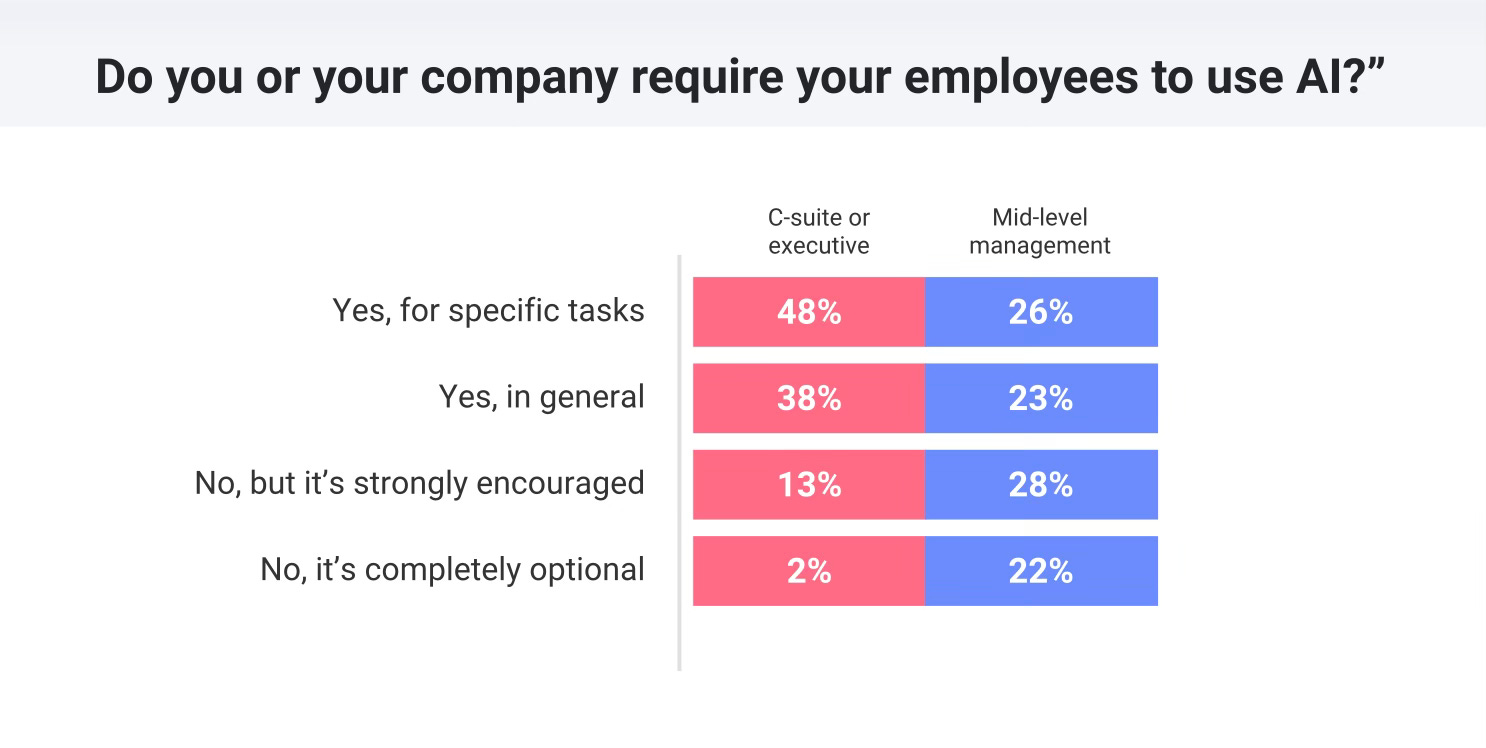
Employees and executives drift further apart on AI
The disconnect between the C-suite and the rest of the organization on AI is getting wider. A recent survey found that while 86% of executives believe AI use is mandatory, only 49% of middle managers agree. The C-suite is selling a vision of AI as a transformative teammate, while employees are experiencing it as a helpful but limited tool. The result is a stalemate. The companies that have narrowed the gap find that empowered managers are key to translate C-suite vision into day-to-day reality.
Most companies lack real plans for change communications
61% of companies have no formal approach to change communication, according to a recent Gallagher survey. During ongoing disruption, communicating change effectively is a core competency. Without it, every new initiative is dead on arrival. The fact that most companies have six or fewer people in a communications role, regardless of size, shows how undervalued this function is. If you don’t have a real plan for communicating change, you don’t have a real plan for executing it.
Ask not what your COO can do for you…
The COO is no longer just an operator; they are the CEO’s strategic partner in execution. As CEOs spend more time focused externally, the COO is the one who has to translate vision into reality. Yet the COO’s success increasingly depends on their ability to build strong relationships with their C-suite peers more than abstract “operational excellence”. They are the connective tissue of the organization, but if they lack the time and space to “grab a beer” across the organization, they can quickly go from effective partner to inefficient enforcer.
Data Point: Mandatory to use, option to learn?
35%
Number of businesses that report having data and AI upskilling programs available to all of their employees.
In Other News
Mastercard bots target C-suite roles: Card giant offers SMEs a virtual chief financial officer through artificial intelligence technology, with other C-suite roles to follow. (Computer Weekly)
Workers who are receptive to ‘corporate BS’ may struggle with analytical thinking. (HR Dive)
How AI Is Accelerating Skills-Based Hiring and Upskilling. (Talent Culture)
US companies say they plan to accelerate global hiring despite hurdles. (HR Dive)
Shadow AI rises as leaders choose speed over governance. (CIO Dive)
AI Job Loss Is Breaking the Psyche of Workers, Psychiatrist Warns. (Futurism)
Washington state wants to keep employers from microchipping workers, before anyone even gets the idea. (Fortune)