

Welcome back to Human Capital Intelligence! Your go-to source to keep up with the best insights from over 250 leadership, HR, and people sources. As always, we would love to hear from you at ken@reyvism.com with questions you’d like answered or topics covered.
Sent this by a friend? Sign up here to receive HCI in your inbox every week.
By Ken Stibler; Powered by Reyvism Analytics
Accountability Is Leadership's Greatest Weakness
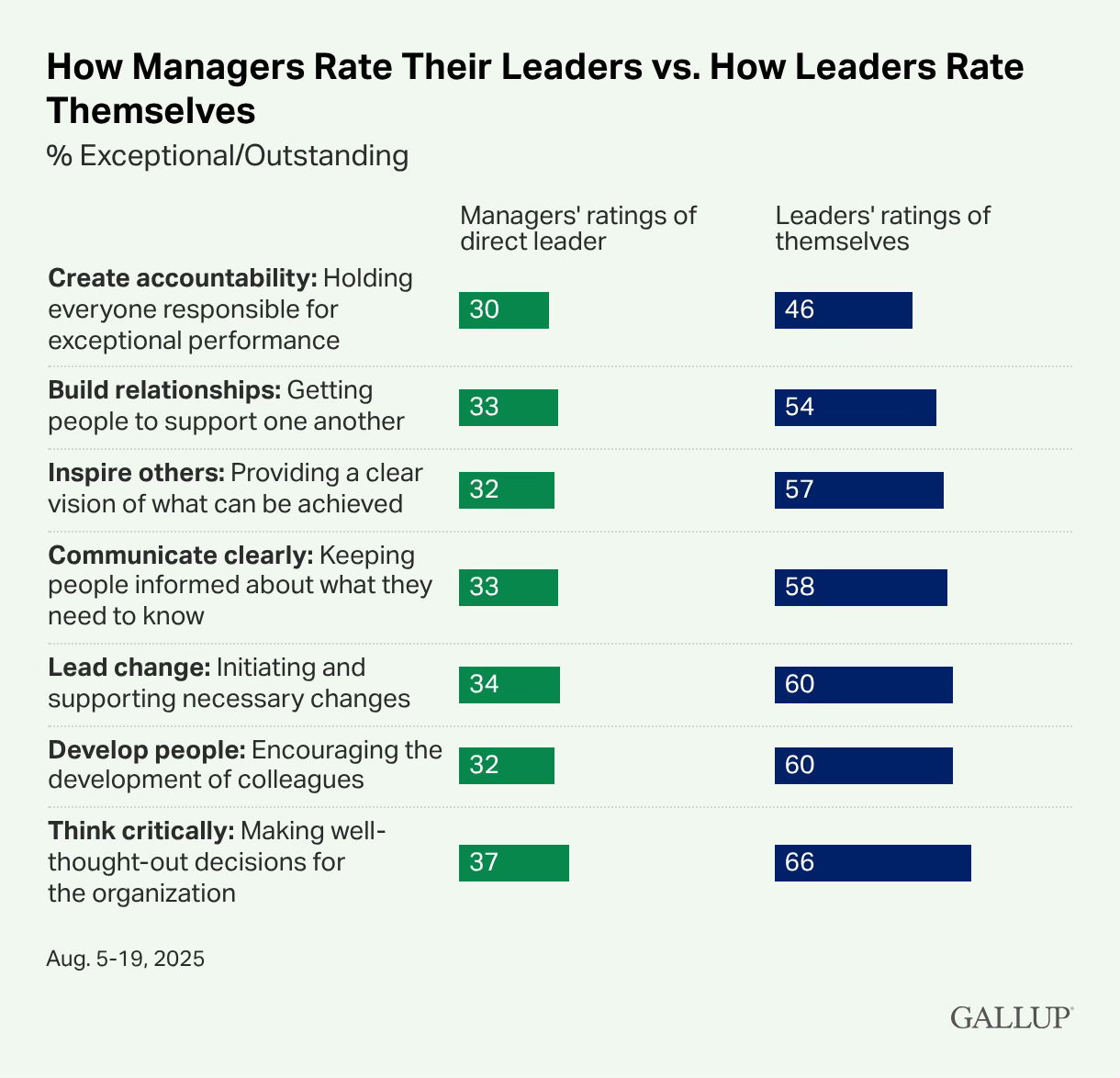
There is a 20-point gap between how leaders rate their own ability to create accountability and how their managers rate them. That is a performance problem. A recent Gallup study of seven core leadership competencies found that “create accountability” was the lowest-rated skill for both leaders and managers—and the one with the largest gap between leaders’ self-perception and the reality their teams experience.
This is the quiet crisis of accountability in most organizations, and it can only be addressed top. Beyond the implications for execution, this accountability gap is a primary driver of disengagement. Gallup finds that managers who believe their leaders are accountable are three times more likely to be engaged at work. The mechanism is simple: accountability drives clarity. When leaders fail to set clear expectations and hold the organization to them, the most common result is a quiet drift.
The takeaway is that accountability is a design choice. It is built into the systems that connect what you say matters to what you actually measure. It is reinforced in the weekly one-on-one, not just the annual review. And it starts with closing that 20-point gap by asking your own leadership team what they see, and really listening.
Your talent development budget’s been slashed. Now what?
AI budgets are soaring while talent development budgets are shrinking across the middle market. On paper, this promises efficiency, scalability, and a clear path to future-proofing the business. Investing in people, by contrast, can feel like a softer, less measurable bet.
The paradox is that the more powerful AI becomes, the more critical human skills like judgment, collaboration, and adaptability are to realizing its value. AI can automate tasks, but it cannot build trust, navigate ambiguity, or lead a team through change.
When organizations cut training, coaching, and leadership development, they are not just trimming a budget line; they are hollowing out the very capabilities they need to make their AI investments pay off. The result is a workforce that is stressed, disengaged, and unprepared to manage the complexity that AI introduces.
Quote of the Week: Valid or not, why broadcast this?
"The best leaders don't just hold their people accountable. They hold themselves accountable for their people's success."
—Jim Harter, Chief Scientist, Gallup
Reading List:
Why leaders lose the room in high-stakes meetings
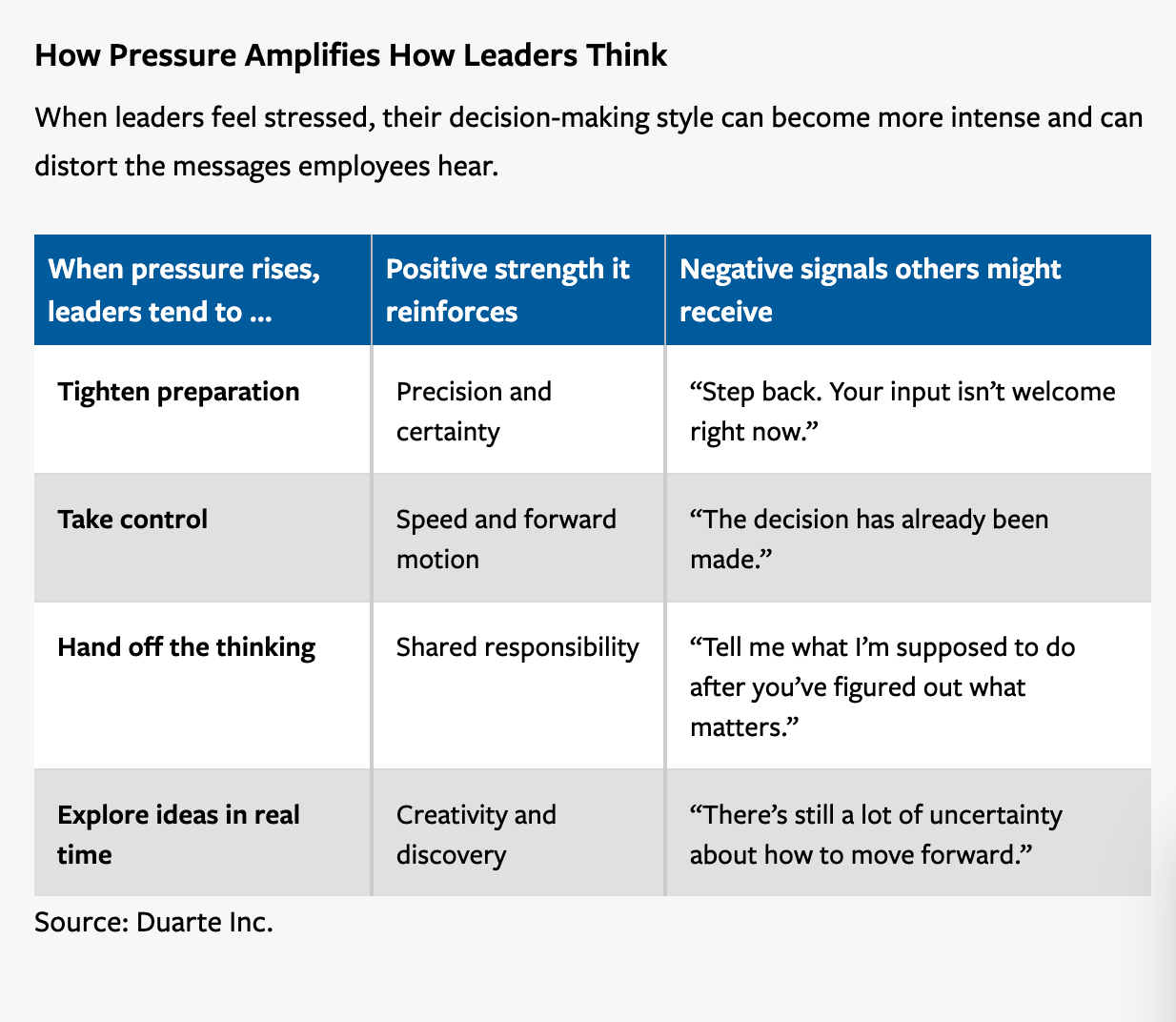
Most advice on leadership communication focuses on presentation skills. But the most consequential communication happens in meetings where tough issues are being discussed. An MIT Sloan analysis finds that under pressure, leaders tend to lean too hard on their natural thinking process, inadvertently making it harder for the audience to follow, contribute, and align. The key is not to change your style, but to recognize how your style is experienced by others and build in safeguards to protect shared understanding.
Women are avoiding the technology that threatens them most
The jobs women hold are three times more likely to be automated by AI, yet women are using AI at a rate 25% lower than men on average. This is not a competence gap; it is a confidence and trust gap. A Fortune analysis warns that if this trend continues, we are at risk of creating a two-tiered AI economy, where one group reaps the benefits of augmentation while the other is left behind. The solution is not to push for blind adoption, but to address the underlying issues of bias, psychological safety, and equitable design.
Why talent lifecycle alignment quietly breaks after hiring
Organizations have invested heavily in improving hiring accuracy. Yet for many, the talent lifecycle quietly breaks down in the first year. A Talent Culture analysis argues the issue is rarely flawed hiring science. It is a measurement gap between what organizations hire for and what they reward. When performance evaluation systems reward different signals than those used during selection, the accuracy of hiring science stops mattering. This is a governance issue, not just an HR program.
Data Point: “Performance” reviews
14%
Number of employees that strongly agree performance reviews they receive inspire them to improve.
In Other News
Toxic managers dehumanize employees, leading to extreme burnout. (HR Dive)
JPMorgan monitoring keystrokes and video calls of junior bankers. (Fortune)
Leaders report a ‘growing gap’ between what’s expected of them and the support they receive. (HR Dive)
How compensation teams can become strategic finance partners. (HR Dive)
Highly skilled workers have been training AI — that comes at a cost. (Financial Times)