

Welcome to the latest edition of Human Capital Intelligence, your weekly brief synthesizing over 250 leadership, HR, and people sources to filter out the noise. As always, we would love to hear from you at ken@reyvism.com with questions you’d like answered or topics covered.
Sent this by a friend? Sign up here to receive HCI in your inbox every week.
By Ken Stibler; Powered by Reyvism Analytics

CEO core competencies evolve
The modern CEO's most crucial skill has become the ability to discern whether their unique perspective delivers maximum impact amid multiplying challenges, new research from the BCG Henderson Institute finds.
With business leaders now juggling more exotic disruptions alongside traditional performance expectations, successful executives recognize they cannot personally address every issue and must instead focus exclusively in areas only they can influence. This selective engagement strategy—determining what to prioritize, what to simplify, and where to personally lead—increasingly separates high-performing chief executives from their peers.
Six core competencies now define CEO effectiveness: creating purpose and clarity, establishing focus, building capacity, generating drive, reducing complexity, and minimizing unhealthy friction. The most impactful leaders translate organizational purpose into clear priorities, eliminating distractions, and ensuring their organization possesses the right skills, technology platforms and emotional resilience to execute effectively.
Former BCG founder Bruce Henderson's observation that "leadership is about navigating through uncertainty and ambiguity with clarity and conviction" has never been more relevant.
In an increasingly VUCA (volatility, uncertainty, complexity, ambiguity) environment, CEOs must resist the temptation to involve themselves in every decision, asking instead whether their participation will materially enhance purpose, focus, capacity or drive—or help reduce complexity or friction. Those who master this discernment, empowering their teams while concentrating their limited bandwidth where only they can contribute, position their organizations for sustainable success amid disruption and accelerating change. For investors, this evolved approach to executive leadership has become a critical indicator of long-term organizational viability.
What’s Next: Unfortunately “turning off the news” is not an option for CEOs, especially when you are the only one in your organization watching the horizon and plotting direction. Accelerating change will require new leadership competencies. While the change will not be fun, the new needs of the role are both critical and rewarding.
AI training offers a rare ‘triple win’
A rare alignment of interests is forming around AI skills development, creating a strategic "triple win" opportunity. Leadership teams are now recognizing the threat of insufficient AI capabilities, with nearly two-thirds of executives warning that skill gaps endanger technology implementation, and over half planning internal upskilling initiatives. Employees are equally invested: 89% of job-seekers seeing digital fluency as essential for career advancement— aligning personal goals with corporate priorities.
Organizations implementing structured AI training programs capture the third dimension of this convergence: measurable business outcomes. Accenture's marketing department training initiative delivered 25% improved brand value, up to 55% faster market response, and eliminated one-third of manual tasks. Despite these compelling economics, only 8% of major corporations have committed to AI training programs that match their technological ambitions—creating a clear differentiator for investors seeking reliable predictors of which companies will successfully monetize their AI investments.
What’s Next: Finding a point of clear agreement between organizational, executive, and employee needs is a clear winner for adaptation, engagement, and efficiency.
Quote of the Week: No new normal
“Business leaders should lay low and accept that any planning has to be agile. This is going to be a volatile period. What you all want is certainty and you’re not going to get it.”
— Elaine Chao, Transportation Secretary in the first Trump Administration to a group of CEOs
Reading List:
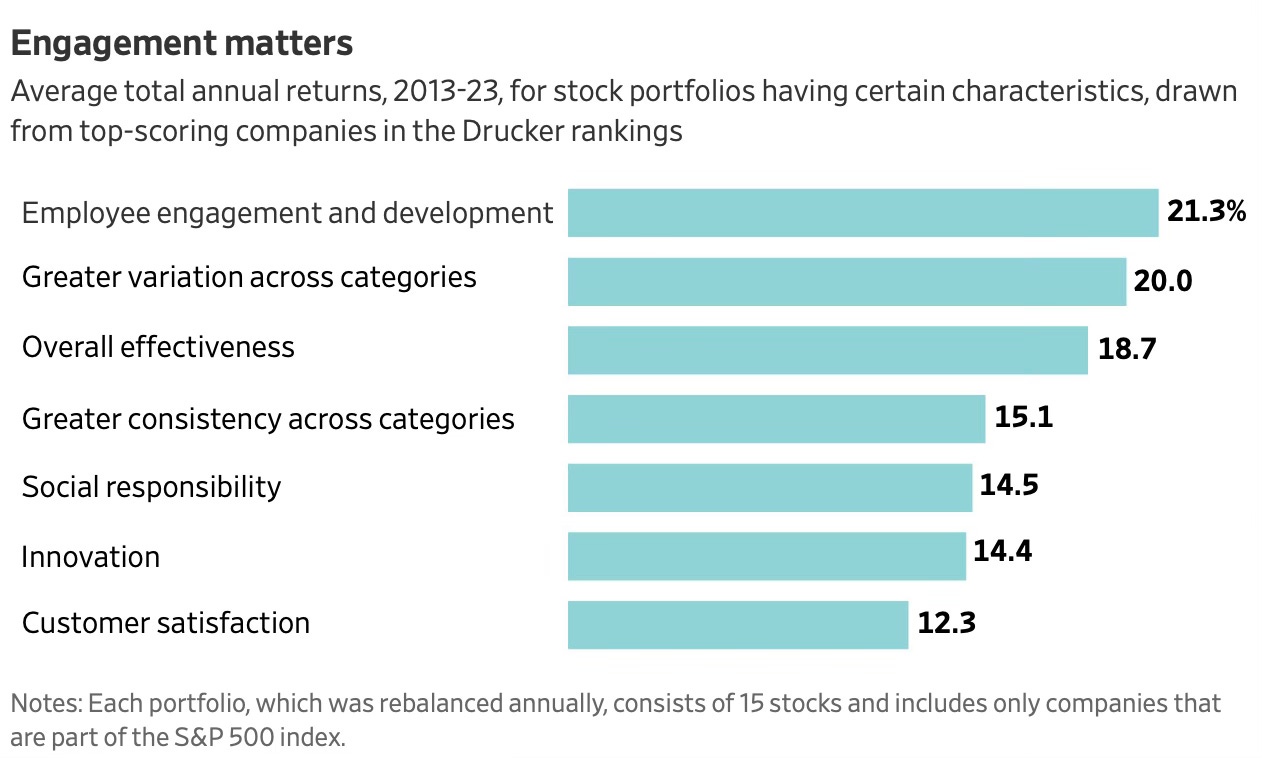
Combination of engagement, innovation, and execution lead organizational value creation
Companies strategically emphasizing employee engagement outperform their peers, with University of Bern research revealing firms ranking highest in workforce development generated 21.3% annual returns over 11 years—exceeding both market averages and organizations with more balanced performance profiles. This finding contradicts conventional wisdom about balanced stakeholder management, instead supporting Peter Drucker's principle that organizations must strategically "pick their spots" while maintaining minimum thresholds across all dimensions.
What’s Next: The idea of setting hard minimum standards and clearly designating core areas of competitive awesomeness resonated with me, especially as executives’ to-do lists stretch much faster than time or energy.
When in doubt, communicate
In an increasingly volatile economic/market/regulatory/technological period, proactive communication with employees is an easy opportunity to boost engagement —even when there's no substantive news to share. While effective leaders avoid short-term distractions, they also address the “fog” head on when distractions undermine employee confidence and morale. Rather than allowing this uncertainty to fester, top executives are leveling with their people on the risk of new tech, the likelihood of layoffs, and the potential effects, or lack thereof, of regulatory change.
What’s Next: Across all polling and metrics, employees are scared: AI, a weakening economy, and a generally dizzying pace of change. A simple email from you has high return on your time in terms of clarity, confidence, and ultimately engagement.
As skill obsolescence accelerates, “train don’t buy”
The economics of AI talent acquisition have reached an unsustainable tipping point, with 75% of hiring managers admitting they're recruiting AI specialists too hastily without building sustainable talent pipelines, while 68% report paying significant salary premiums during negotiations with these in-demand candidates.
“Many organizations are transforming their capabilities so rapidly that they can’t acquire all the skills they need.” — Gartner
Despite this clear market imbalance, only 27% of organizations are prioritizing internal upskilling—a figure unchanged since 2023. With technical skills becoming outdated in around 2 years, strategic investment in developing existing talent has a higher ROI than premium-priced external recruitment
What’s Next: We’ve said it before, but learning and development is a key piece of organizational infrastructure. The AI applications available don’t need computer scientists, they need critical thinkers that have exposure to playing, learning, and applying new tools in real organizational contexts.
Data Point:
3.1%
The decline in increased wages from job switching, with job movers only increasing their wages by 4.6% in January and February, far lower than the 7.7% bump they could receive in early 2023.
In Other News:
The conventional wisdom is that you want a boss who is decisive and resolute about the path forward. But that has it backward. (Wall Street Journal)
Employment for computer programmers in the U.S. has plummeted to its lowest level since 1980—years before the internet existed. (Fortune)
In a survey of 1,400 U.S. workers, 79% told Monster their role didn’t live up to the description provided by a recruiter or hiring manager. (HR Dive)
Record number of Americans working more than one job. (The Hill)
‘People are really angry’: A vibe shift around layoffs is happening across the workforce. (CNBC)
When it comes to tech and showing business value, today’s CHROs should check with yesterday’s CMOs. (Fast Company)
UBS follows Deutsche Bank by banning staff from working remotely on both Friday and Monday. (Fortune)
Quiet Quitting Is Out. Now Gen Z Is Revenge Quitting. (Vice)