

Welcome back to Human Capital Intelligence! Your go-to source to keep up with the best insights from over 250 leadership, HR, and people sources. As always, we would love to hear from you at ken@reyvism.com with questions you’d like answered or topics covered.
Sent this by a friend? Sign up here to receive HCI in your inbox every week.
By Ken Stibler; Powered by Reyvism Analytics
How to Lead Through Fear
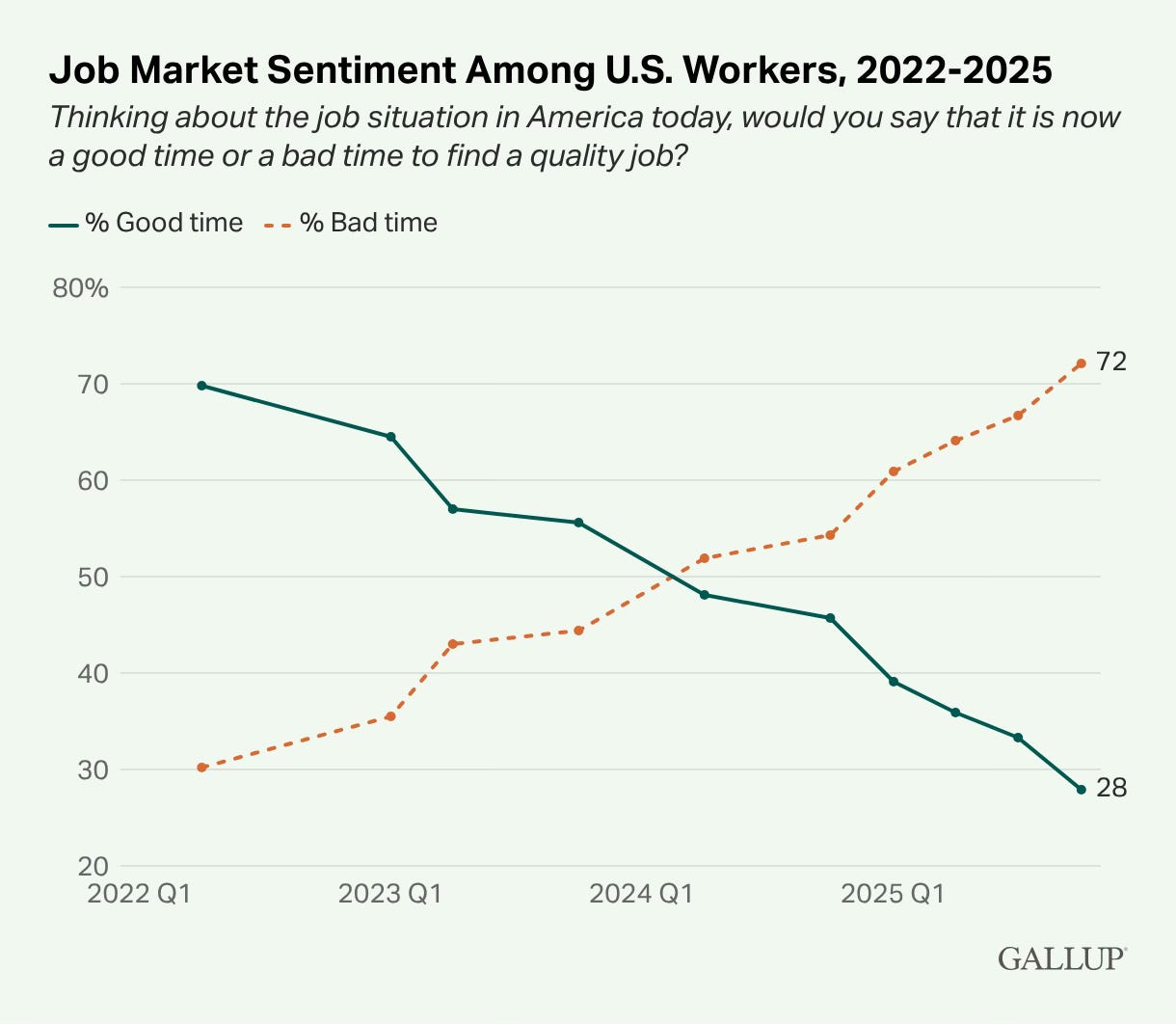
Your employees are terrified. The data is unambiguous: for the first time, more U.S. workers are struggling than thriving, according to Gallup’s Q4 2025 survey. Worker engagement is at a decade low, and just 28% of workers say now is a good time to find a quality job, down from 70% in mid-2022. Globally, only 22% of workers feel their job is safe from elimination, per ADP’s survey of 39,000 workers. The workforce is restless but stuck, a combination that creates quiet deterioration.
An example: 30-year-old CEO of $11 billion Harvey earned the backing of OpenAI and Sam Altman. He says you have to ‘re-earn’ your role every 6 months. (Fortune)
When workers cannot leave, discontent accumulates. The most engaged employees leave first. The ones who stay are increasingly those who feel they have no choice. Gallup finds that workers who are not thriving miss 53% more days due to health problems and are 32% more likely to be actively job seeking.
Leaders who treat this fear as information will win. It is a signal about clarity and fairness. The data shows that workers who feel secure are more productive and engaged. Creating that security, where warranted, costs almost nothing. Communicating it clearly costs even less. The organizations that do this well will find themselves with a captive audience that is actually paying attention.
Protecting your top performers
In an environment of widespread cost-cutting, leaders think they are protecting their top performers. The data shows the opposite is happening. The employees who drive the most value are the most exposed when development budgets are slashed, a mistake that costs organizations a 36% drag on share price growth over two years.
The mechanism is simple: top performers are the first to feel the loss of growth opportunities and the most likely to burn out from new administrative burdens. Protecting them is not about retention bonuses; it is about protecting the conditions under which they do their best work.
Quote of the Week: Work itself is changing
"57% of U.S. work hours are now automatable using technology that already exists today. Two years ago, that number was 30%. The gap is no longer about technology. It's about knowing where and how to start."
—McKinsey Global Institute, November 2025
Reading List:
White collar employees increasingly getting pay cuts
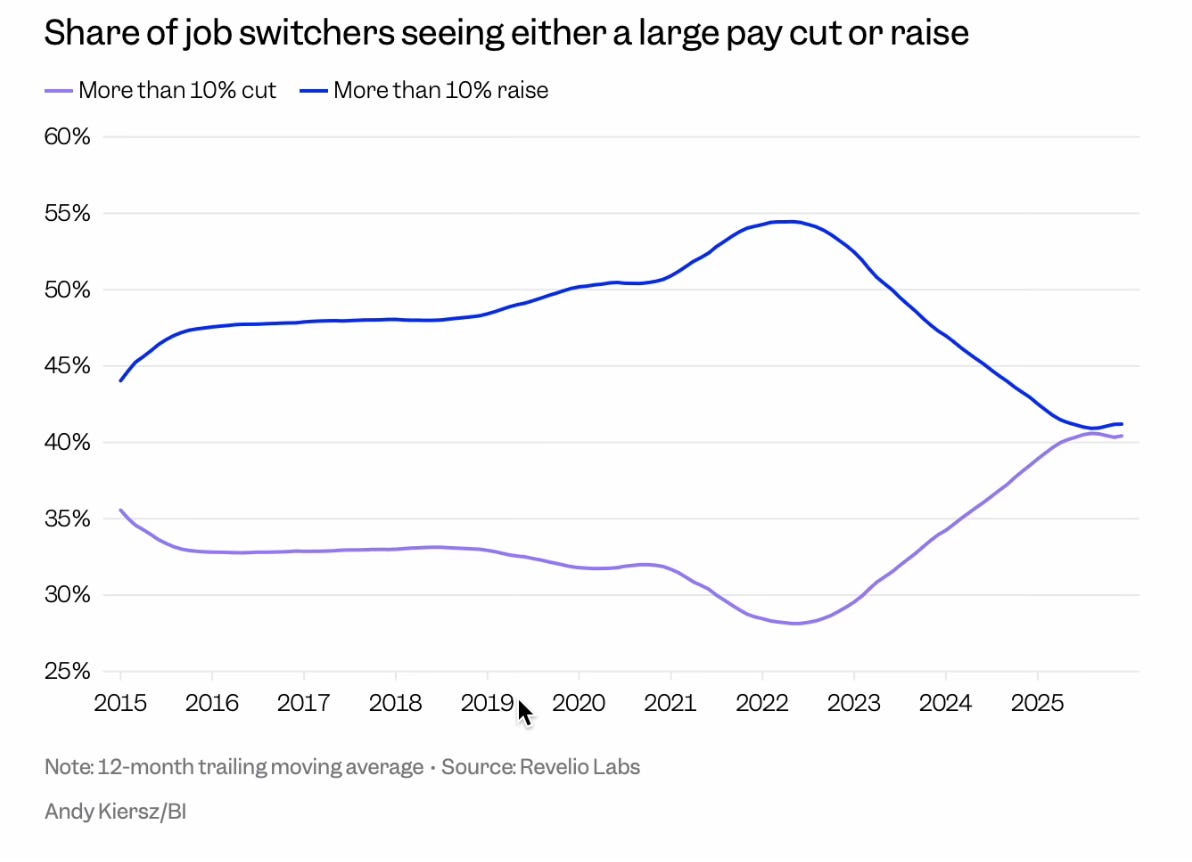
Among white-collar workers who changed jobs at the end of last year, 40% took salary cuts of more than 10%, the highest share in a decade, per Revelio Labs. With long-term unemployment nearly doubling in three years, employers are requiring more experience for open roles. For workers who accept a pay cut, the consequences compound, as future raises and offers are anchored to a lower base.
Performance reviews are shifting from awkward ritual to continuous conversation
Deloitte eliminated annual appraisals a decade ago, saving two million hours annually. Yet a Gallup poll finds 56% of employees still get a formal review once a year or less, and only 2% of CHROs say their systems work. The gap between research and reality is a change management problem, and it is costing organizations the engagement of their best people.
Why are we so relieved when meetings cancel?
A Rutgers University study finds that unexpectedly gaining time alters our perception of how that time passes, leading people to choose longer, more ambitious activities. The finding has a practical implication for leaders: over-scheduled teams are less capable of the deep, intentional work that moves the needle. Looks like the humble calendar is actually a leadership tool.
Data Point:
22%
The number of US employees that feel safe from layoffs, lower than Egypt, Nigeria, and most of the developing world according to an ADP survey of 39,000 workers across 36 markets.
In Other News
Toxic managers dehumanize employees, leading to extreme burnout. (HR Dive)
JPMorgan monitoring keystrokes and video calls of junior bankers. (Fortune)
Leaders report a ‘growing gap’ between what’s expected of them and the support they receive. (HR Dive)
How compensation teams can become strategic finance partners. (HR Dive)
Highly skilled workers have been training AI — that comes at a cost. (Financial Times)