

Welcome back to Human Capital Intelligence! Welcome to your go to 2026 source to keep up with the best insights from over 250 leadership, HR, and people sources. As always, we would love to hear from you at ken@reyvism.com with questions you’d like answered or topics covered.
Sent this by a friend? Sign up here to receive HCI in your inbox every week.
By Ken Stibler; Powered by Reyvism Analytics
We’re talking about AI…because work is now tools + people

Many of our readers are in the middle market, where AI is an idea, a promise, or a nuisance more than a reality. And yet… the most seductive narrative in American work culture right now isn’t that AI will take your job. It’s that AI will save you from it. That’s the version the industry has spent the last three years selling to millions of nervous people who are eager to buy it.
A new study published in Harvard Business Review follows that argument to its actual conclusion, and what it finds that AI supercharges the intensity of work, rather than reducing it.
In companies with strong AI adoption, nobody was told to hit new targets, people just started doing more because the tools made more feel doable. But because they could do these things, work began bleeding into lunch breaks and late evenings. The employees’ to-do lists expanded to fill every hour that AI freed up, and then kept going.
The CEO takeaway: your best people are at the highest risk. The research shows that the first signs of burnout are coming from the people who embrace AI the most. The productivity gains are real, but the company captures them, not the employee, breeding resentment.
This a utilization problem. You’re burning out your most valuable asset—human judgment—on low-value review tasks. The companies that get this right will not be the ones with the most tools. They will be the ones that figured out how to make people and tools work together without burning both out.
Critical markets are rapidly breaking down, that’s a leadership problem
We hate saying things that make it feel like there’s more on the to do list. But in this case, three markets that every business depends on are deteriorating at the same time. Digital attention costs are soaring as platform saturation drives down engagement and drives up CPM.
Cost-per-hire climbed sharply in 2025 despite 1.8 million Americans searching for jobs for over 6 months and AI-d applications flood job platforms. Meanwhile, 74% of employers now call pharmacy costs unsustainable, with GLP-1 drugs alone reshaping benefits strategy from an HR decision into a board-level conversation.
Treating these as separate functional problems—a marketing problem, an HR problem, a finance problem—is the mistake. The rising costs and declining effectiveness across these domains demand a unified strategic response. The CEO takeaway: every dollar spent on employee retention is also a marketing dollar.
Every decision about benefits is also a decision about your cost of talent acquisition. Leaders who continue to manage these in silos are being be picked apart by converging crises, while those who see the connections and make the trade-offs will build a structural advantage their competitors won’t understand, and can’t, replicate.
Quote of the Week: Low hire, low dynamism
“The fact that it is low-hire, low-fire is actually not a great state to be in. The churn is important to the productivity growth.
You want to see the most talented go to the places where that talent is the most rewarded. And if we are in this really stable period, that means that talent is not being repositioned to its best use.”
— Nela Richardson, chief economist at ADP
Reading List:
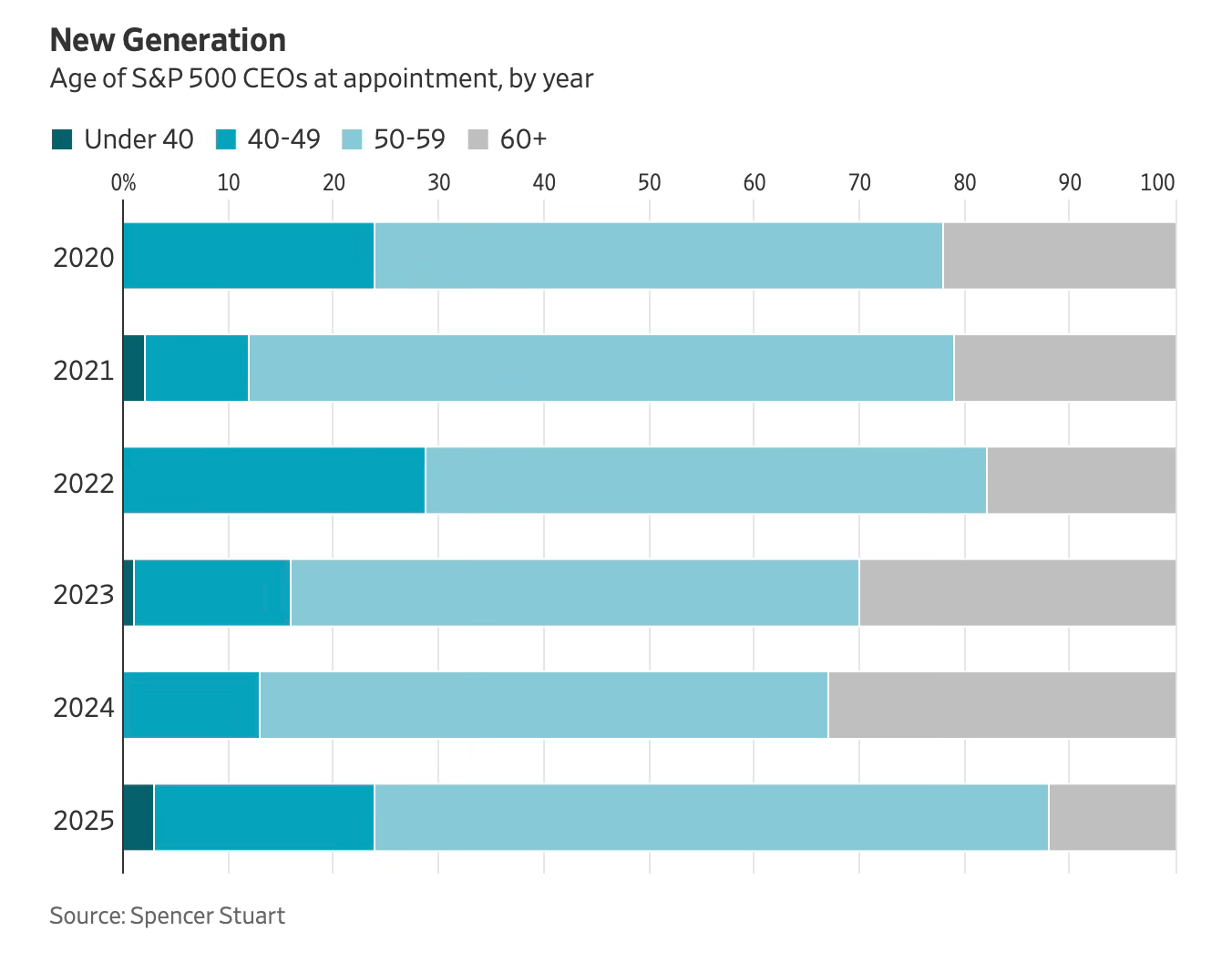
CFO turnover reaches new high as flux extends across the C-Suite
CFO turnover hit a seven-year high last year, with one in nine CEOs at top public companies also being replaced. The churn is being driven by a combination of burnout, heavier workloads, and the need for a different kind of leader in a rapidly changing world. Boards are more impatient, and the playbooks of the past no longer apply. The new class of leaders is younger and less experienced, a sign that companies are prioritizing adaptability over tenure. The message is clear: the C-suite is in flux, and the pressure to perform has never been higher.
A white-collar labor shortage is quietly brewing
Headlines are sending high schoolers away from college on mass, with computer science enrollment plummeting and 60% of Gen Z reportedly pursuing skilled trade work. As white-collar workers contemplate a future where their skills are devalued, many are looking to trades that can’t be automated. This migration is overdue but could potentially create gaps in some area of white collar talent like finance and data analysis.
Nobody is prepared for retirement, here’s how to make that work for you
Americans aren’t ready for retirement. The average person thinks they need $2.1 million to retire comfortably, but 62% have less than $150,000 saved. As Gen X, the first generation primarily dependent on 401(k)s, begins to retire, the crisis will only get “harder and nastier.” For employers, this presents both a challenge and an opportunity. With so many people unprepared for retirement, there is a growing pool of experienced workers who are willing and able to keep working.
Data Point: HR turns to AI
82%
The percentage of HR leaders who say they’re comfortable using AI to perform some parts of their jobs, according to the Hartford Business Journal.
In Other News
Why the Smartest Leaders Respond to Crisis By Saying Less. (Entrepreneur)
JPMorgan analysis finds Trump’s tariffs are working on China—at a huge cost to American small business. (Fortune)
People Trust Websites More When They Know a Human Is on Standby. (Wall Street Journal)
What CEOs Mean When They Say Leading Is Complex. (WSJ/Mercer)
The U.S. spent $30 billion to ditch textbooks for laptops and tablets: The result is the first generation less cognitively capable than their parents. (Fortune)
SHRM: Demand for HR workers is down amid AI adoption. (HR Dive)