

Welcome to the latest edition of Human Capital Intelligence, your weekly brief synthesizing over 250 leadership, HR, and people sources to filter out the noise. As always, we would love to hear from you at ken@reyvism.com with questions you’d like answered or topics covered.
Sent this by a friend? Sign up here to receive HCI in your inbox every week.
By Ken Stibler; Powered by Reyvism Analytics
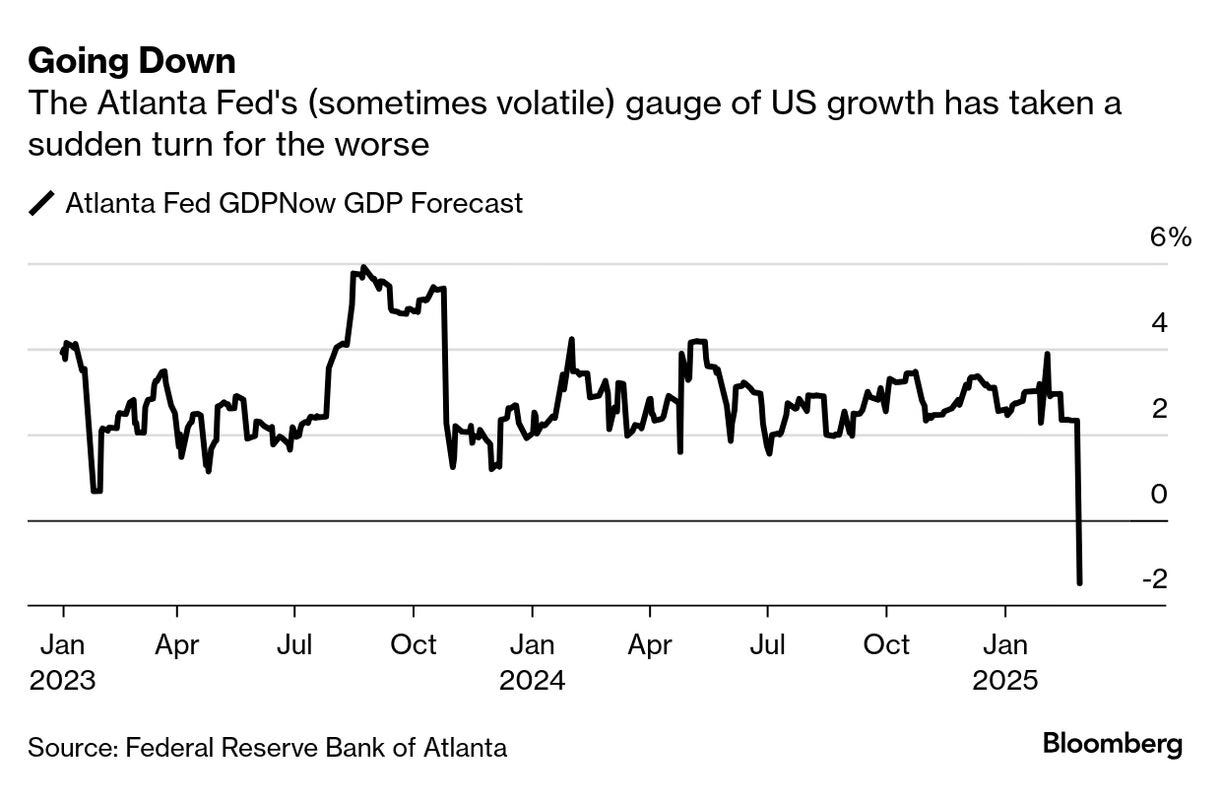
Get ready for the economy to look, and feel, bad
The Atlanta Federal Reserve's dramatic forecast revision—from 2.3% GDP growth to a 1.5% contraction in just nine days—signals an abrupt economic deterioration as government spending cuts ripple through critical sectors. Maryland's private contractors have already announced over 1,250 layoffs following Trump administration budget slashes, while unemployment claims from federal employees nearly tripled last week to 1,624 nationwide. This rapid contraction in government spending, which accounted for one-tenth of Maryland's GDP in 2022, threatens to cascade through regional economies dependent on federal contracts.
Business leaders who initially championed Trump's return are now expressing mounting anxiety over his administration's erratic policy implementation. "Everybody's paralyzed," laments Nasdaq Private Market CEO Tom Callahan, while tech CEO Hassane El-Khoury questions basic strategic decisions: "Are we going to grow the business? Well, I don't know. Are there tariffs or not?" The U.S. stock market now lags behind major indexes in Europe, China, Mexico, and Canada—all targets of Trump's expanding tariff threats—while consumer confidence recorded its largest one-month decline since November 2023.
The industrial sector faces particularly acute challenges as Trump's proposed 25% tariffs on steel and aluminum imports and general tariffs on Mexico and Canada set to deliver a serious blow to most companies which deal in physical goods.
“If your company isn’t planning mass layoffs, communicate that.”
— Julia Toothacre, chief career strategist at Resume Templates
In turn, worker anxiety is spreading rapidly, with nearly half of employees surveyed by Resume Templates expressing fear that Trump's policies will trigger layoffs at their companies. Respondents identified three primary concerns: tariffs and trade disruptions (59%), cuts to government contracts (55%), and immigration policy changes (39%). The uncertainty is particularly pronounced in accounting, education, and information technology sectors, leading career strategists to advise employers: "If your company isn't planning mass layoffs, communicate that. Transparency and honesty are the best strategies for leaders right now. People need to know their jobs are safe."
What’s Next: With tariffs going into effect today, the political uncertainty is now turning into policy risks to employment levels (consumer demand), corporate spending plans (B2B demand), and rising input costs. With external uncertainty bleeding into worker anxiety, it’s worth it to understand and clearly communicate any the impacts on your business.
Now or later, upskilling is a strategic issue
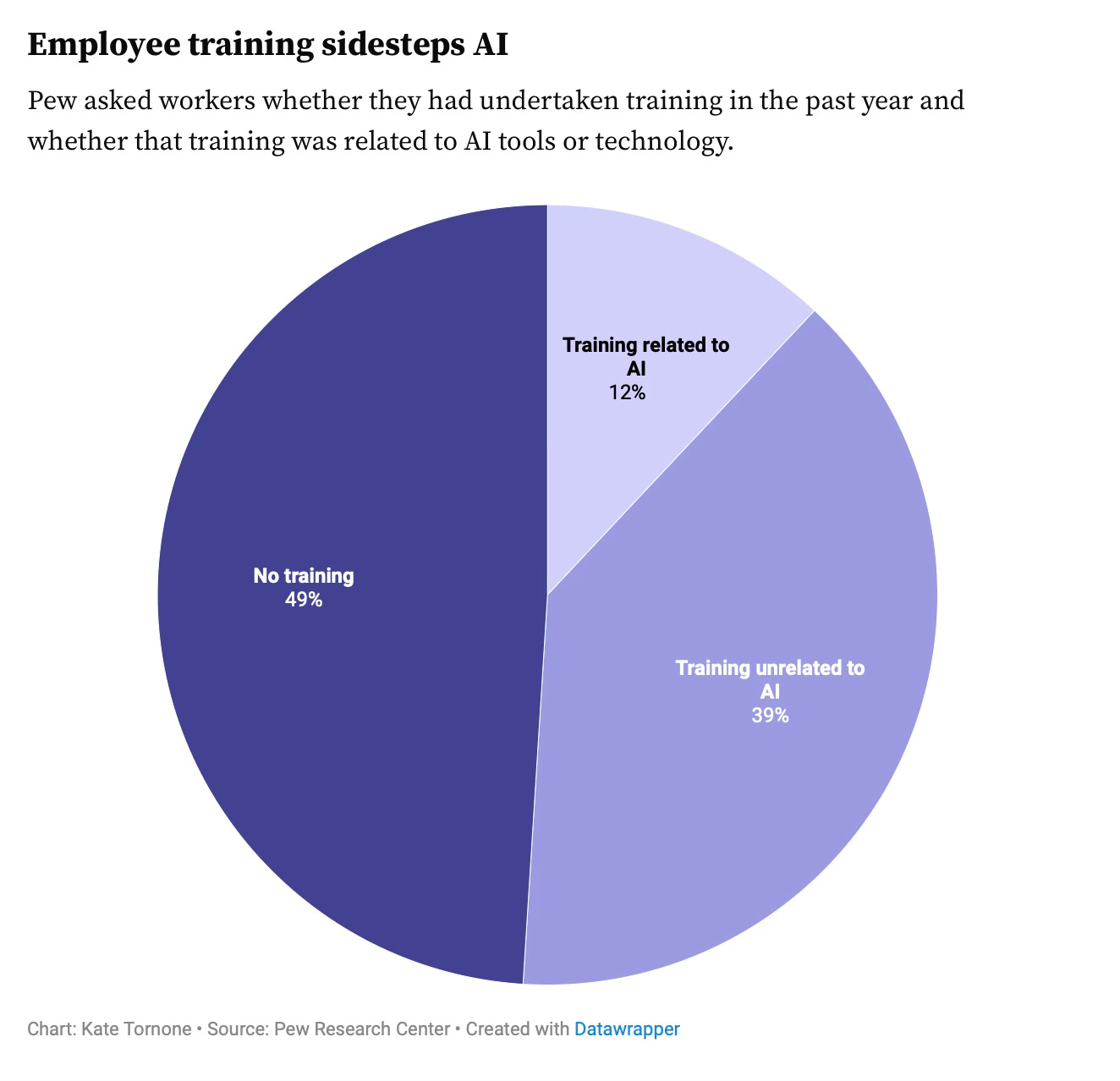
Despite half of workers receiving job training last year, just 12.2% learned functional AI skills—a glaring gap as automation transforms industries, Pew Research reveals. The disconnect is worsened by terminology sensitivities, with employees often interpreting "upskilling" and "reskilling" as criticism rather than opportunity, hamstringing adoption efforts at the exact moment they're most needed.
Top-performing S&P 500 companies generate 300% more revenue per employee by treating talent management with the same rigor as financial capital, McKinsey reports. This strategic workforce planning approach becomes crucial as generative AI threatens to replace 30% of current worked hours by 2030, requiring organizations to proactively identify capability gaps before they materialize.
Market leaders are implementing five best practices: 1. aligning talent investments with financial ones; 2. measuring both capacity and capabilities; 3. planning for multiple talent scenarios; 4. innovating talent acquisition approaches; and 5. embedding workforce planning into operations. Rather than defaulting to expensive external hiring, successful companies are strategically balancing internal redeployment, targeted upskilling initiatives, and selective recruitment—a strategy that proved essential when one telecommunications company pivoted from external hiring to internal development.
What’s Next: As said previously, the people function is now a long-term keeper of strategy, tech, institutional knowledge, and organizational adaptation. It’s time to bring plain old operational HR into the strategic fold.
New TikTok Term: ‘Task Masking’
“Task-masking” is a quickly spreading trend where workers film themselves giving a performance of busyness on the job — some type furiously loud or make frustrated noises at their computer screens, while others walk fast around the office.
One user’s clip shows his go-to activities to pretend to be busy at work — including flipping through a notebook from the first page to the last pretending to look for an important page of notes.
Reading List:
Far from hustling, employees are detached, defeated, and eying the exit
A JPMorgan Chase executive demanded "more hustle and scrappiness" from 25,000 employees just days after CEO Jamie Dimon dismissed staff resistance to the bank's five-day return-to-office mandate. Yet far from hustling, employees are more detached than ever. Defeat permeates the workforce mindset, with ADP reporting 58% of employees now classify as "rattled"—up from 54% last year—characterized by workers who have simply accepted that "their job is a job" that merely pays bills.
How T.J. Maxx’s parent company became a retail juggernaut thanks to good corporate governance and a no-frills culture. (Fortune)
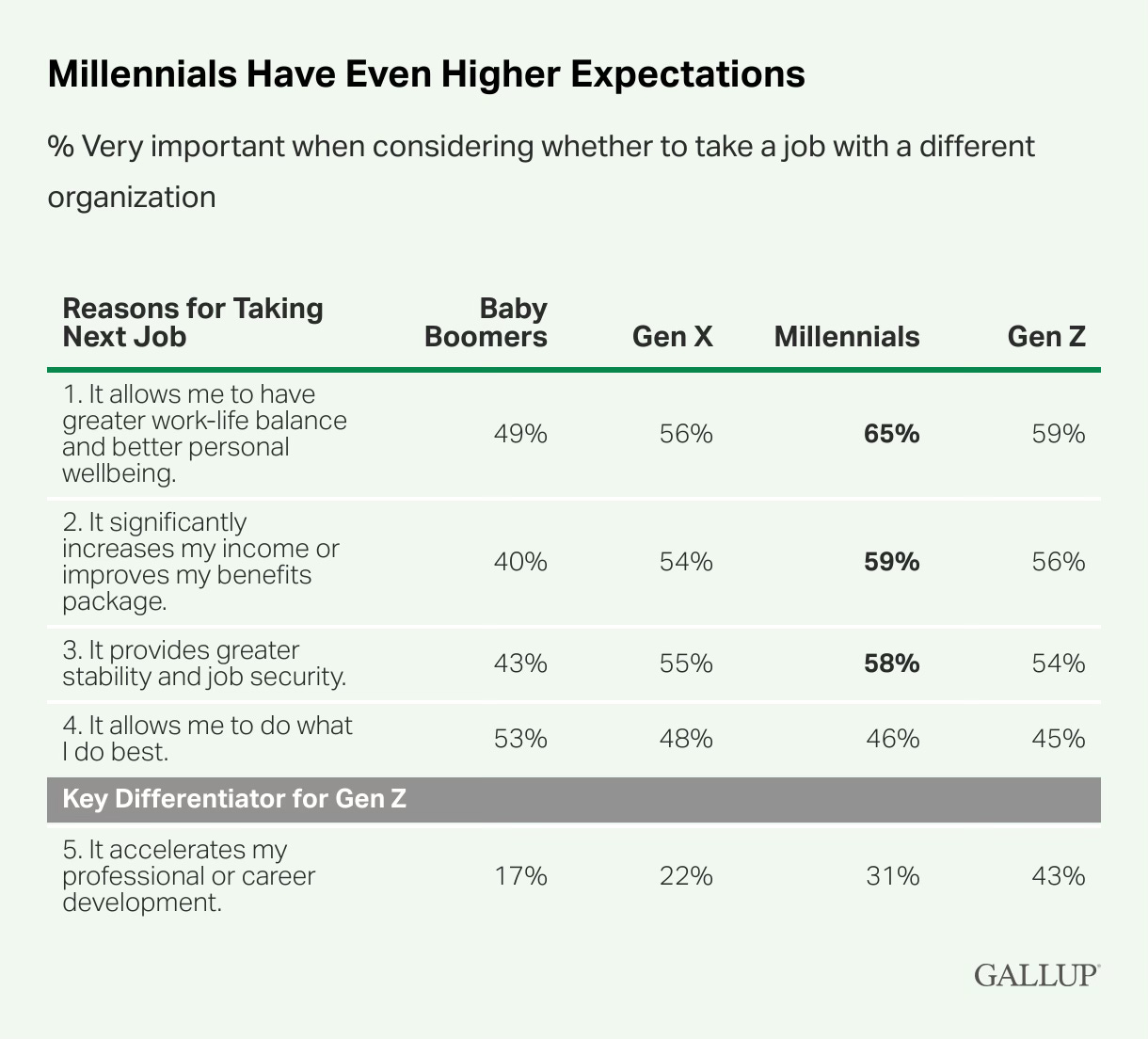
Meanwhile, the exit doors are spinning, with 51% of employees actively exploring new opportunities amid historic low satisfaction levels in Gallup's "Great Detachment" era. This exodus mentality comes as one-third of Americans report layoff anxiety for 2025, with workers prioritizing work-life balance, competitive compensation, job security, and role alignment—creating a paradox where 69% now value job security over career advancement yet remain ready to leave organizations where just one in five believe their employer genuinely cares about their wellbeing.
What’s Next: Like yelling at an employee who is already rattled, demanding hustle from burned-out and disengaged employees only serves to make the underlying problem worse. Engagement isn’t easy but it can be simple, starting with straightforward conversations about expectations and a clear strategy.
Job postings become a bad metric as investor attention raises the incentive to lie
Wall Street's dual pressure for cost-cutting and growth has corrupted hiring metrics, with 40% of companies now admitting to posting fake job listings, while 30% maintain phantom openings solely to project expansion to investors and employees. This deception extends to investment announcements, illustrated by Apple's recent $500 billion spending pledge that analysis reveals merely aligns with existing spending. Columbia professor Daniel Keum estimates 80% of such corporate announcements simply "repurpose existing investments," creating a market where qualified candidates encounter silence from employers listing jobs they never intend to fill.
What’s Next: As the labor market looks set to melt down, and the temptation to use job postings as a show of strength rises, ignore the temptation to do this. Fake job postings erode employee trust and can damage the perceptions of potential applicants (who could be tomorrow’s purchaser or partner).
For more companies, the next CEO hire will be external
External CEO appointments have hit a record level, with 44% of new S&P 1500 chief executives now coming from outside the organization — a 12% increase from 2023. The shift reflects boards' growing preference for leaders who can objectively navigate transformation without emotional ties to past decisions amid business uncertainty, particularly in rapidly evolving sectors like healthcare, technology, and consumer goods. Meanwhile, stability-focused industries like financial services continue to favor internal promotions.
What’s Next: While external leaders offer a fresh break, shifting fully away from internal hires entirely delays career advancement for hungry employees and spurs the most productive employees (who will always be in demand) to look elsewhere.
Data Point:
$1,500
The average American companies spent per employee on training in 2024
In Other News:
Warren Buffett warns bosses of the ‘cardinal sin’ of leadership - delaying the uncomfortable correction of mistakes. (Fortune)
What Will AI Do to Your Job? Take a Look at What It’s Already Doing to Coders. (Wall Street Journal)
Job seekers started 2025 with optimism, despite low turnover and stagnant openings. (HR Dive)
Three Ways to Batten Down Executives’ Personal Digital Lives: Holes in home Wi-Fi, kids oversharing online and other missteps give hackers a doorway to corporate networks. (WSJ Pro Cybersecurity)
How are C-suites reacting to Trump’s DEI orders? Most are in a holding pattern, a Littler survey showed — but certain initiatives may be on the chopping block. (HR Dive)
Burden of proof for ‘reverse discrimination’ lowered by the Supreme Court. (HR Dive)
Workplace chat's future: more AI agents, fewer humans. (Axios)
Gen Z isn’t quiet quitting. They’re rejecting outdated leadership: Why companies that fail to evolve will lose an entire generation of talent. (Fast Company)