

Welcome back to Human Capital Intelligence! Your go-to source to keep up with the best insights from over 250 leadership, HR, and people sources. As always, we would love to hear from you at ken@reyvism.com with questions you’d like answered or topics covered.
Sent this by a friend? Sign up here to receive HCI in your inbox every week.
By Ken Stibler; Powered by Reyvism Analytics
The value of clarity and empathy are surging

The premium on basic human connection is rising exactly as fast as the technology meant to replace it. While leaders obsess over AI integration, Gallup’s latest data shows that the workforce is quietly checking out.
There are 3.2 million fewer engaged workers today than there were in 2023. The root cause is a profound sense of disconnection. In 2020, 54% of Millennial and Gen-Z employees felt someone cared about them at work. Today, that number is 41%. The organizations winning right now are the ones treating empathy as a hard operational requirement.
The mechanism for delivering that empathy is what researchers call attunement. A new study by found that leaders who practice four specific skills (flexibility, reading nonverbal cues, self-regulation, and collaboration) see measurable jumps in team cohesion and psychological safety.
Flexibility means asking what a team needs rather than assuming. Reading cues means paying attention to the silence on a Zoom call. Self-regulation means managing your own stress so you do not transfer it to your direct reports.
But empathy without clarity is just sympathy. When performance criteria are vague, trust erodes and stress spikes. McLean & Co found that employees who clearly understand their job expectations are 8.6 times more likely to be engaged.
Organizations that fail to provide this clarity see voluntary turnover rates 40% higher than those that do. The mandate for HR and senior leadership is clear: before you ask your teams to adapt to the next technological shift, you have to ensure they actually understand how they are being measured today.
Younger employees are sabotaging AI adoption efforts
The biggest threat to your technology strategy is coming from the demographic you assumed would champion it. A new report from Writer and Workplace Intelligence found that 29% of knowledge workers admit to actively sabotaging their company’s AI rollout.
Among Gen Z workers, the number jumps to 44%. The sabotage is not subtle. Employees are entering proprietary information into public AI tools, refusing to use approved platforms, tampering with performance reviews, and intentionally generating low-quality work to make the technology look bad.
They are doing this because they are terrified. Nearly a third of those sabotaging the tools cited fear that AI would take their jobs. But the resistance is a strategic error. Sixty percent of executives say they are considering cutting employees who refuse to adopt AI, and 77% say those who refuse to become proficient will not be considered for promotions.
The divide is already showing up in the data: AI “super-users” are three times more likely to have received a promotion and pay raise in the past year. The challenge for leaders is not buying better tools. It is convincing a fearful workforce that using the tools is the only way to stay employed.
Quote of the Week:
"The leaders who are putting in the work to radically redesign operations with human-agent collaboration at the center are the ones compounding their advantage in ways competitors can't replicate."
— May Habib, CEO of Writer
Reading List:
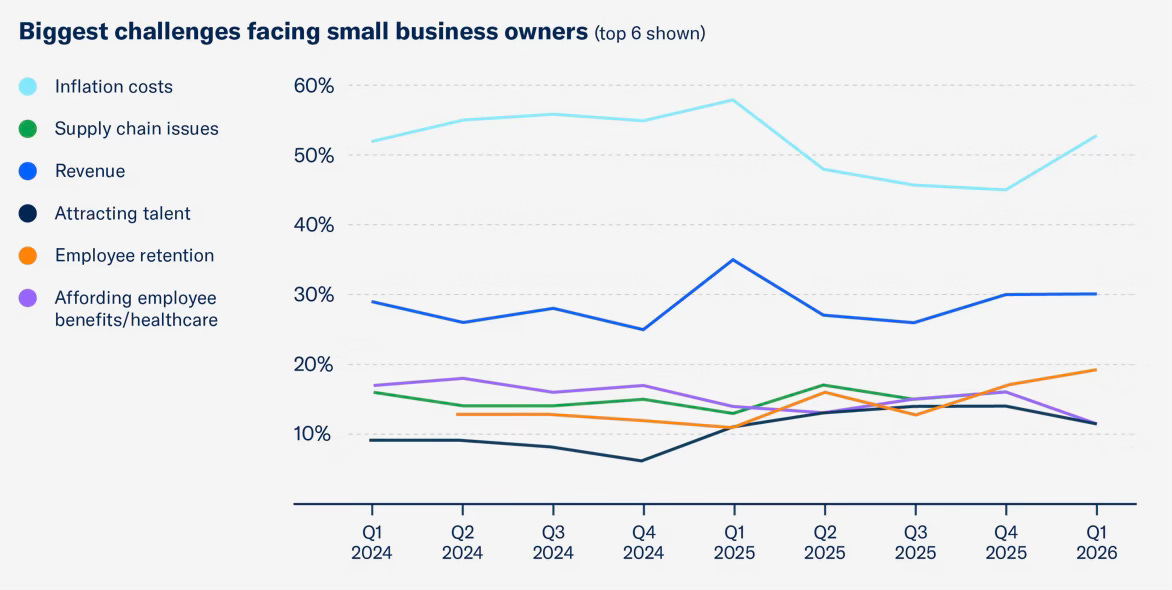
Macro fears lead small business to cut back on hiring
The latest U.S. Chamber of Commerce Small Business Index shows a sharp decline in optimism on the economy, investment, and hiring. While 69% of small business owners rate their own business as being in good health, only 28% say the U.S. economy is in good health. Consequently, just 30% expect to increase staff in the year ahead, a 12-point drop from the previous quarter. Inflation remains the top concern for the 17th consecutive quarter.
Middle management is undergoing an identity shift
Large companies are redefining middle management roles and handing off work to AI. Large companies are shifting from manager titles to “org leads” and “player-coaches" who build alongside their teams. Employers advertised 12.3% fewer middle-manager jobs in 2025 than in 2024. While fully offloading management to AI is impractical, the shift toward smaller, cross-functional teams with AI support is accelerating.
Companies increasingly turn to “in office trials” in interviews
Hiring managers increasingly are expecting candidates to show their live work. Companies are using work trials, job simulations, and live tests to evaluate candidates. Startups like Rounds use AI agents to conduct technical simulations, while others pay candidates to work in the office for a few days. The goal is to see how candidates think, adapt, and use AI tools to accelerate their work.
Data Point
In Other News
Why More People Are Dropping Out of the Job Market. (Wall Street Journal)
US workers increasingly trapped in the ‘Great Detachment’ as hiring slows, report shows. (Fox Business)
US workers are quitting at the lowest level in a decade. (HR Dive)
Nearly half of American households have no retirement savings: In 2022, 46% of households reported retirement savings, with 26% above $100K and 9% over $500K. (USA Facts)
AI may threaten critical thinking in the workplace. (HR Dive)
You’re looking at the AI revolution all wrong, top economist says: 40% unemployment and a 3-day work week are the same thing. (Fortune)