

Welcome back to Human Capital Intelligence! Your go-to source to keep up with the best insights from over 250 leadership, HR, and people sources. As always, we would love to hear from you at ken@reyvism.com with questions you’d like answered or topics covered.
Sent this by a friend? Sign up here to receive HCI in your inbox every week.
By Ken Stibler; Powered by Reyvism Analytics
AI is now a frontline issue for most businesses. Here are the best practices for adoption.

American executives are all in on AI as the future of work…in Mark Zuckerberg’s case a bit too much (readers, please don’t create an AI avatar of yourself to manage employees). Despite AI’s return on investment lagging the promise, 92% of executives say AI makes them more productive.
Outside of the C-Suite, people are less convinced. 40% of non-managers say it saves them no time at all and around half of individual contributors are actively opposed. That gap has become a management crisis. Four in ten executives are boosting AI spending this year, making it their top strategic response to global disruption.
Meanwhile, 80% of enterprise workers are avoiding or rejecting the tools being deployed, 29% admit to actively sabotaging their company’s AI strategy, and a new phenomenon called “workslop,” AI-generated output so flawed it creates more work than it saves, is costing organizations an estimated $8.1 million per 10,000 employees.
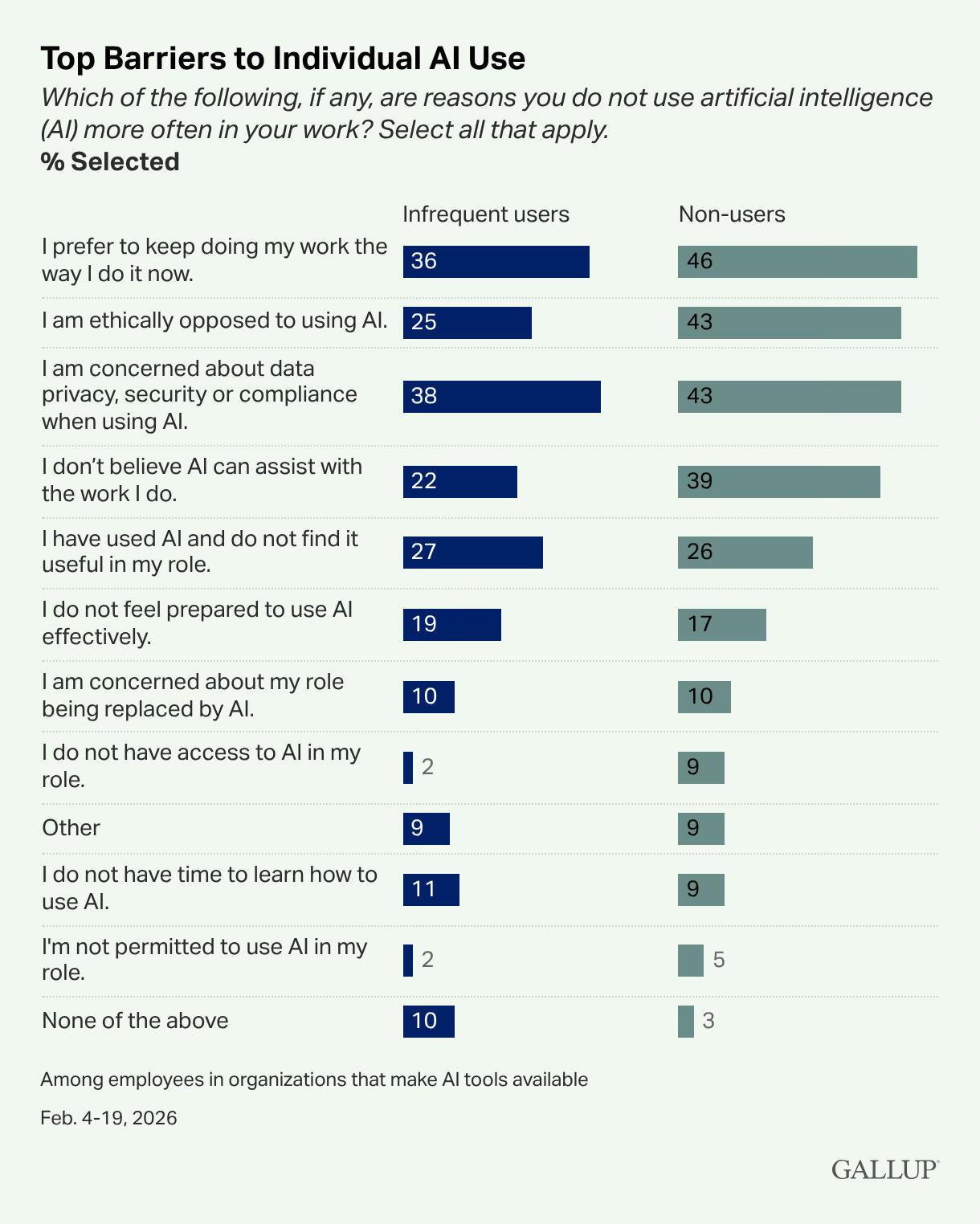
The generational fault lines are widening it. Among Gen Z workers, 44% have sabotaged their company’s AI rollout in some way, driven by fear of job loss and frustration that the technology diminishes their value. Their anxiety is not unfounded: 60% of C-suite executives say they plan to lay off employees who cannot or will not use AI.
The organizations breaking through share three common practices.
Leadership clarity: Intuit overcame its engineering holdouts by setting transparent expectations, modeling AI use at the executive level, and creating listening posts to surface concerns.
Manager support: Gallup data shows employees whose managers actively champion AI are nearly twice as likely to use it frequently.
Protected time to build judgment: Infosys begins reskilling its 300,000 employees by banning AI tools for the first months of training, ensuring workers develop foundational thinking before the technology accelerates it.
Leadership for the speed of today’s challenges
Ask former Navy SEAL Rich Diviney to draw a high-performing team and he will not draw a pyramid. He will draw a blob. In his dynamic subordination model of leadership, the person closest to the problem and most competent steps up and leads. The leader is wherever the leader needs to be.
This is becoming a structural necessity as AI compresses five-year goals into six-month sprints. Gusto CEO Josh Reeves is building autonomous agents that will soon file taxes and set up retirement accounts for small businesses. Managing that velocity requires teams that move like special operations units, a point echoed by Jamie Dimon in his recent shareholder letter.
The new contours of leadership require understanding the attributes of your people, adaptability, persistence, judgment, and putting the right person at the wheel when the terrain demands it.
Quote of the Week:
The way CEOs are using AI today follows a clear pattern. Most rely on it for familiar, tactical tasks like research, summarizing information, writing, and day-to-day communication. Far fewer leaders are tapping AI as a strategic partner.
— Joe Galvin, Chief Research Officer of Vistage
Reading List:
Five ways to bridge the CEO trust gap
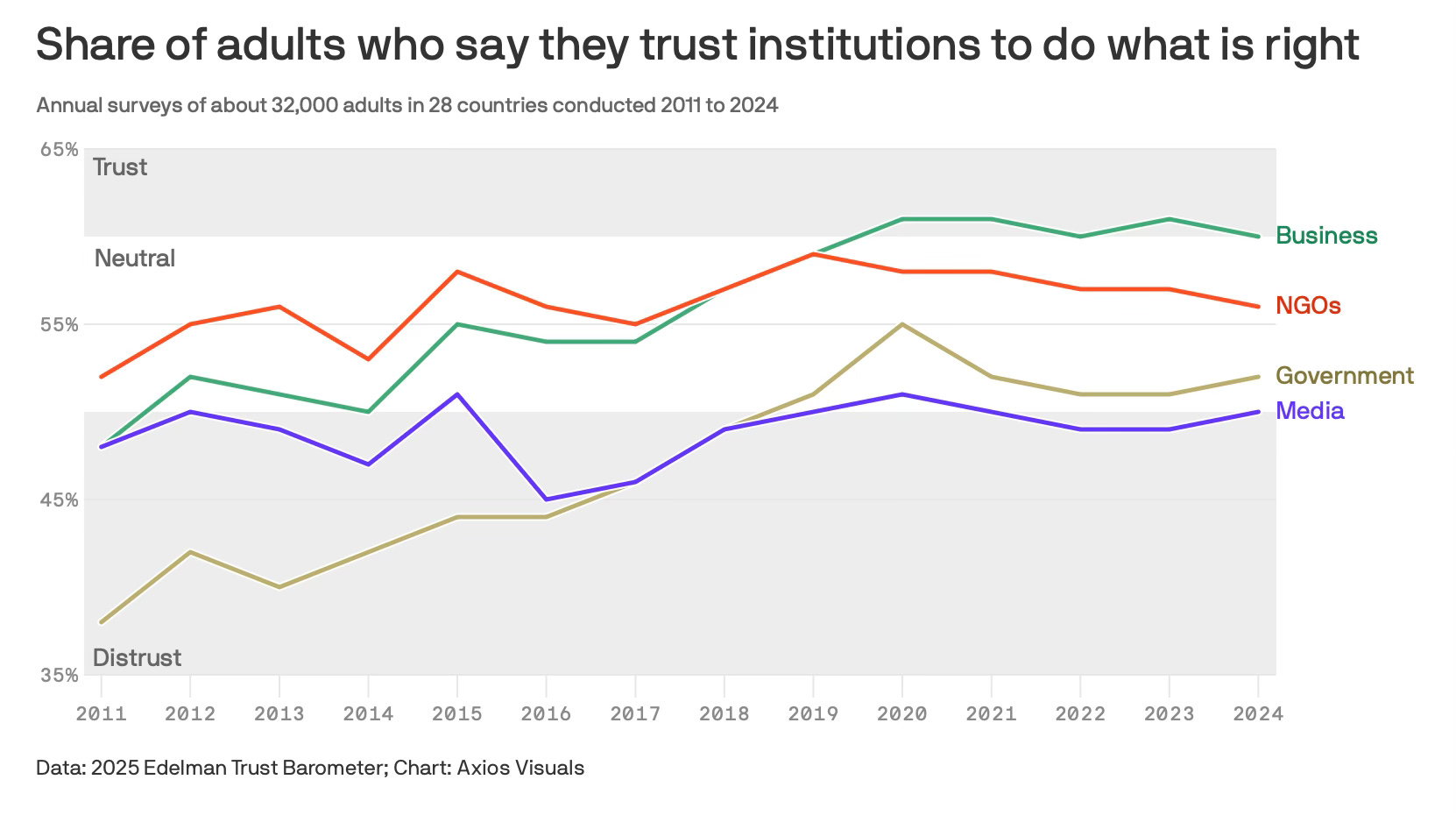
Every internal message about AI making work better lands next to a layoff headline - in turn trust is eroding faster than most CEOs realize. The ones closing the gap practice open-book management, share strategy in plain language, own mistakes directly, and ensure decisions align with stated values. Flexibility and purpose have to be core principles, not situational leverage.
The reason why your productivity changes so much day-to-day
The difference between your best day and your worst is 80 minutes of productive work, according to a new University of Toronto study. On sharp days, people complete more goals and aim higher. Pushing through long hours yields short-term gains, but extended overwork degrades the cognitive clarity required for performing well tomorrow too.
How to create a culture of learning
Three-quarters of organizations say they lack the staff and time to build a learning culture. The ones that succeed are not finding more time. They are protecting it: dedicated learning hours (median of 40 per year), public recognition for skill development, and structured mentorship. As skills evolve faster than training cycles can accommodate, making learning digestible and culturally celebrated is becoming a critical retention strategy.
Data Point:
76%
The number of CEOs who report regularly using generative AI, according to a recent Vistage study (a 10% increase in just nine months). Yet most remain on the sidelines when it comes to actually embedding it into how they lead and run their organizations
In Other News
Why More People Are Dropping Out of the Job Market. (Wall Street Journal)
US workers increasingly trapped in the ‘Great Detachment’ as hiring slows, report shows. (Fox Business)
US workers are quitting at the lowest level in a decade. (HR Dive)
Nearly half of American households have no retirement savings: In 2022, 46% of households reported retirement savings, with 26% above $100K and 9% over $500K. (USA Facts)
AI may threaten critical thinking in the workplace. (HR Dive)
You’re looking at the AI revolution all wrong, top economist says: 40% unemployment and a 3-day work week are the same thing. (Fortune)