

Welcome to the latest edition of Human Capital Intelligence, your weekly brief synthesizing over 250 leadership, HR, and people sources to filter out the noise. As always, we would love to hear from you at ken@reyvism.com with questions you’d like answered or topics covered.
Sent this by a friend? Sign up here to receive HCI in your inbox every week.
By Ken Stibler; Powered by Reyvism Analytics
Deep Dive:
AI adoption strategies are shifting, what stage is your initiative?
We talk a lot about AI for a newsletter about human capital, but with AI agents (which Microsoft calls “digital labor”) functioning more like digital coworkers than mere software tools, you can’t properly separate the people from the tech anymore in businesses.
Perhaps that tricky overlap between the data, systems, spend, and people is why so many companies are struggling to turn the promise of automated systems into business outcomes. This week the WSJ reported how costumers are increasingly expecting an “always-on economy”. Yet rather than supercharging the business, many organizations are still failing to see AI’s ROI.
Less than 2% of large firms have achieved break-even returns on their AI investments, with just over one-third reaching full deployment on priority projects. Big spenders are pivoting. For example, J&J has shifted from 900+ experimental use cases to focusing only on the top 10-15% of initiatives which they found drove 80% of value.
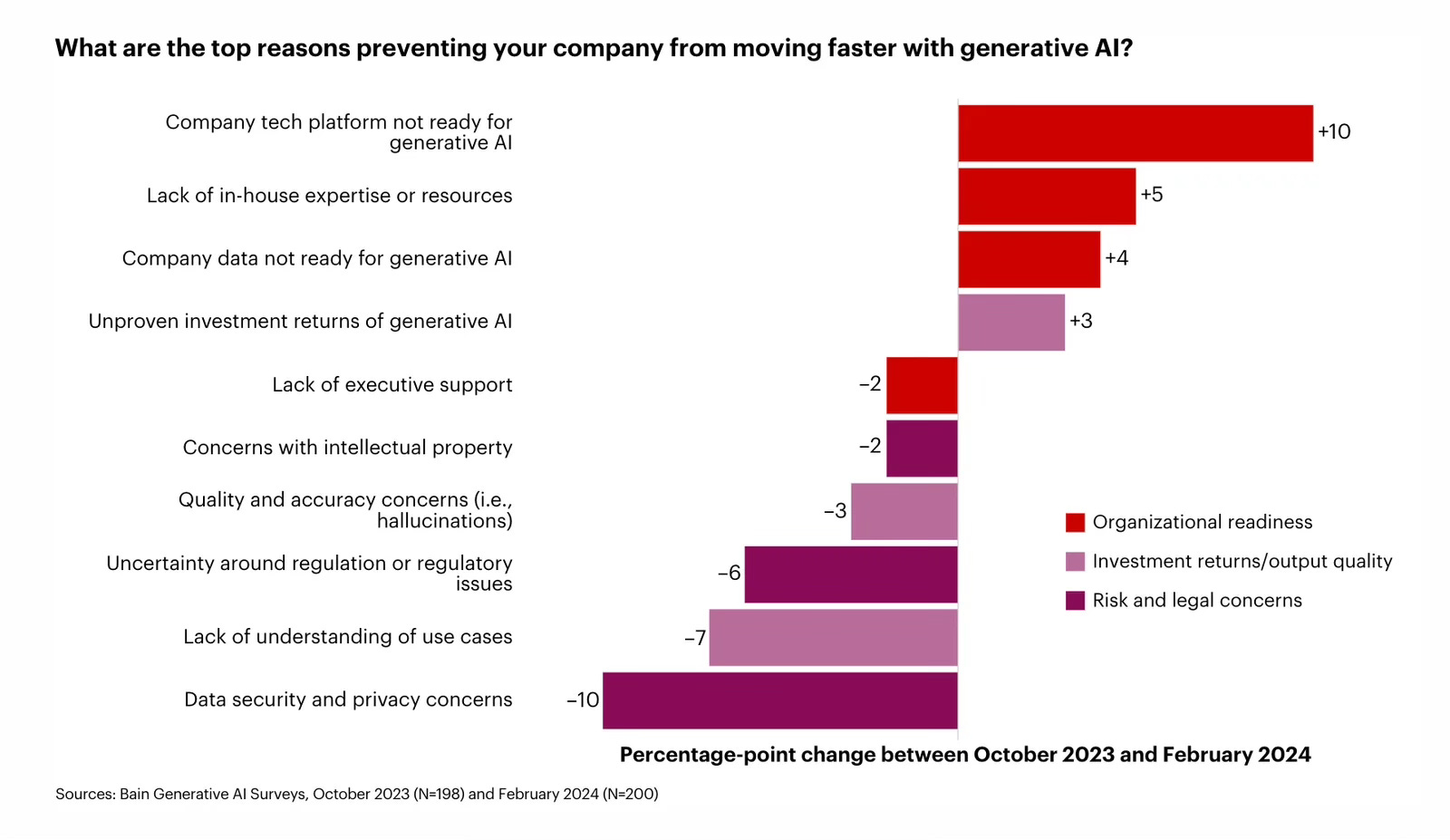
This shift is industry-wide, with Gartner reporting the percentage of companies developing their own AI tools dropped from 50% in late 2023 to 20% by the end of 2024. With 88% of projects failing to scale beyond proof of concept, more CIOs are turning to commercial, off-the-shelf solutions rather than building custom tools that require scarce technical talent.
Meanwhile, employees aren't waiting for formal initiatives. Half of all workers are already using unapproved AI tools and most wouldn't stop even if banned. This "Shadow AI" usage stems from employees seeking to improve personal productivity, with 45% of prompts occurring via personal accounts.
What’s Next: This is not an item for next year, or when the tech matures. Employees are leading AI use, one way or another. Simple place to start, describe your company and your biggest challenges, and ask it to create a plan to balance governance with practicality, identify the highest-value, simplest win use cases
Lagging indicators or lagging definition? Why this slowdown is different
President Trump's economic policies have created a stark disconnect: despite nonstop headlines and frayed confidence, they've left surprisingly little trace on the economy in conventional metrics. Job growth remains steady at 173,000 over the past two months, virtually unchanged from previous periods, while unemployment has held at 4.2%, just a tenth higher than before.
While most companies aren't conducting layoffs, spending plans and hiring are effectively frozen. This slowdown is uniquely psychological, and likely the first real recession of the social media era (smartphones were not yet ubiquitous in the Great Recession).
While eroding confidence can bleed into a real recession through slowed spending, the perception of a terrible economy is worth challenging to prospects and employees. When less-than-half of your workforce believes their company is financial stable, despite strong fundamentals, the psychological dimension of this economic moment requires as much attention as traditional metrics.
What’s Next: With companies increasingly hiring back fired employees, it’s worth it for business planners to address sentiment head on in communications while treating it more skeptically in personnel and strategy decisions as its relation to reality fades.
Quote: Bad omens, hold the guac
“The consumer is sitting on the sideline, citing saving money because of concerns around the economy as the overwhelming reason consumers were reducing the frequency of restaurant visits.”
— Chipotle CEO Scott Boatwright on the chain’s first decrease in quarterly same-store sales since 2020.
Reading List:

Ordinary businesses quietly face a rise in cyber crime
Deepfake technology has dramatically lowered the barrier to sophisticated cyber attacks, with Palo Alto Networks finding it takes just 70 minutes for someone with no experience to create a convincing fake job candidate—a tactic already exploited by state actors like North Korea to infiltrate companies. This represents just one example of how cyber attacks are becoming cheaper and easier to execute while targeting increasingly smaller businesses that lack adequate defenses. With nearly 40% of all businesses facing daily attacks and a successfully attack costing $98.5 million on average, the energy to prepare is cheaper than the cost of inaction.
What’s Next: Rather than a “not my business” issue, multiple Vistage member companies have already seen fake job candidates. Be on alert, especially HR, as human targets tend to be the softest.
Scarce employee resources - attention
Employee attention is becoming scarce, with Microsoft's research revealing workers face 275 daily interruptions—roughly one every two minutes. This attention deficit is worsening, with after-hours messaging up 15% and night meetings increasing 16% year-over-year. For CEOs, the message is clear: interrupted workflows are undermining productivity goals, and though nearly half of companies are adopting AI solutions, technology alone cannot solve fundamentally misaligned work expectations.
What’s Next: Companies that redesign workflows to protect focused time may gain significant competitive advantage in an economy where human attention, not just talent, is scarcest.
Boss burnout hits the bottom line
Manager burnout is costing the global economy $438 billion in lost productivity as employee engagement plummets to just 21% in 2024—with managers themselves showing the steepest engagement declines. While engagement is often seen as a soft issue, Gallup research shows that teams led by engaged managers are 27% more profitable, 20% more productive, and have 41% lower absenteeism. When managers burn out, those metrics reverse — dragging team performance, turnover costs, and profitability down with them.
What’s Next: Boss burnout carries scary implications for organizational effectiveness, companies that invest in coaching programs see an immediate 5% improvement in manager engagement.
Data Point: We never said it was easy
<2%
Percentage of over 900 companies surveyed that have seen 100% returns on AI investments yet, despite 100% of the companies investing in AI initiatives
In Other News:
Lashing out at staff is bad for business: Shouty leadership is in vogue but smart executives do something far more effective. (Financial Times)
Small businesses struggle to hire and retain workers. These tactics can help. (HR Brew)
Less than half of employees (45.2%) are confident in the business health of their employers, according to Glassdoor. (HR Brew)
Former KPMG manager working remotely in Georgia can sue under New York law, court says. (HR Dive)
An AI Customer Service Chatbot Made Up a Company Policy—and Created a Mess. (Wired)
Tech is turning its back on Gen Z: Less training for newbies. Few entry-level jobs. And AI is about to make things even worse. (Business Insider)