

Welcome back to Human Capital Intelligence! Your go-to source to keep up with the best insights from over 250 leadership, HR, and people sources. As always, we would love to hear from you at ken@reyvism.com with questions you’d like answered or topics covered.
Sent this by a friend? Sign up here to receive HCI in your inbox every week.
By Ken Stibler; Powered by Reyvism Analytics
Get ready for a whole host of new AI compliance headaches
Nearly 70% of employers now use AI in hiring; which is great for speed but no so much for rapidly increasing, legal exposure. The federal government has signaled permissiveness, and many employers have read that as permission to move fast. It is the opposite. The compliance burden is fragmenting into a state-by-state patchwork harder to manage than a single federal standard would have been.
The regular suspects have been active. Colorado just signed SB 26-189 requiring employers to notify individuals within 30 days when an automated tool materially influences an adverse employment decision, effective January 2027. New York City requires bias audits and public disclosures. Illinois mandates applicant notification. California has expanded its civil rights framework to cover AI-driven employment decisions with extended record retention. Courts are not waiting either: a federal judge allowed disparate impact claims to proceed against Workday’s screening software, and a separate class action alleges AI applicant scoring violates the Fair Credit Reporting Act.
Your vendor contract does not transfer legal accountability. Employers remain responsible for employment decisions regardless of whether a human or an algorithm informed them.
If you are using AI in hiring, performance management, scheduling, or productivity monitoring, the compliance obligation already exists under Title VII, the ADA, and the ADEA. The new state laws add disclosure, audit, and recordkeeping on top. Algorithmic errors at scale quickly become systemic violations. Map your tools, engage your vendors on transparency, and document decision-making processes now.
New critical metric: agent to employee ratio
The metric that will define workforce planning for the next decade just arrived. Leading mid-market organizations (ie the 5% of firms that have actually figured out how to do AI well) have an average of 144 AI agents deployed for every human employee. In small businesses, the ratio is 59 to 1. These are production systems doing work; the cumulative population of specialized, agents spawned across a typical operating period, executing work that used to require human handoffs between systems.
At ClickUp (a $4 billion productivity platform with 1,300 employees), the company now runs roughly 3,000 internal AI agents. The CEO instituted a policy: employees must go through an AI agent before pinging him directly. The shift, as he describes it, is from “actually doing and waiting on the work, to reviewing the work and ensuring that it meets your standards.” Employees are becoming managers of agents.
Guardrails exist (agents cannot delete anything for example), and the company maintains an “agent org chart” listing every agent by name, owner, and cost to run. When people talk about scale decoupling from headcount, this is what they mean. The question for every HR and operations leader is what workforce planning looks like when your employee-to-output ratio is no longer fixed.
Quote of the Week:
"The biggest shift is from actually doing and waiting on the work, to reviewing the work and ensuring that it meets your standards."
— Zeb Evans, ClickUp CEO on how the shifting agent-employee ratio is affecting work
Reading List:
Leadership development is no longer just for leaders
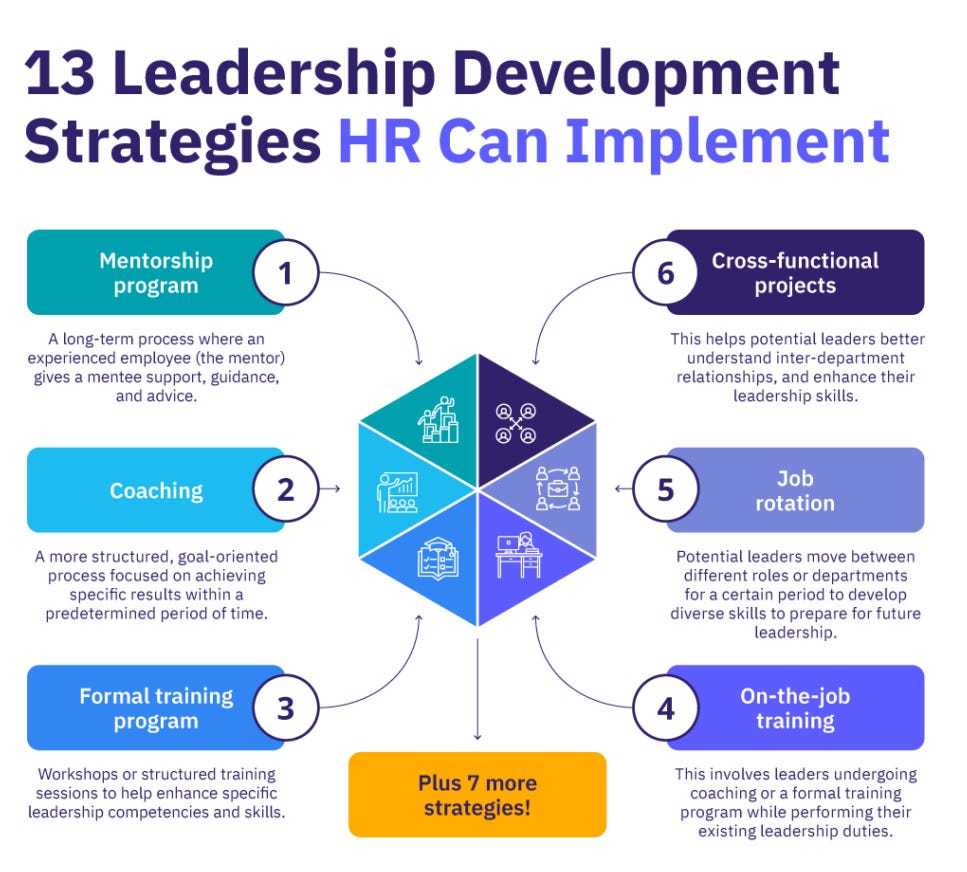
New research from ADP speaks for itself: Half of organizations now offer leadership development to workers at all levels with 79% reporting improved organizational culture and 68% saying job performance improved. Communication and decision-making top the list of what executives value and learners want. The challenge is access: 63% of managers say the role of leader was more difficult than anticipated, and more than half report their organization provided little training to prepare them.
Designing operations for resilience without sacrificing efficiency
The traditional assumption is that efficiency and resilience oppose each other. New MIT Sloan research argues they don’t have to if you’re willing to accept some complexity. Most organizations optimize for internal metrics (on-time performance, utilization rates, inventory turnover) that capture efficiency without customer or external resilience. The fix becomes pairing measurements (one metric for efficiency, one for customer experience for example), strategic buffers deployed by disruption probability rather than uniform rules, and curated choice sets that remove high-risk options before customers select them.
MBA’s are having a fire sale as fewer businesses want their wares
Business school applications are rapidly declining and institutions are responding with discounts on specialized degrees promising AI-era relevance. The two-year MBA faces intensifying ROI scrutiny as employers value demonstrated skills over credentials. Schools are pivoting toward shorter programs, acknowledging the market has moved faster than their curricula. The price cuts suggest that any MBA you might want to hire should get cheaper, even if they become scarcer than over the past decades.
Data Point:
30 days
The timeline Colordo businesses have to notify individuals of “adverse AI-influenced decisions”
In Other News
Employers adopt AI tools faster than they can train workers to use them. (HR Dive)
What 25,000 Intern Applicants Taught Me About People. (Forbes)
Workers are getting paid to teach AI how to do their jobs. (CBS)
OpenAI just acquired the consulting firm it was born alongside. The model company is now the services company. (The Next Web)
Your Work Team Is Now a ‘Pod’ and Your Co-Workers Are AI Agents: Companies are restructuring engineering teams into smaller, more nimble cross-functional ‘pods,’ made up of humans and AI agents. (Wall Street Journal)