

Welcome back to Human Capital Intelligence! Your go-to source to keep up with the best insights from over 250 leadership, HR, and people sources. As always, we would love to hear from you at ken@reyvism.com with questions you’d like answered or topics covered.
Sent this by a friend? Sign up here to receive HCI in your inbox every week.
By Ken Stibler; Powered by Reyvism Analytics
Creating employee engagement during a culture of fear

When former Google CEO Eric Schmidt was booed during a graduation speech about AI, it was as much a protest against a technology as it was signal that uncertainty is fast metastasizing into fear. The fear is justified. Customer service roles fell 130,180 in the year through May 2025. Credit authorizers are down 26.2% since ChatGPT’s introduction. The playbook is visible: Intuit cut 17% of its staff, targeting mid-level managers. Meta laid off thousands and moved managers to IC roles. As one Capital One employee virally posted: “This is exactly why you should never sacrifice too much for these companies. You are always disposable to them.”
And to a degree it’s true, isn’t it?
The question is what the new compact looks like. Sophos CEO Joe Levy faces this directly. When employees ask if support jobs will be eliminated, his answer is honest: “I don’t know.” Instead of false promises, Sophos uses a four-part framework: provide tools, give training, share examples, and offer incentives. Most companies stop after the first two. Sophos goes further because “What should I do with it?” is the most common question. They make AI part of performance reviews, measuring both outcomes and the process of finding efficiencies.
The leadership challenge is maintaining engagement when the workforce assumes they are being automated out. The answer is not pretending the threat does not exist. It is giving employees agency over the transition. Leaders who admit uncertainty but provide tools and incentives for employees to figure it out alongside them replace paralyzing fear with productive experimentation.
Fast adoption and poor governance kicks AI risks to HR departments…or legal
Get ready for shadow AI. Verizon data shows a fourfold increase in non-malicious insider actions tied to unauthorized AI use. Of the 45% of professionals using AI regularly, 67% access platforms via unauthorized personal accounts. Workers with access to sensitive material are plugging it into their tool of choice, leaving their organization blind to the exposure.
The risks are concrete: 28% of data loss prevention violations involved employees entering source code into AI tools. In 3.2% of cases, workers uploaded proprietary research. Yet only 13% of organizations have adequate AI agent governance. The gap is driving the development of AI-BOMs to track configurations and system prompts. Until governance catches up to adoption, IP loss and compliance violations will land on HR and legal.
Quote of the Week:
"We as employers aren't doing a good enough job saying [to older workers], we value the skills that you already have, so much so that we want to invest in you to help you do your job better."
— Becky Frankiewicz, Chief Strategy Officer at ManpowerGroup
Reading List:
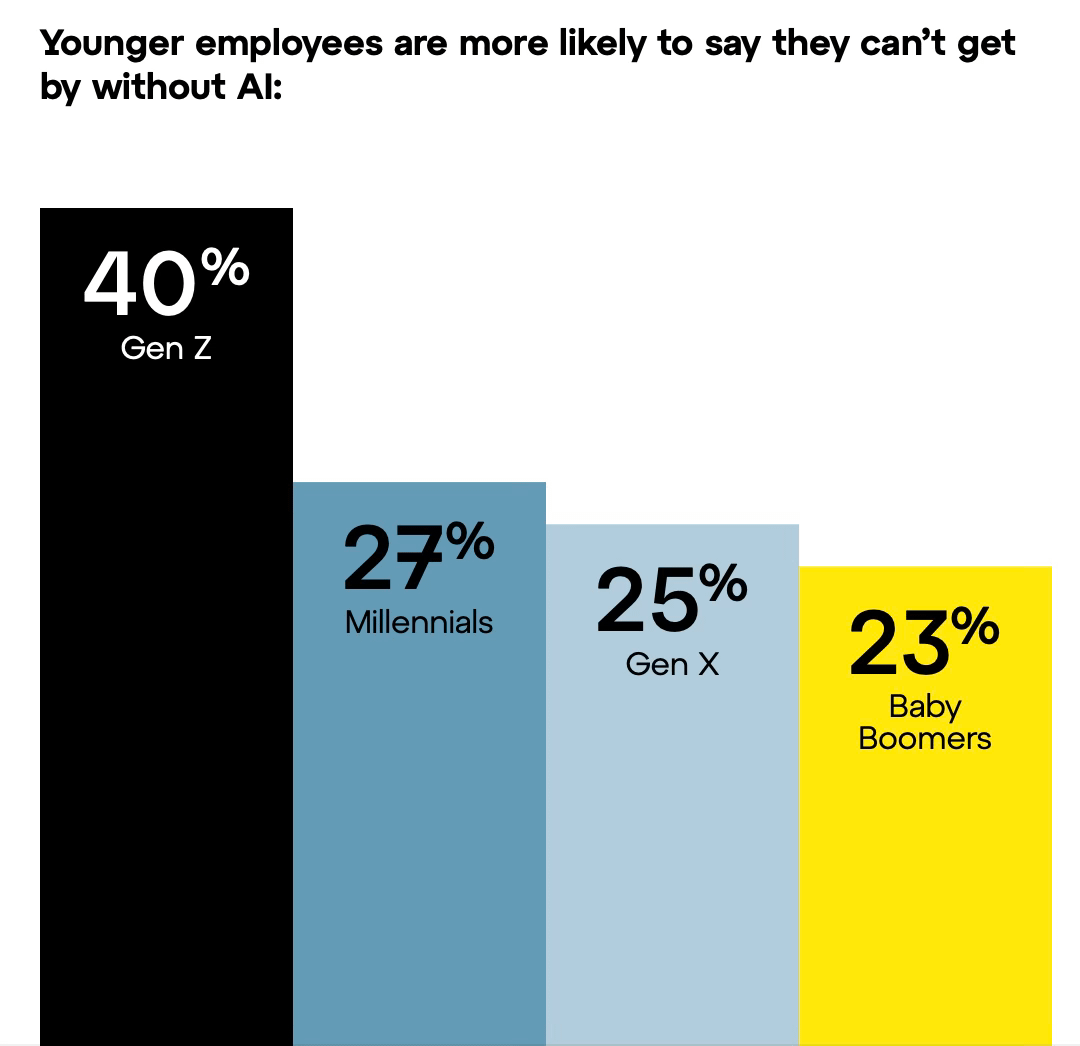
Workers contend with ‘skill atrophy’
There is a vicious cycle forming in AI adoption. A new GoTo survey found that 60% of employees feel pressured to use AI for productivity, yet 39% say the reliance has already weakened their skill sets. Half acknowledge they depend too heavily on the technology. The pressure to adopt is eroding the very capabilities that make human judgment valuable. While “perishable” skills tied to specific tools will be replaced regardless, but durable skills like judgment, critical thinking, and decision-making are what will differentiate high performers in an AI-saturated workplace.
Despite public examples, most employers are not cutting paid leave
When Zoom cut parental leave from 22 to 18 weeks and Deloitte halved theirs from 16 to 8, it felt like the start of a trend. It is not. A Marsh McLennan Agency survey found 86% of firms have no plans to change vacation time and 93% will maintain sick leave levels. The legal environment is part of the reason: 12 or more states now mandate paid family and medical leave, and 18 require paid sick leave, making cuts both complex and risky. If your organization is holding the line while competitors cut back, that is a story worth telling your employees.
When it comes to leadership, replacement is abdication
The most relevant AI risk for leaders might be abdication more than competitive effects. Data finds that leaders who outsource judgment to AI - out of fear of obsolescence - become less trusted by their teams. AI can generate, optimize, and even mimic wisdom. But it cannot hesitate, doubt, or read a room.
Data Point:
67%
Number of professionals who use AI regularly are accessing platforms using unauthorized personal accounts.
In Other News
Indeed parent company touts record growth driven by AI. (HR Dive)
Bolt’s cofounder scrapped its HR department. This CEO says people management is key to thriving in the AI age. (CEO Daily)
Meta is rapidly reorganizing its workers’ jobs around AI: ‘Transfers aren’t optional’. (The Guardian)
LinkedIn declares war on AI slop: The job networking site plans to target low-quality AI posts that distract its users from finding value on the platform. (Fast Company)
While other tech CEOs warn of mass job losses, Glean’s chief says AI will never replace a single worker. (Fortune)