

Welcome back to Human Capital Intelligence! Your go-to source to keep up with the best insights from over 250 leadership, HR, and people sources. As always, we would love to hear from you at ken@reyvism.com with questions you’d like answered or topics covered.
Sent this by a friend? Sign up here to receive HCI in your inbox every week.
By Ken Stibler; Powered by Reyvism Analytics
The job market is becoming a growth issue for businesses

The unemployment rate is low. The stock market is high. Consumer spending is healthy. And yet, unemployment expectations are at levels previously seen only surrounding recessions. The disconnect has a name now: “doomjobbing”. Workers scrolling through infinite listings, submitting applications into automated systems that never respond, slowly internalizing the conclusion that they are unemployable. When enough people believe the economy is broken, they start behaving as if it is.
The corporate side is equally contradictory. Microsoft posted $82.9 billion in quarterly revenue (up 18%) while shrinking headcount and budgeting $900 million for a voluntary retirement program. Its AI business generates $37 billion annually, growing 123%, and capex is expected to exceed $40 billion this quarter. Meta cut headcount by 1% in Q1 and announced further reductions for May. Across the tech sector, Q1 2026 layoffs hit 52,050, a 40% increase over the prior year.
This is how the job market becomes a growth constraint. Companies generating record revenue with fewer people signals efficiency to investors and instability to workers. Workers who feel unstable spend less, apply more desperately, and disengage from their current roles.
Never before has the share of people expecting unemployment been this high without the economy actually being in recession. The risk is that the perception gap closes in the wrong direction: the economy catches down to where people already believe it is.
CHRO importance rising, but HR has its own "K-shaped economy"
The CHRO has never been more strategically important. CHROs in Russell 3000 companies rose from 148 in 2021 to 230 in 2025. Their pay grew 14.7% between 2024 and 2025, 6% higher than all over executives. At S&P 500 firms, the growth was 30.4%. CHROs are attending board meetings, overseeing AI transformation mandates, and the Conference Board’s CHRO Confidence Index just hit a new high of 59.
The K-shape is emerging below the C-suite too. The average HR professional expects to earn $130k+ yet the average salary offered is $90k. That $42,000 gap is larger than the U.S. average across all professions, a particular irony given that HR professionals set salary bands for everyone else.
Meanwhile, no company included a Chief Diversity Officer among its highest-paid executives in 2024 or 2025. The function is bifurcating: the top elevated into the boardroom, the middle squeezed by the same budget pressures HR is supposed to help the rest of the organization navigate.
Quote of the Week: Nice on paper
"Having healthcare benefits you can't afford is like unlimited vacation, it's a false promise."
— Denise Rousseau, Carnegie Mellon University
Reading List:
Workers increasingly ditch company insurance policies as costs surge
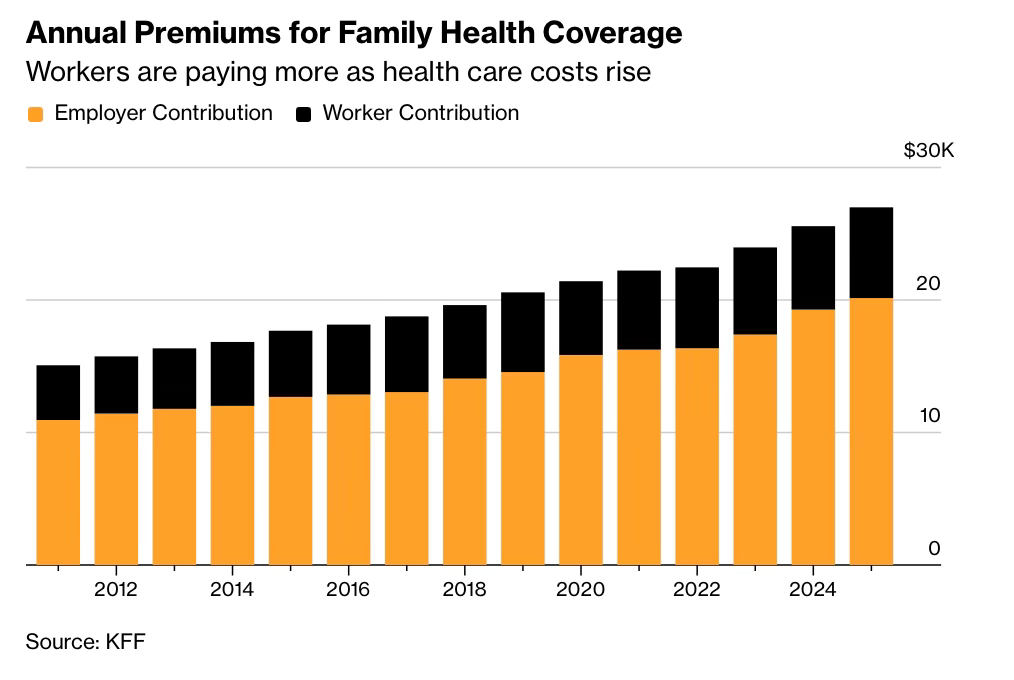
The workers that employer health plans depend on to stay solvent are starting to leave. Young, healthy professionals are opting out because they cannot afford the premiums, choosing health-share cooperatives or going without coverage entirely. The share of workers on employer plans has fallen to 61% (from 64% in 2020), and total costs per employee are expected to grow 6.5% in 2026, the highest rate in a decade. Every healthy worker who opts out makes the remaining pool sicker and more expensive.
Starbucks switches to weekly pay to match growing worker need
Starbucks will begin paying employees weekly in August, moving away from the biweekly standard most U.S. employers follow. The decision came directly from employee feedback: "getting paid sooner would help." Hourly wage growth slowed to 0.2% in March, the weakest rate in five years, and nearly one-quarter of U.S. households now spend more than 95% of their earnings on necessities.
Interim leaders in demand as change efforts challenge traditional leaders
Demand for interim C-suite leaders has increased 151% since 2021, according to Heidrick and Struggles. Requests for human capital expertise jumped 129% in the past year alone. HR tops the list of functions seeking interim support, driven by the dual pressure of managing its own transformation while helping the rest of the organization navigate workforce planning and organizational redesign. The pace of change is outstripping the capacity of permanent leadership teams to manage it all simultaneously.
Data Point:
90%
The year on year decline in new job postings as “low fire, low hire” goes to zero hire, high fire.
In Other News
67% of high school graduates opting against college cite cost-of-living concerns, poll finds. (Higher Ed Dive)
KPMG Cutting 10% of U.S. Audit Partners After Voluntary-Retirement Push Falls Short. (Wall Street Journal)
Total compensation not currently helping engagement much, McLean reports. (HR Dive)
The uncomfortable truth about AI and the American worker. (Fortune)
Reed Hastings says AI will drive a return to humanities: ‘I’d be doubling down on emotional skills’. (Fortune)
Amazon pushes AI use and closely tracks adoption, as some employees push back. (Business Insider)
AI literacy is popular at the DOL: The agency is bolstering efforts to ready the US workforce for the age of AI. (HR Brew)