

Welcome back to Human Capital Intelligence! Your go-to source to keep up with the best insights from over 250 leadership, HR, and people sources. As always, we would love to hear from you at ken@reyvism.com with questions you’d like answered or topics covered.
Sent this by a friend? Sign up here to receive HCI in your inbox every week.
By Ken Stibler; Powered by Reyvism

Leaders need a change strategy
I gave a speech this week and afterward the COO of one of the attendees pulled me aside. He wanted to talk, even though his company was already doing most of what I had recommended. That itself was notable. When I asked why they were so far ahead, I was ready to write it off as rare leadership and move on.
Then he named something that’s surprising for reasons I’m still not fully sure of: they had spun up a continuous improvement function years ago. That is the gap many leaders miss. Good leadership is a state whereas a continuous improvement function is a mechanism. One depends on the quality of the people in the room. The other runs regardless of who is in the room if done well.
“Oh no! Not another thing…” - CEOs
This is particularly important these days as the change is coming fast and from all directions at systems ill-prepared to handle it. The result is burnout at best if now downright risk:
Rapid technological change is creating all sorts of changes that are far beyond the normal playbook: Companies aren’t prepared for how AI is accelerating the ability to impersonate CEOs for fraud. (HR Dive)
But change management (these days somewhere between incremental updates and holding on for dear life) is not the same thing as a change strategy is not a change management plan. A change strategy is the organizational infrastructure for making continuous change decisions well. It requires three things:
clear articulation of what will not change (the values, the talent philosophy, the trust compact with employees),
a structured process for evaluating what should change and at what pace,
and leadership accountability for the irreversible decisions.
The CEO from the first paragraph had all three. They did not build them in response to AI. They built them years earlier, and the AI transition was simply the latest input into a machine that was already running.
The practical implication is uncomfortable for leaders who prefer to move fast. Irreversible decisions, the ones that cannot be undone once made, require a higher bar of deliberation than reversible ones. Nobody said change at this rate was going to be comfortable, but it just might be less uncertain with the right structures.
AI-driven dis-engagement, Part 2
The new disengagement does not look like disengagement. Workers are busy, productivity metrics are up, but something is quietly eroding that’s hard to put your finger on.
Boston Consulting Group’s research calls it the joy paradox: 67% of workers report higher job satisfaction with AI, but 41% report a significant increase in cognitive load, and 47% say they spend more time managing AI than doing the actual work. Meanwhile, Penn State and USC researchers found that passive AI use (copying and pasting AI-generated responses) reduces feelings of ownership by 20% and meaningfulness by 10%.
Workers feel less connected to their output even when that output is better. And often its just replacing busy work more than being strategically valuable, white-collar employees spend 6.4 hours per week “botsitting,” managing AI output rather than producing, and one in three AI sessions fails completely.
The fix involved reorienting our relationship with the tools. Organizations that deploy AI as a productivity layer without redesigning workflows are trading long-term engagement for short-term output metrics. The 66% of employees given no guidance on what to do with AI-freed time are not being empowered. They are being left to drift.
Quote of the Week: More human, not less
“The skills that are most resistant to displacement by AI are the ones that are the most distinctly human: relationship building, conflict resolution, the ability to guide and motivate other people, and ethical judgment.”
— Maria Flynn, Jobs for the Future
Reading List:
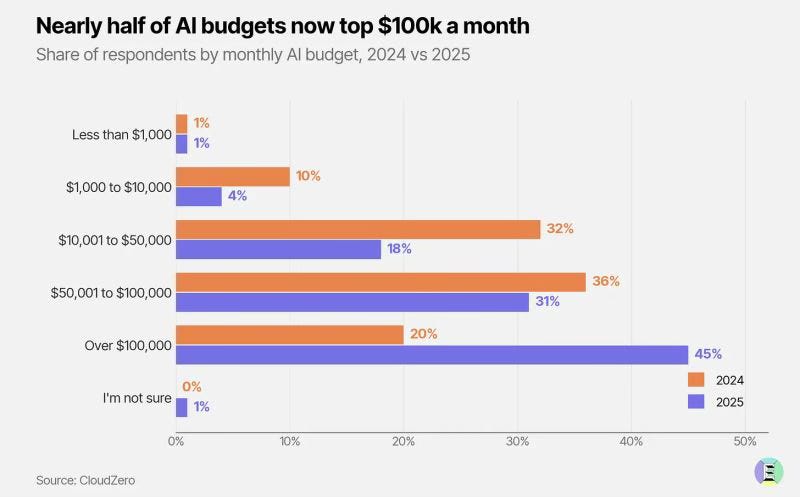
What are tokens, why is everyone talking about them, and should you care?
Tokens are suddenly the “new thing” CEOs are being forced to think about. Simply put, tokens are the units vendors use to represent AI work and they are becoming the new headcount budgets. The top AI services are priced per token rather than per seat, which means the cost of AI scales with usage rather than with the number of employees who have access. Amazon recently cautioned its own employees against "tokenmaxxing," or using the most powerful models for tasks that do not require them.
Fortune 500s launch programs to own the labor as key shortages undermine growth strategies
Rather than lobbying for better workforce pipeline, Fortune 500 companies are increasingly building them…and in turn potentially controlling strategic talent supplies. With an estimated 2.1 million skilled trades jobs potentially going unfilled by 2030, the talent market cannot move fast enough. Meta, Bloomberg, and Ford are all investing in programs to offer free training and guaranteed jobs for every graduate in hot areas like data center construction.
GenZ's newest psychological feature: slow and steady?
44% of Gen Z prefer steady progress over fast-paced promotions, and 55% are delaying major life decisions due to economic uncertainty according to the 2026 Deloitte Gen Z and Millennial Survey. The instinct is to read this as a lack of ambition. It is more accurately read as a rational response to the environment they inherited. Gen Z entered the workforce during a pandemic, watched the mass layoffs of 2023-2024 eliminate people who had done everything right, and is now navigating an AI transition that makes career planning genuinely uncertain.
Data Point: “Botsitting”
6.4
Number of hours white-collar workers spend per week "botsitting" (managing AI output rather than producing work) according the Glean Work AI Index.
In Other News
People who eagerly seek out managerial positions may be least suited for the roles. (HR Dive)
Doomjobbing Report: 48% of Job Seekers Apply Without Reading the Full Job Description. (Monster)
Labor market adds 172,000 jobs in May, but growth remains uneven: Most industries saw no changes or declines in total employment. (HR Brew)
Making the case for fractional and AI employees: At New York Tech Week, a panel focused on how startups can benefit from workers—agentic or otherwise—who aren’t on the full-time payroll. (HR Brew)
More Employees Embrace ‘Microshifting,’ Carving Their Workday Into Chunks: The hope is that it can help people produce better work, while preventing burnout and turnover. (Wall Street Journal)
New York passes a bill aimed at halting ‘ghost jobs’. (HR Dive)