

Welcome back to Human Capital Intelligence! Your go-to source to keep up with the best insights from over 250 leadership, HR, and people sources. As always, we would love to hear from you at ken@reyvism.com with questions you’d like answered or topics covered.
Sent this by a friend? Sign up here to receive HCI in your inbox every week.
By Ken Stibler; Powered by Reyvism Analytics
Supporting your employees when everyone is overwhelmed

When we sit down to write this newsletter each week, there is a hesitant calculus about what is worth bring to you. Our audience skews heavily executive. We are always considering the fact that each new problem we bring up, or even action proposed, is pulling from an already depleted ability to do much with it in most workplaces.
This is especially difficult as an era of layoffs, geopolitical unrest, AI-fueled uncertainty, and unrelenting pressure to deliver leaves little room for anything else. Asking people to think about their career development on top of everything feels impossible. But supporting your team’s growth is an essential part of your job. The question is how to make career development feel relevant rather than tone-deaf when your own plate is just as full.
The answer is to stop treating learning as an extracurricular activity. Helen Tupper, cofounder of career development consultancy Amazing If, notes that most employees know they should be building new skills, but the demands of the here and now leave little room for it. They put their day job over their development.
The solution is to build learning into the week, not onto it. Look at their calendar. There is almost certainly something already coming up, such as a client event or a presentation, where they could play a bigger part. Let them open the meeting, lead the Q&A, or debrief the client. When it is done, make sure you take the time to reflect on it together.
And since you are figuring it out too, resist the urge to pretend otherwise. Share what you are currently reading or working on. Talk about a conversation that challenged your thinking. Be open about a mistake and what you took from it. As Tupper puts it: “Learning can look like anything, as long as they can see you doing it.”
How can learning compete in an attention deficit?
Workplace training has a TikTok problem. Learning experiences were designed in an era when social media exist and there weren’t a host of tools we have now to present complex ideas in genuinely entertaining ways. Now, people are scrolling constantly, consuming content that is fast, personally relevant, emotionally engaging, and designed by teams who understand human attention down to the millisecond.
When employees are asked to sit through dense modules and generic slides that feel like they were built before color TV, the disconnect is obvious. Low engagement with training is likely as much an issue of bland resources and boring design that do not feel worthwhile, as of being busy.
For the future of trainings, creativity, story-led content, and direct relevance to those taking it are better than completeness. On that note, measure impact rather than just completion is key to make learning more than just a box to check. Completion rates alone tell us very little about whether learning has actually had an impact.
Quote of the Week: Not how I’d roll out AI
Standard Chartered CEO Bill Winters apologized for offending colleagues and strangers alike when he said the British bank’s aim with using AI is to partly replace “lower-value human capital.”
Reading List:
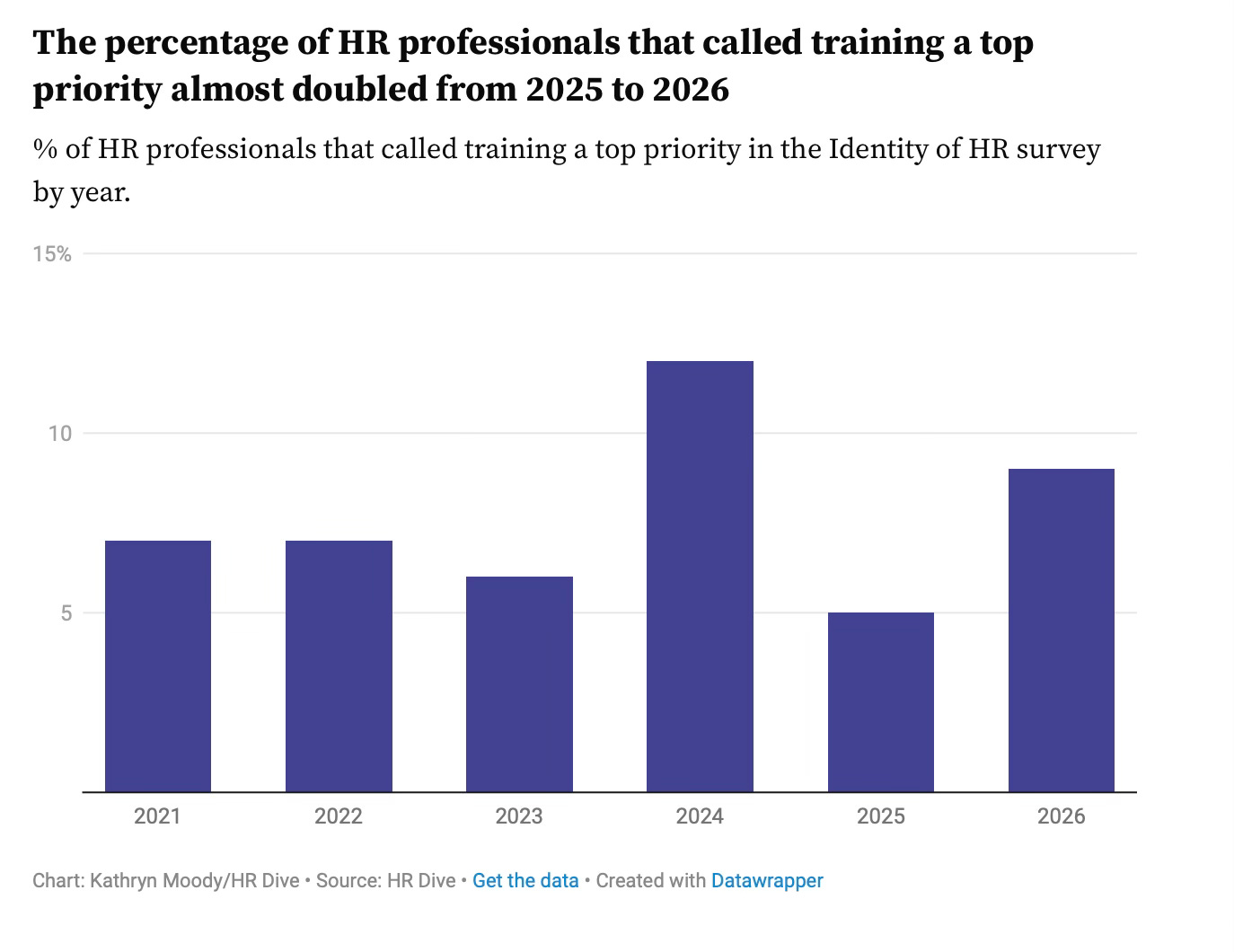
HR invests more time in training as “skill engagement” becomes a rare point of workplace alignment
The share of HR leaders naming employee training their top priority jumped nearly 90% since last year. AI is the driver: it is increasing role complexity faster than existing programs were designed for. A Go1 survey of 2,000 L&D leaders found 7 in 10 professionals use AI weekly, but only 14% consider themselves advanced users. The organizations making the strongest progress are treating workforce capability as infrastructure, not a budget line that fluctuates with hiring.
CEOs get ruthless about performance
The corporate ethos of the previous decade, when leaders put empathy out front while quietly wishing employees worked harder, is over. As AI gives employers more leverage in a sluggish white-collar market, a growing chorus of CEOs is saying the quiet part out loud. Nestle's Philipp Navratil pledged to be "ruthless in assessing talent." Citigroup's Jane Fraser reminded staff they are judged on results, not effort. Executives used the phrase "performance culture" 633 times on S&P 500 earnings calls last year, up from 460 the year before. B-players are being managed out.
Don’t let yourself go numb, or back to sleep on AI’s disruption
There is a lot of noise right about AI right now, but the cost of tuning it out is rising too. Adecco Group research across 2,000 C-suite executives shows a widening gap between what leaders expect AI to deliver and what their organizations can actually do. While 45% of leaders expect AI agents integrated into workflows within a year, less than a third of workers agree, and only 36% of leaders say their talent strategy clearly shows how AI creates opportunity rather than displacement. "AI may move at software speed," Adecco CEO Denis Machuel said, "but organizational trust moves at human speed."
Data Point: Even the summer camps aren’t hiring
30%
Year on year fall in camp counsel jobs indicating a rough climate for teens looking for a summer job. Literally EVERYONE is affected in this economy.
In Other News
‘I live in survival mode’: The rise of the multi-job workforce. (BBC)
The 19th-century guide to running an effective meeting: A US officer and engineer devised the process that is still in use today. (Financial Times)
Target plans to evaluate employees on customer engagement. (HR Dive)
More workers are raiding their 401(k)s as average balances fall, Fidelity says. (CNBC)
Bolt CEO says he let go of his entire HR team for creating problems that didn’t exist: ‘Those problems disappeared when I let them go’. (Fortune)