

Welcome back to Human Capital Intelligence! Your go-to source to keep up with the best insights from over 250 leadership, HR, and people sources. As always, we would love to hear from you at ken@reyvism.com with questions you’d like answered or topics covered.
Sent this by a friend? Sign up here to receive HCI in your inbox every week.
By Ken Stibler; Powered by Reyvism

How do we know what should stay the same and what should change?
This question is probably harder to answer now than it has ever been, and not for the reason most people cite. The pace of change is obvious. What is less obvious is that the cost of being wrong has become asymmetric. In a stable environment, if you change something that should have stayed the same, you reverse it. The cost is friction and some lost time. In the current environment, some changes are irreversible.
You cannot un-fire 17% of your workforce. You cannot un-break the trust compact once employees have watched you track their mouse clicks and walked it back. You cannot un-signal to your best people that they are disposable.
These are real cases. Meta reversed course on an employee mouse-tracking tool after internal backlash. The policy was reversible. The damage to the psychological contract was not. Microsoft omitted a question from an internal survey about whether leadership was listening and got (ironically) hammered for it. They can add the question back. The signal about what leadership is willing to hear is harder to take back. Snowflake’s CIO threatened layoffs to force AI adoption. Whether the signal and rise in ChatGPT use is worth it remains debatable.
We don’t have a perfect answer to this question. However the leaders we see doing this well are the ones who have a clear mental model of what is reversible and what is not, and they apply that model before they act. The practical discipline is simple: before any significant change, ask whether it can be undone.
If the answer is no, the bar for needing to proceed should be much higher. The changes that look bold in the short term and are genuinely irreversible in their human consequences deserve the most scrutiny, not the least.
The strategic value of variance
Artificial intelligence is an engine of sameness. Just like a good manager, it trains on what good is, optimizes for reliability, and produces the expected. In many operational functions, that consistency is a feature. But in strategy, design, and human capital, that consistency is sneakily becoming a strategic risk.
When every organization has access to the same models, the same prompts, and the same generated patterns, the baseline of acceptable work rises, but the ceiling of differentiated work becomes harder to reach. Wharton research on user experience design highlights this trap: AI can accelerate the creation of competent, me-too experiences, but it systematically compresses the productive variance that leads to breakthroughs. The same dynamic applies to talent. Workers increasingly prefer AI feedback because it is less judgmental, but a culture optimized for comfort over candor will eventually lose its edge.
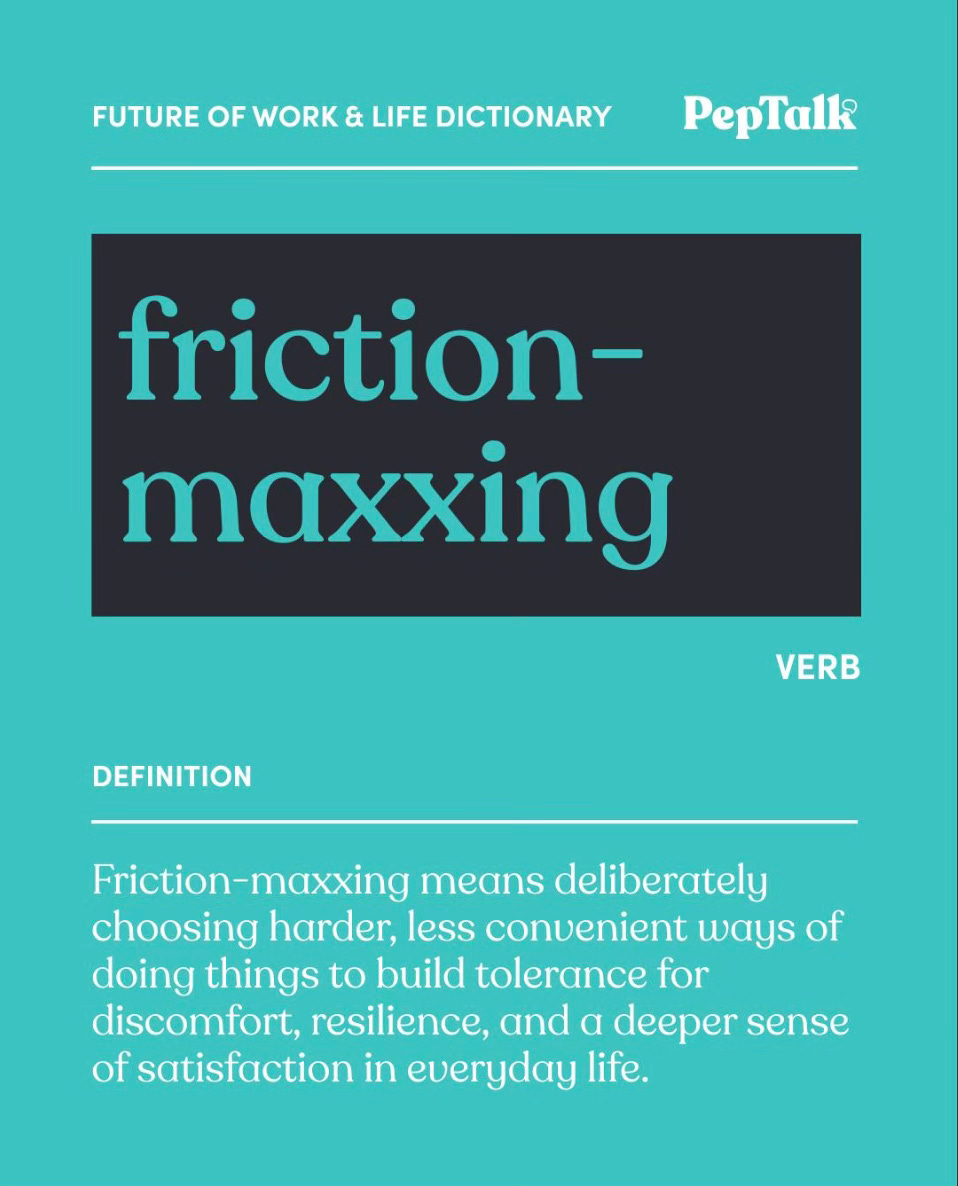
The best path forward is to augment the baseline, but deliberately introduce human friction, divergent thinking, and non-consensus decision-making into their most critical processes. Differentiation requires variance, and variance requires humans.
Quote of the Week: One foot in, one foot out
"I hate the word balance. If you can finish everything before you go to sleep, you don't have an interesting enough job."
— Arianna Huffington, Founder and CEO of Thrive Global
Reading List:
Spending more than your G&A budget on AI
So-called tokenmaxxing (quick note: genzs have taken to adding the term “maxxing” onto any word to imply doing it extensively) is on the rise. Stupid name aside, the phenomenon of spending any amount of money on AI credits is leaving some companies with some head scratching numbers. Last week it came out that one Fortune 500 company spend half a billion dollars on AI credits. When you are spending more on AI than all G&A and labor costs combined, the “efficiency” thesis of adoption needs to be seriously re-considered
Employees can now reject AI for religious reasons
When a North Carolina software engineer secures an exemption to avoid using AI at work on religious grounds it sounds silly. But the legal implications of Pope Leo XIV's encyclical are serious. What the pope did with this formal decry was offering a written theological argument to around 60 million Catholic workers in America. Under Title VII, employers must accommodate sincerely held religious beliefs unless doing so causes undue hardship. If you are mandating AI use across your workforce, get ready for a rise in exemptions and potentially legal risk if it’s treated it as a condition of employment.
Culture plots its revenge in the efficiency era
The efficiency era has treated culture as a soft variable to be managed after the structural cuts are made, but McKinsey research shows companies with strong, aligned cultures are three times more likely to deliver superior total shareholder return. Culture is not the backdrop to strategy. It is the operating system, and the efficiency era's habit of treating it as an afterthought is accumulating a debt that will show up in execution long before it shows up in earnings.
Data Point:
200
The number of metropolitan areas where unemployment rates were higher in April 2026 than a year earlier, according to the Bureau of Labor Statistics, signaling a broader cooling in the labor market outside of a few high growth areas.
Beyond hiring that divide is critical for understanding geographic differences in spending for sales targeting.
In Other News
These COOs became CEOs. Here’s what they wish everyone knew about the tricky transition. (CEO Daily)
Leaders who can’t see worker problems are creating a ‘dignity debt. (HR Dive)
1 in 4 White-Collar Workers Are Stalling Out: Invisible barrier keeping many Americans from getting ahead—midcareer stall. (Wall Street Journal)
A Three-Minute Protocol to Reduce AI Manipulation Risk: A simple critical-thinking habit can protect employees and organizations from AI-enabled deception and manipulation. (MIT Sloan)
Rising healthcare costs are prompting HR to rethink benefits strategies: Three-fourths of employers think they’re doing enough to help mitigate medical costs, but only 46% of employees agree. (HR Brew)
‘I’ve applied for more than 400 roles’ - how young people are facing the job shortage. (BBC)