


Welcome to Human Capital Intelligence, a roundup of the key trends affecting all things employee. The newsletter aggregates and synthesizes the most important trends, data and stories from global consultancies, trade bodies, and research organizations. I hope to make this newsletter your bi-weekly island of intelligence in a sea of data, and I would love to hear from you at ken@stibler.me with ideas, feedback or anything else you find interesting.
Labor Markets
Talent Remains Hot while Small Businesses Continue to Feel the Heat
Job growth once again came in hot for May, marking the 10th-straight-month that economists have underestimated the pace of new job creation. This runs counter to the layoff narrative that has continued through the fall in symbolically important sectors like tech and finance. However, the data shows that despite falling job openings and news coverage of layoffs around late April, hiring conditions will remain tight for the foreseeable future.
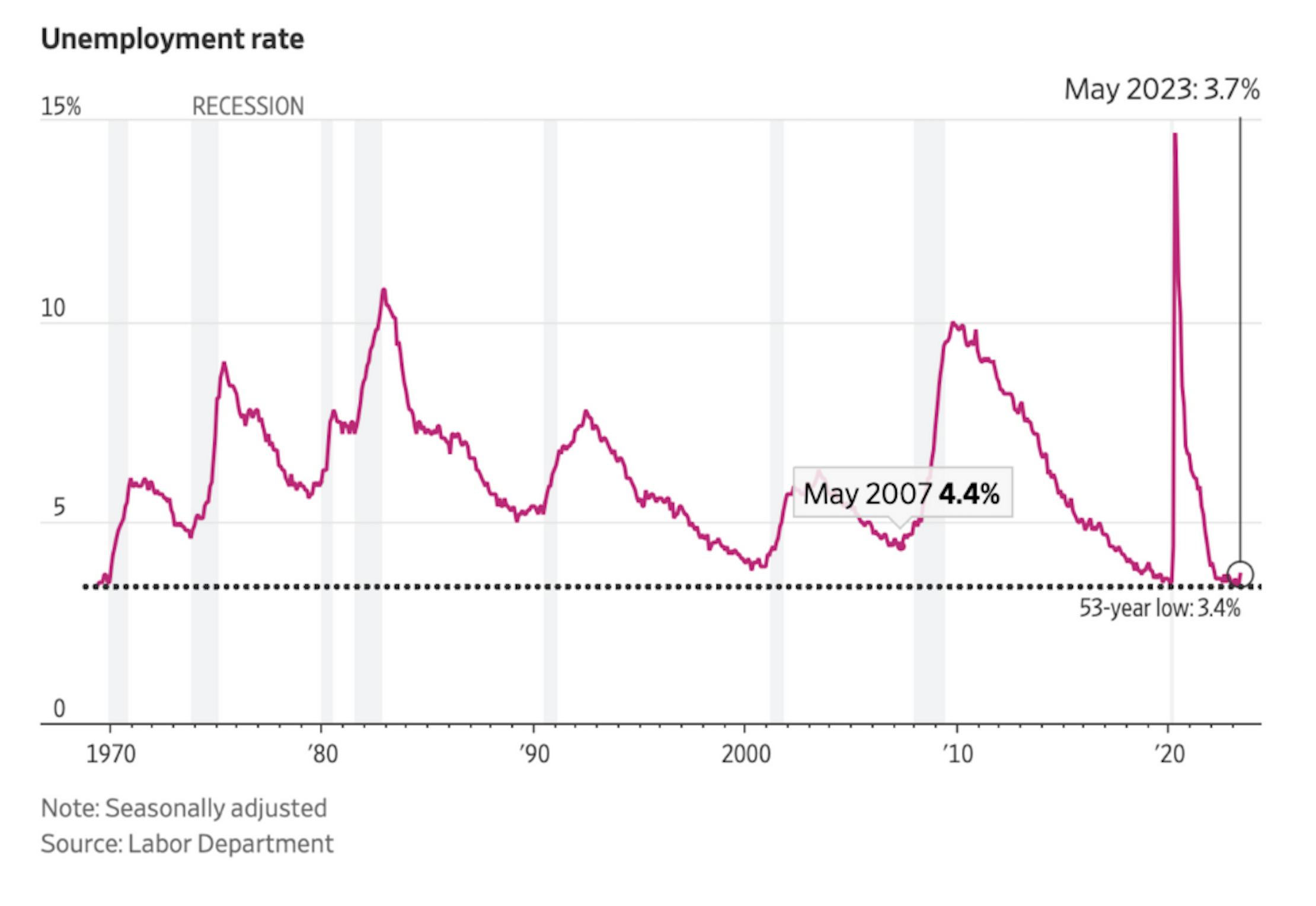
While confidence among job searchers has cooled off - partly due to the same news coverage of layoffs - data and polling firm Morning Consult finds that higher expectations and job switching are durable and persistent. In their State of Workers 2023 Report, the firm found that job searching remains above pre-pandemic levels, and expectations of higher pay for job-switching has remained elevated, even as the actual pay bump from doing so has fallen.
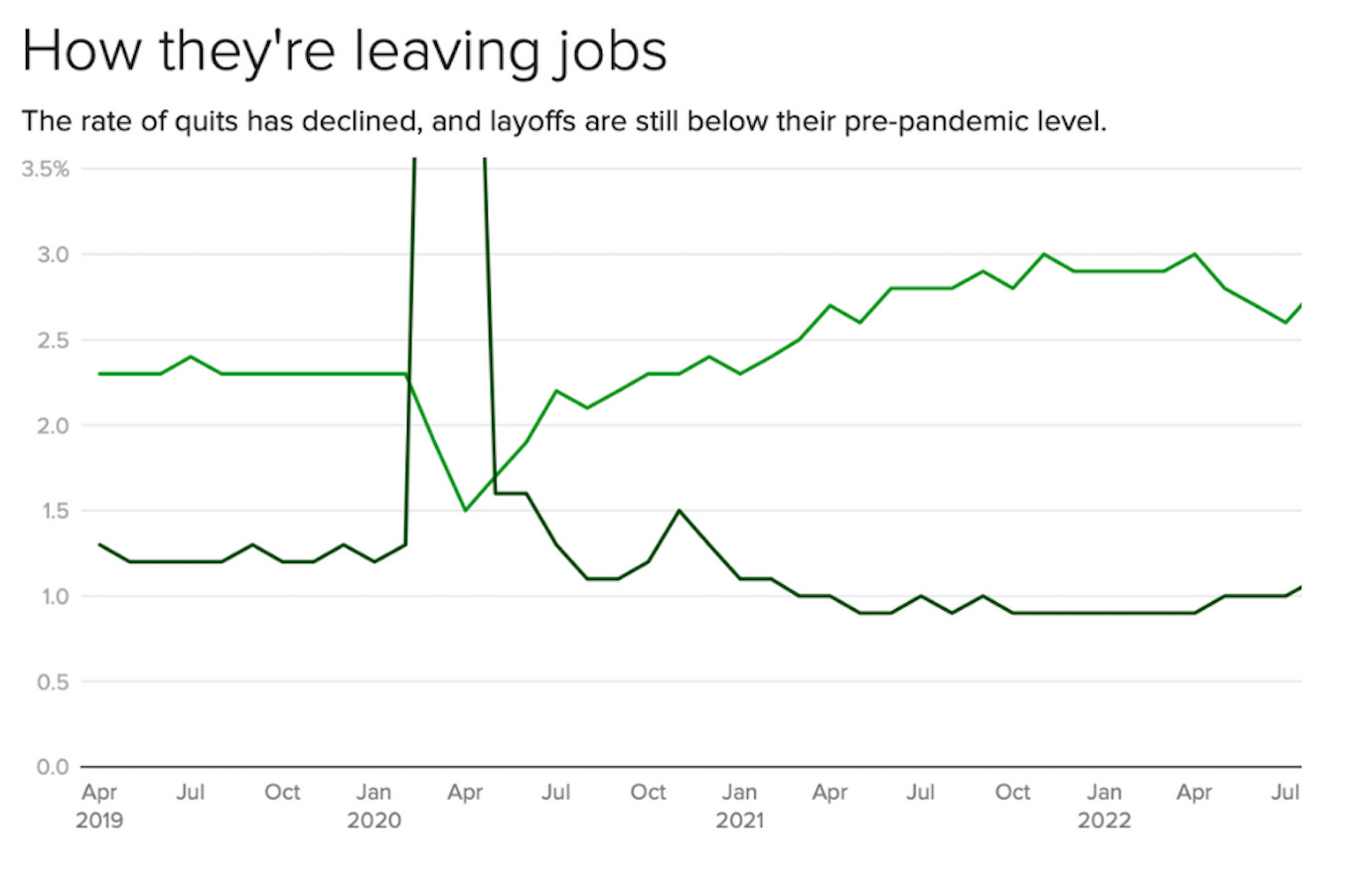
This appears to reflect structural changes in employees' expectations, with a bias towards job switching being built in, quiet quitting seen as more legitimate, and salary expectations for 2023 elevated from pre-pandemic levels. As Vistage’s Head of Research, Joe Galvin, put it at the recent executive summit in Philadelphia, “[Hiring] will get easier, not easy”, no matter how much the news focuses on layoffs.
Labor quality surpasses availability as top problem for small businesses
While much attention goes to monthly job reports, labor availability is being replaced by quality as a top concern for small businesses. The National Federation of Independent Business (NFIB), an industry group for small business, reported that 17% of small business owners’ plan to fill open positions in the next three months. They also expect to pay more for talent, with 40% reported raising compensation and an additional 21% planning to raise compensation in the next three months.
However, the same survey found labor quality was small businesses’ top concern, with nearly a quarter of surveyed firms reporting problems, surpassing inflation at 23% and labor cost at just 9%. This trend makes sense as elevated quit-rates have taken a blender to the workforce, often not creating good-fits in the process and creating an unwelcome tailwind for low US employee engagement rates.
Nearly 100 million workers have changed jobs since the pandemic, taxing systems like HR and onboarding while workplaces undergo rapid disruption. Merely paying more for talent is an ineffectual shift and does little to solve labor quality concerns that are likely to be a medium term symptom of the current labor market.
Ken’s Take Away: Focusing on boosting retention through streamlined hiring processes (this is a growing painpoint for white collar employees), onboarding improvements, and identifying sources of immediate hire-to-overwork, are likely to see a higher ROI than raising compensation alone to attract relatively mobile talent. Alternatively, as early-career labor markets cool down and AI vendors proliferate, a combination of new talent and tech could offer a way to ease internal pressures on top talent while bootstrapping innovation.
Additional Labor Market Reading:
Not a Tech Firm? Snaring Top Laid-Off Tech Talent Won’t Be Easy. (WSJ)
Nine Rounds of Interviews and No Call Back: It’s Harder Than Ever to Land a White Collar Job. (WSJ)
Americans Have Never Been So Unwilling to Relocate for a New Job. (Bloomberg)
HR and Compliance
National Labor Relations Board Gets More Aggressive with Violations
Since last October, unfair labor practice charges have increased 16% according to the National Labor Relations Board (NLRB). NLRB General Counsel Jennifer Abruzzo said such numbers reflect more workers learning of, and exercising, their rights to collective action and bargaining in the workplace. The trend comes after NLRB leadership expanded their scope with several legal opinions which boost employee rights within the act, and the board’s own authority to reinterpret the law on issues like noncompetes, unionization, and unfair dismissal.
The rise in cases is a natural conclusion of increased action against workers meeting a move towards greater transparency on otherwise taboo topics in the workplace, especially for younger workers on Tik Tok. There’s also overlap between resurgent unionization efforts and the increased cases as recent rulings have loosened what counts as tampering with unionization effects, according to Stephanie Caffera, a labor and employment partner at law firm Nixon Peabody “Nonunion employers need to pay close attention to the NLRA in ways they have not had to do before, because NLRA rights affect many aspects of employment such as social media and confidentiality policies, the handling of employee complaints, and employee discipline and discharge,” she said.
Given the scrutiny from NLRB, here are some learnings from recent cases:
Become familiar with “protected concerted activity.” This cornerstone of labor policy means that employees have the right to discuss their wages and salaries and to speak up about workplace safety and other working conditions. “Some of those complaints can get heated, and savvy employees are filing unfair labor practice charges based on their employer’s response.”
Understand the NLRB’s view on unlawful threats. Employers should be aware that statements about the possible outcomes of collective bargaining, the risks of unionization and other comments may now be considered unlawful threats.
Rethink approach to employee relations. Employees who feel they are heard inside their organization and have the support of their managers, will first use those pathways to resolve their concerns. As Caffera put it, the main reason employees seek to form a union is because of how they are treated by their direct supervisors. Those who don’t have that confidence in their managers will turn outward—to a union, an enforcement agency or an attorney.
Traditionally California, Illinois, and New York have been the leading indicators of how difficult hiring regulations will get. A couple of new rules out of Washington State have suggested Olympia may be adding a new state into the mix.
For example, Washington passed a law (SB 5123), that prohibits employers from making hiring decisions based on off-duty cannabis use, or pre-employment drug tests. The state also passed a law that protects workers from productivity quotas.
Ken’s Take Away: Both bills reflect the increased legislative activity of labor organizers, who are also pushing similar legislation in dozens of states. While the latter bill is currently limited to warehouse workers, it could pose a pesky precedent for managers in the future.
Managing Employee Fear around AI Adoption
May saw the first meaningful proliferation of AI ‘fear anecdotes’. For business journalists, it became chip shot content to write of people getting fired by AI, to white collar workers now walking dogs to mental health phone operators replaced by a chat bot. This fear came to the fore with two stories that offer a glance at battle lines to come. First, IBM announced that the company is pausing hiring for 7,800 ‘automatable’ jobs. This is impactful on its own as this automatable jobs category is rather large given the power of generative AI, and even marginally reduced labor cost can significantly change the competitive landscape. It also was met by a flood of fear about the implications for workers.
Read More: CNET Journalists Seek to Unionize, Saying AI ‘Threatens Our Jobs and Reputations’. (Bloomberg)
While IBM did this well, the fear and anxiety induced by AI automation was embodied in the Writers’s Guild of America striking over fear that major studios would automate their workers the moment they could. Such stories are leading to broad skepticism of AI, with widespread use of AI being a negative for prospective employees across all generational cohorts according to Morning Consult’s State of the Worker 2023 Report
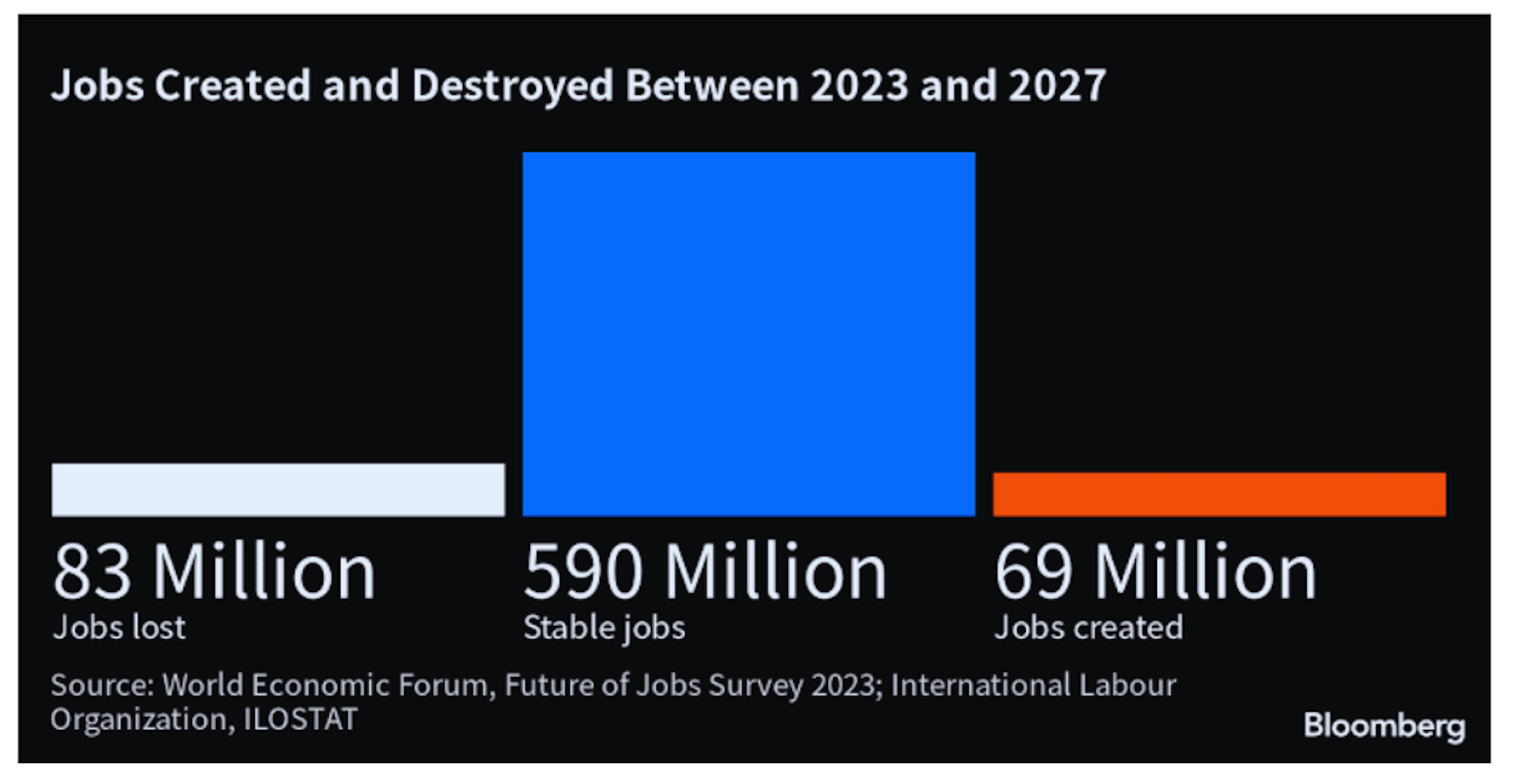
Ken’s Take Away: Given that demographics, labor market stress, and competitive pressures are conspiring to make technological transformation critical, it is important to ensure that any AI adoption efforts are designed with the fears of employees in mind, so that AI doesn't accidentally exacerbate labor woes.
Instead of focusing on headline technologies (there is a joke in the industry that it's only AI on a powerpoint), emphasize the practical benefits to employees mentioned above. Also, given the increased expectation facing CEOs and disruption facing employees, providing cognitive clarity and stability (via training, educational resources, clear positions regarding how AI will affect your workforce) can avoid luddite responses to innovation that undermine the productivity advances of exciting tech.
Additional HR Reading:
Is It HR’s Job to Ensure Workers Are Happy? (SHRM)
How not to lay off: Big Tech Layoffs Leave HR Professionals with Key Questions. (SHRM)
Corporate Diversity Programs Get Religion. (WSJ)
AI Anxiety: How These 20 Jobs Will Be Transformed By Generative Artificial Intelligence. (Fortune)
American Workers Testing Positive for Marijuana Reaches 25-Year Record. (WSJ)
Culture and Engagement
Losing Faith in Traditional Ideas, Americans Put Increasingly Unrealistic Expectations on Their CEO
The traditional values associated with Americans are rapidly eroding. Recent polling by the University of Chicago found that Americans, especially younger ones, are caring less about community, religion, and the country at rapid rates, with only money increasing. This situation is raising expectations on CEOs who Americans now trust more than traditional institutions like the government, military, and media according to Edleman’s Trust Barometer.
The report found that 61% of people surveyed expressed trust in businesses — significantly higher than the number who trusted governments or the media. Trust in governments worldwide dropped to 53%, after seeing an 11-point surge in May during the coronavirus pandemic. "Trust has actually gone local," Edelman said. "Business is the most trusted institution, but 'my employer' and 'my employer CEO' and even 'my employer publication' — newsletter — is more trusted than media."
More than three-quarters of respondents worldwide, and 72% in the U.S., said they trusted their employer "to do what is right." "It's a big responsibility now for businesses to be part of the information flow — not replacing mainstream media, but supplementing with quality information that the employees can use in their everyday lives," Edelman said. With the responsibility also comes new demands of businesses and their CEOs.
"The events of this past year reinforced business' responsibility to lead on societal issues such as upskilling workers and racial justice," Edelman said in the press release. "It has also led to new expectations of business expanding its remit into unfamiliar areas, such as providing and safeguarding information." Nine in ten respondents said they want CEOs to speak out about racial issues, the pandemic and job automation, while 53% of respondents believed that corporations need to fill the information void "when news media is absent." Additionally, this trust comes with greater expectations in the workplace, with 60% and 50% of millennials and genZs respectively believing that layoffs were avoidable.
Ken’s Take Away: While the rise of quiet quitting might hint at what happens if this nascent trust is lost, this greater position of responsibility for corporate leaders is a great opportunity to provide workers with the clarity and confidence that raise commitment. On the flip side, transparency of expectations and offerings is critical to make sure the gap between employees' expectations and employers' reality does not widen to a critical level.
Employee Resource Groups for Caregivers Offer Powerful Benefits
As the compensation merry go round carries no promises of attracting better talent (per the included labor quality story), understanding common employee pain points can add higher impact and lower cost perks to the mix. A 2022 white paper, published by the Rosalynn Carter Institute for Caregivers, found that one in five employees serves as an unpaid caregiver for a family member who is aging, ill or disabled. These employees miss an average of 3.2 days a month to provide care, and are also at greater risk of quitting: Nearly one-third of caregiver employees have voluntarily left a job because of their caregiving responsibilities, according to the institute’s research. These employees who need the most help are part of the “sandwich generation,” struggling with caring for both young children and elderly parents.
Caregiver Employee Resource Groups have successfully advocated for a spectrum of benefits at some companies. Among other things, a growing number of companies have employee paid time off for caregiving outside of sick days and parental leave, as well as coverage for the cost of home-care aides. For their part, firms are recognizing how appealing more tailored and empathetic benefits can be for employees who are likely to see the value of such resources beyond a purely monetary addition to total compensation.
Quantifying the Enterprise Value of Culture
The claim that a company’s best assets are its people is now being built in to investment strategies with three ETFs that profit from the undervaluation of an employee-friendly corporate culture, the Financial Times reports. Workers’ views of their companies are scored across seven categories to create a Human Capital rating. The data to construct each rating is exclusively drawn from a proprietary database and public websites, such as Glassdoor, where employees review their former employers.
Research on the data has shown that financial performance was strongly correlated with employees’ perceptions of autonomy, fairness, trust, alignment of interests and psychological safety, while easily measured metrics such as job titles and benefits provide weaker performance signals.

JP Morgan researchers concluded that the ETF offers a potential source of market beating returns. Such gains come as businesses are increasingly damaged by high turnover and less engaged workers. While this trend is quite far upstream from the PE or M&A valuation techniques that can often drive decisions, take solace in the fact that efforts to boost cultural competences will increasingly affect business valuations.
Additional Workplace Reading:
The Future Workplace Depends on Efficiency, Effectiveness, and Balance. (MIT Sloan)
So The Boss Wants to Make You More Efficient. (WSJ)
The shared workspace trend is growing, but researchers say many companies are doing it wrong. (WSJ)
Is Changing How Americans Find Jobs and Get Promoted. (Gizmodo)
Why Remote Work Could Lead to Less Innovation. (WSJ)
Multigenerational Workforce
GenZ Stereotypes Hide Some Rough Potential
It's hard to say whether GenZs or Millennials have gotten a worse wrap. As the former enters the workplace, they are less excited about work, lie more, are more likely to burnout, use phones more and take longer breaks. While certainly based in an ugly truth about GenZ at work, generational stereotypes are so pervasive - and generally not positive - that Gallup has stopped publishing their generational data.
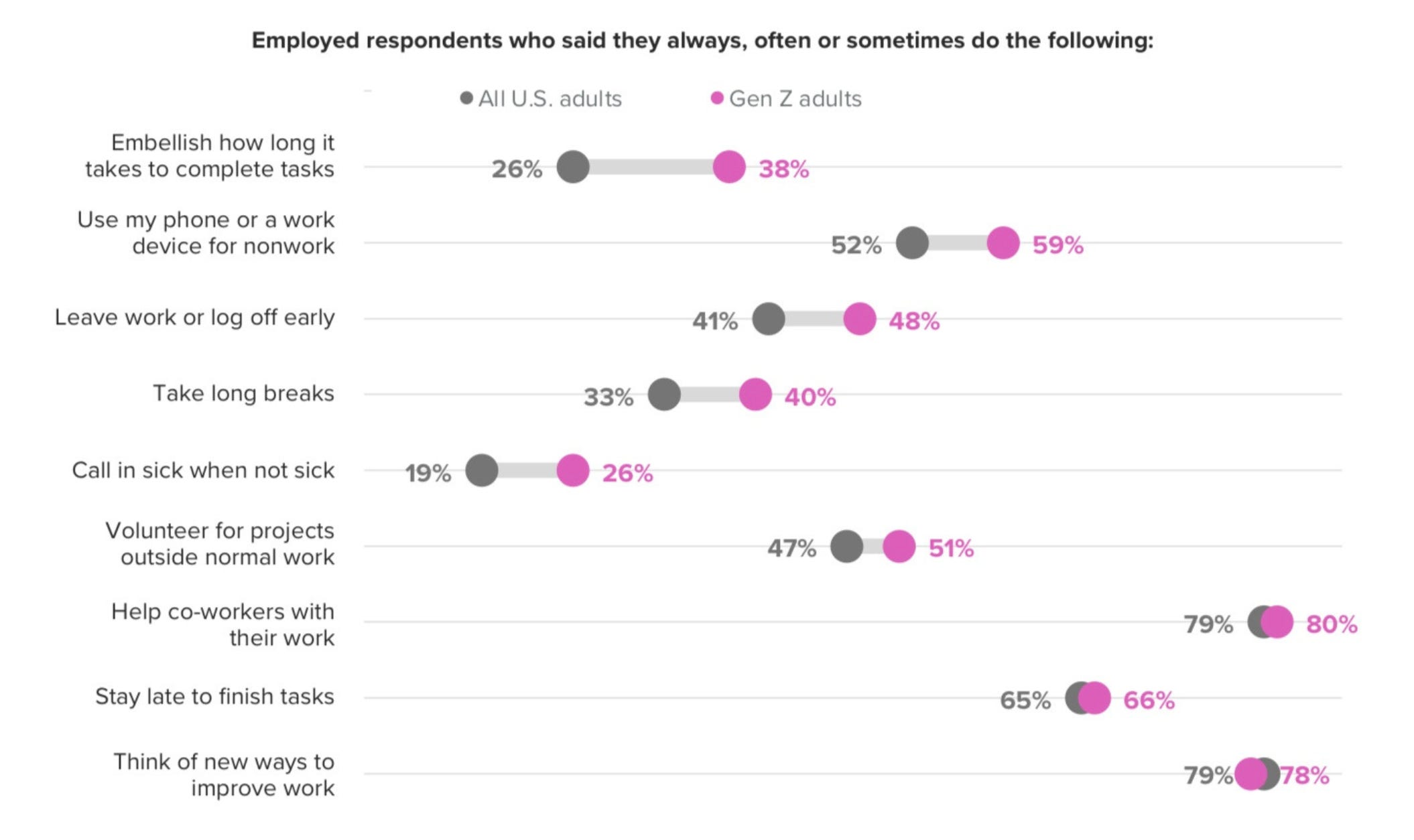
However the problem with stereotypes is they are often misleading, as on the remote work issue where younger workers increasingly don't mind going in. Such stereotypes also hide some of the value that younger workers from this cohort can offer. They are more empathetic, likely to help coworkers, and increasingly go into the office which they see - in part - as justification for higher compensation and faster career progression.
Data also suggests there is a subset of about 15-20% of the cohort who are more likely to stay late, work on weekends, and report intellectual stimulation as their top driver. This cohort is data savvy, hard working, and painfully aware of their need to overcome the stereotypes about them.
Ken’s Take Away: This subset of GenZ ‘type A players’ is invaluable for innovation and succession and are hungry to prove themselves … if you can find them among the mountain of identical applications.
Social-Pressure-Headaches as Culture Wars Rage
A string of high profile skirmishes in the ‘culture wars’ against marketing initiatives for Pride month have inadvertently cast attention on companies waning commitments to diversity equity and inclusion (DEI). Such commitments, many made in the backlash of Summer 2020’s George Floyd protests, included increased resources and attention to DEI issues.
Unable to placate either audience, CEOs have recently been retreating from maximalist stances given the no-win nature of current social divides. While this is mostly constrained to the consumer space where ‘political elasticity of demand’ matters more, it has generated backlash against ESG and DEI related efforts in states like Florida and Texas.
While the backlash from either side of the political spectrum has been fairly short lived for brands caught in the fire storm, efforts to ban companies institutionalizing social stances is starting to create actual policy consequences, for example inFlorida where the state made DEI training illegal for firms to require.
Ken’s Take Away: For most B2B firms, these skirmishes have little direct impact. However, with a contentious election beginning to gear up, it is worth revisiting any past DEI commitments to protect against being blindsided. This is especially the case as such initiatives have been wrapped up in cost cutting initiatives and slowly generating employee backlash online.
Additional Multigenerational Reading:
New Grads Use ChatGPT in Job Search. (SHRM)
Young Workers Value Work-Life Balance. They’re Just Bad at It. (WSJ)
Okay Boomer: The Largest Generation’s Lasting Impact on Staffing. (CultureWise)
3 Things Today's College Grads Want Most out of Their First Jobs. (Money)
Job growth cools for college grads, but ‘there’s still a lot of opportunity,’ career expert says. (CNBC)
In Other News
If Fed Rate Increases Hit Small Businesses the Hardest. (WSJ)
Firm Migrations in the United States: Magnitude and Trends. (Bureau of Labor Statistics)
AI Literacy, Explained. (Education Week)
Video: A Business Leader’s Guide to Artificial Intelligence. (Morning Consult)
How Much Do Labor Costs Drive Inflation? Spoiler: Actually Very Little (Federal Reserve Bank of San Francisco)
YouTube Creator Ecosystem Supports More Than 390,000 Full-Time Equivalent Jobs. (Forbes)
AI Is Reshaping Jobs. Here Are the Companies to Watch. (Barrons)
A Once-in-a-Generation Convergence of Technology and Pressure to Operate more Efficiently has Corporations Saying Many Lost Jobs may Never Return. (WSJ)
How AI Will Change the Workplace. (WSJ)
Generative AI at Work: Effects on Labor Productivity. (National Bureau of Economic Research)
Offices Remain Half-Empty as Companies Settle into Hybrid Work Plans. (WSJ)
OpenAI CEO Sam Altman says the Remote Work ‘Experiment’ was a Mistake—and ‘it’s Over’. (Fortune)
A Zero-Tolerance Approach to Talented Jerks in the Workplace is Risky. (The Economist)
Cybersecurity Leaders Suffer Burnout as Pressures of the Job Intensify. (WSJ Pro Cyber)
FTC Brings Charges Over Noncompete Clauses. (SHRM)
America’s Biggest Source of Jobs Is Cooling Off: Entrepreneurs are Being more Cautious with Hiring in Response to Shifts in the Economy and to Rising Wages. (WSJ)