

Welcome back to Human Capital Intelligence! Your go-to source to keep up with the best insights from over 250 leadership, HR, and people sources. As always, we would love to hear from you at ken@reyvism.com with questions you’d like answered or topics covered.
Sent this by a friend? Sign up here to receive HCI in your inbox every week.
By Ken Stibler; Powered by Reyvism
Change as a skill

Thirty-nine percent of core skills will change by 2030, according to the World Bank. MBA programs are rebuilding curricula around judgment as everything else becomes a commodity. And employers want AI proficiency from new hires…while complaining that Gen Z workers lack the critical thinking to use those tools well (more on that In Other News). Everyone agrees: build new skills. Yet skill (re)development is the right answer to the wrong question.
The harder question is whether your organization can keep building skills indefinitely without the building process itself becoming destabilizing. Reskilling programs have a target. They close a specific gap at a specific moment. What most organizations lack has no target: the ability to keep working while the next requirement is still forming. Call it change tolerance. A leadership discipline, not a training program.
In practice this looks like clear directions from January feeling abstract and inapplicable by February. A major initiative gets reprioritized, two experienced people rotate out, their replacements arrive with different assumptions. Each shift is manageable alone. In combination, they erode alignment faster than leaders can restore it.
No reskilling budget touches that problem. What touches it is whether your managers have the mandate to rebuild shared understanding every time the context moves and whether they have the time. Right now almost none do.
AI is increasingly a distraction from the real work
The organizational energy being spent on AI is starting to crowd out the work AI was supposed to improve. Software engineers describe workplace paralysis from the release cadence alone (major releases have jumped from 18 in 2023 to 69 in 2025) and report spending more time learning, evaluating, and switching tools than building.
Middle managers are buried under oversight: validating AI output, coaching juniors who produce polished deliverables but cannot tell when the analysis is wrong, and interpreting what "AI-enhanced" means for client work with no firm-wide guidance.
The time juniors save producing output is consumed by managers checking it. Manager engagement has fallen from 30% to 22% in two years. Ninety percent of companies use AI in recruiting; fewer than 5% report transformational outcomes on any metric. The attention tax is real, and it is compounding. If your people are spending more time managing AI than doing the work AI is supposed to support, that is worth measuring before adding the next tool.
Quote of the Week:
This is the first time I have seen a technological innovation benefit older workers more than younger workers in terms of job security…All of that deep experience and expertise in a specific profession—but also in those soft skills of critical thinking and understanding at a systems level what’s happening—those are skills that older workers tend to have.”
—Heather Tinsley-Fix, AARP’s senior advisor of employer engagement, on the dilemma facing older workers whose soft skills may be rewarded amid the AI transformation: adapt or retire
Reading List:
Get ready for a wave of “physical AI”
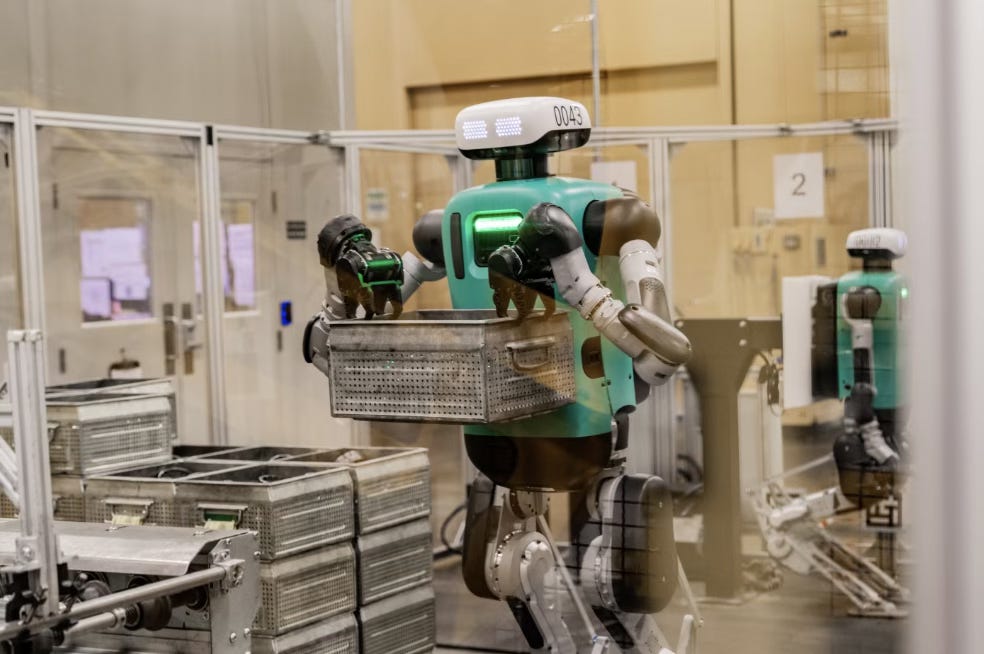
The AI conversation has been dominated by software and knowledge work. The next phase is already getting physical. General Motors installed 50 robot arms at its flagship EV factory while 1,300 workers remain on temporary layoff. JD.com’s founder warned that the company’s 700,000 delivery workers will be replaced by robots sooner or later. Agility Robotics, which makes humanlike robots for warehouses, is going public at a $2.5 billion valuation.
Critical thinking is eroding
A study of 72,000 workers and found Gen Z and millennials are 18% below average in critical thinking, 17% below in attention to detail, 10% below in creative problem solving than other generations. Declining academic standards, weakened vocational pathways, and a generation that onboarded through Zoom rather than by watching experienced colleagues has create a clear but quiet crisis. Now they are using AI tools that produce polished output regardless of whether the judgment behind it is sound. Harvard Business School research confirms the risk: when bonuses depend on outcomes more than accuracy workers actively choose not to examine the AI’s reasoning.
We’re entering an uncompliable territory
Regulators are producing employment law faster than legal teams can implement it. California signed an executive order that could require 90 days' notice for AI-driven layoffs at a threshold of just 25 workers, New York passed a bill that bans companies from posting “fake” jobs, Michigan is debating a bill which makes it illegal to contact employers after work. In aggregate, they are pushing businesses toward a calculation European employers already make routinely: when does compliance risk cost less than compliance itself?
Data Point:
96%
Percentage of HR leaders that that, in the next five years, entry-level employees will be responsible for monitoring AI systems according to Cognizant
In Other News
A 6 year study shows which CEOs are pushing RTO mandates: The ones with the biggest egos. (Fortune)
Inside Consultants’ Messy Shift From Hourly Billing. (WSJ CFO Briefing)
One in three entry-level tasks is now completed by AI: The adaptability imperative. (Cognizant)
Our highly-paid, overworked junior staff keep leaving just as we get them fully trained. (Ask a Manager)
AI Is Learning to Spot Toxic Bosses: Is sacrificing your own privacy worth it to stem your manager’s worst tendencies? (Bloomberg)