

Welcome back to HCI, your go-to source to keep up with the best insights from over 250 leadership, HR, and people sources. As always, we would love to hear from you at ken@reyvism.com with questions you’d like answered or topics covered.
Sent this by a friend? Sign up here to receive HCI in your inbox every week.
By Ken Stibler; Powered by Reyvism
Don’t try to “engage,” declare war on the hated parts of work

People don't hate working, they hate the specific conditions that increasingly make modern work feel uncomfortable. And when you look past the surface of growing “anti-work” movements like Financial Independence, Retire Early (FIRE), the motivation is rarely a desire to sit on a beach. It's a desire to escape the inability to speak honestly, the lack of control over one's own time, and the feeling that employment is a coin flip someone else is making.
The thousands of Google workers petitioning for layoff protections amid record AI investment are expressing the exact same impulse. One group is building an exit; the other is demanding the floor stop moving. Both are reacting to a work environment where volatility and uncertainty feel like permanent features.
Organizations have spent decades trying to "engage" employees by adding things (wellness apps, recognition platforms, culture initiatives). The data consistently shows this doesn't work at scale. What works is removing the things people hate.
A durable post-covid boom in entrepreneurship is evidence that talent will vote with its feet to find clarity over ambiguity, honest communication over corporate euphemism, and predictability where predictability is possible. They aren't leaving because they hate the work. They're leaving because they hate working under conditions they can't influence.
Declaring war on the hated parts of work is a competitive strategy, and the irritants aren't minor splinters. Left unaddressed, they compound into disengagement, attrition, and cultural rot. Organizations that remove ambiguity, create honest feedback loops, and give people genuine control over how they spend their time are doing more than fixing a culture problem. They're building the foundations of durable organizational and talent competitiveness.
A glimpse at HR’s strategic future
Project management software compare Atlassian just hired a Head of Human-AI Collaboration. The title sounds like a novelty, but the mandate is the future of the HR function: deciding what the machines should do and what the humans should do.
The Society for Human Resource Management is already pushing HR professionals to be come skills strategists” who align learning directly to business priorities, while defense agencies are shifting from job descriptions to skills intelligence to map human capability against automated capacity.
The risk of getting this boundary wrong is high. When organizations automate the wrong things, they invite cognitive surrender (the erosion of human judgment as people defer to the machine). They also break the apprenticeship model.
If AI does all the junior work, who mentors the junior staff? Figuring out how to integrate AI without destroying the talent pipeline is the advantage. It’s a massive one. HR is positioned to own this architectural work, but only if it claims the territory.
Quote of the Week: Demanding Layoff Protection
“These layoffs and cuts are not difficult decisions, but simply profit being put over the people that make this company run.”
—a petition from 4,500 Google employees to CEO Sundar Pichai, requesting layoff protections as AI threatens jobs
Reading List:
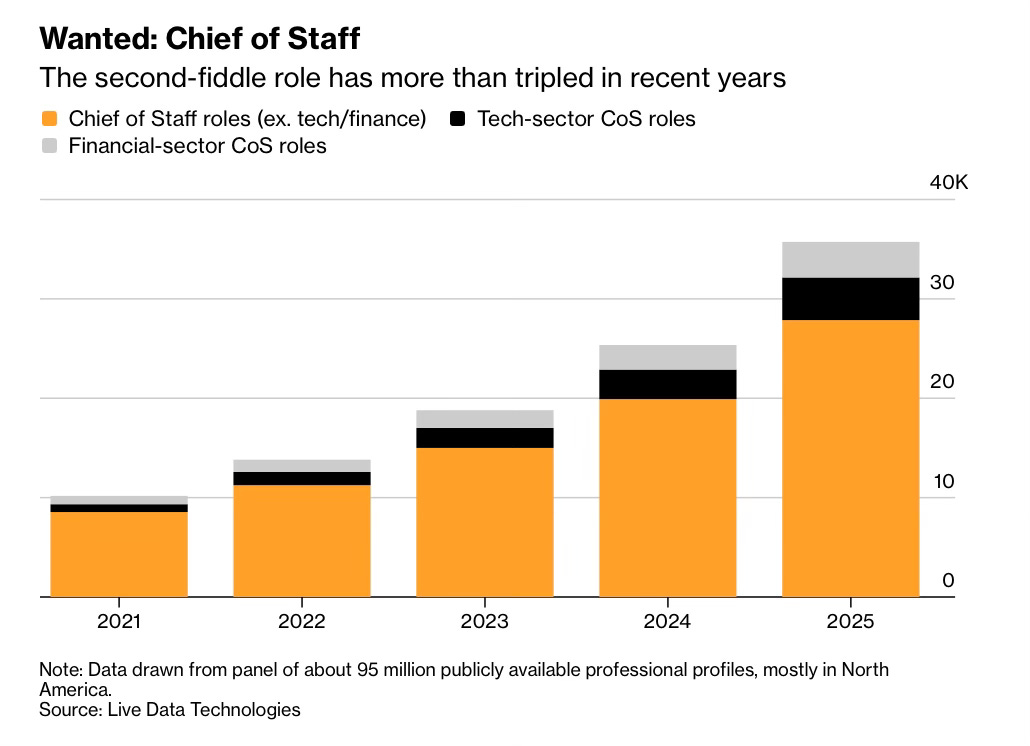
Overwhelmed CEOs increasingly to turn Chiefs of Staff
The complexity of the CEO role has outgrown one person's capacity. The rise of the $400,000 Chief of Staff is an admission that the job has become too large and too fast to run without a second brain. The role functions as a confidante and consigliere, giving a CEO breathing space by amplifying their vision and spearheading strategic projects. If your CEO is overwhelmed and you haven't discussed this role, you're behind.
Do you have an executive onboarding plan?
Most organizations have detailed onboarding for individual contributors and almost nothing for executives. The failure rate of external executive hires is directly attributable to this gap. A great executive onboarding plan requires structured integration: a 90-day plan, stakeholder mapping, and explicit cultural translation. If you're spending six figures on a search and then leaving the new hire to figure the culture out alone, you're wasting the investment.
Deepfakes overwhelm HR’s ability to tell fantastic from fake
AI-generated evidence is already arriving in HR inboxes. Fake doctor's notes, fabricated harassment claims, and synthetic video are overwhelming the verification systems most organizations rely on. Your investigation processes were designed for a world where documents were either real or obviously forged. But that world is gone. If your HR team doesn't have a verification protocol for digital evidence, you're exposed.
Data Point:
47%
The number of workers polled by Gallup who say their organization has adopted AI tools, up from 41% last quarter.
In Other News
The Real Difference in the AI Era: Vision has to come from the top. (WSJ CEO Brief)
The fallacy of the safe role: Why your career security is an inside job. (HR Executive)
Burger King reworks manager role to support guest experience. (Restaurant Dive)
Training AI models might be the chance for a workplace power play: It is becoming clear that the knowledge they require is currently locked inside employees’ heads. (Financial Times)
Front-line workers say they don’t mind AI but want transparency. (HR Dive)
Step Into the ‘Zone of Genius’ (Before A.I. Takes Your Job): A decades-old self-help concept is gaining new purchase among people searching for meaningful work in the age of artificial intelligence. (NYT)