

Welcome back to Human Capital Intelligence! Your go-to source to keep up with the best insights from over 250 leadership, HR, and people sources. As always, we would love to hear from you at ken@reyvism.com with questions you’d like answered or topics covered.
Sent this by a friend? Sign up here to receive HCI in your inbox every week.
By Ken Stibler; Powered by Reyvism
There's a lot of great talent on the market, it takes real systems to access

There are more skilled, recently displaced workers available right now than at any point since the pandemic recovery. The technology sector alone has shed 139,156 jobs through June, up 83% year over year, and AI has been cited in nearly a quarter of all cuts across industries. June payrolls came in at 57,000, well below projections, with the prior two months revised down by 74,000. The talent pool is deep. Most organizations cannot access it because their hiring systems were built for a different market.
The post-pandemic labor market was extraordinarily dynamic. Hiring surged, quits hit unprecedented levels, and workers moved aggressively toward better matches. That dynamism is what made the market healthy -- churn is how workers find higher wages, how firms find better talent, and how the economy reallocates people toward productivity.
What economists are now calling “slack water” is the opposite. Hiring is subdued, separations are scarce, and the matching process has frozen. The unemployment rate sits at 4.2% and looks fine. Underneath, the market is going sclerotic. A worker who would have changed jobs for a raise stays put. A firm that would have taken a chance on someone new holds off. Opportunities stop materializing.
That is a problem for the economy. For you, it is an opportunity…if you have the systems to act on it. In a frozen market, the best people are not applying. They are sitting tight, waiting. Reaching them requires outbound sourcing, referral infrastructure, and speed. If you built those systems during the tight years, you still have them. If you relied on inbound volume and job boards, you are staring at a pool of exceptional people with no way to reach them. The window will close when hiring picks back up and those people land somewhere else. Right now, it is open.
Soft skills are hard and hard skills are soft?
The skills that are hardest to hire for, most expensive to develop, and most resistant to automation are all “soft.” The skills that are easiest to learn, cheapest to source, and most vulnerable to automation are all “hard.” The conventional hierarchy has inverted. Software engineers are finding that the bottleneck with AI coding tools is cognitive, not technical.
The transition from writing code to reviewing and directing it requires ego management, intentional skepticism, and precise communication. Without those skills, developers waste hours rewriting functional automated output to match their personal style, or worse, blindly accept code that introduces technical debt.
Ford figured this out the expensive way. After recalls cost the automaker $4.8 billion per year, the company hired 350 veteran engineers specifically for their judgment and mentorship. They run mandatory peer design reviews to hunt for failure points before blueprints reach the factory floor, and they reprogram ineffective AI tools. The result is a jump from 10th to 1st in the JD Power Initial Quality Survey. The company attributes the turnaround to a culture change emphasizing the role of human workers.
Most organizations’ hiring criteria, compensation structures, and development budgets have not caught up to this inversion. They are still screening for syntax and syntax is now a commodity. If your hiring criteria, compensation structure, and development budget still prioritize technical skills over judgment and adaptability, they are optimized for a world that no longer exists.
Quote of the Week:
“The differentiators that turned AI into real performance included discernment, curiosity, connection and humility. Smart companies will ultimately shift to measuring how employees execute strong judgement in AI usage, instead of usage or tokens alone.”
— Leslie Caputo, organizational psychologist and SVP of global solutions at coaching platform EZRA
Reading List:
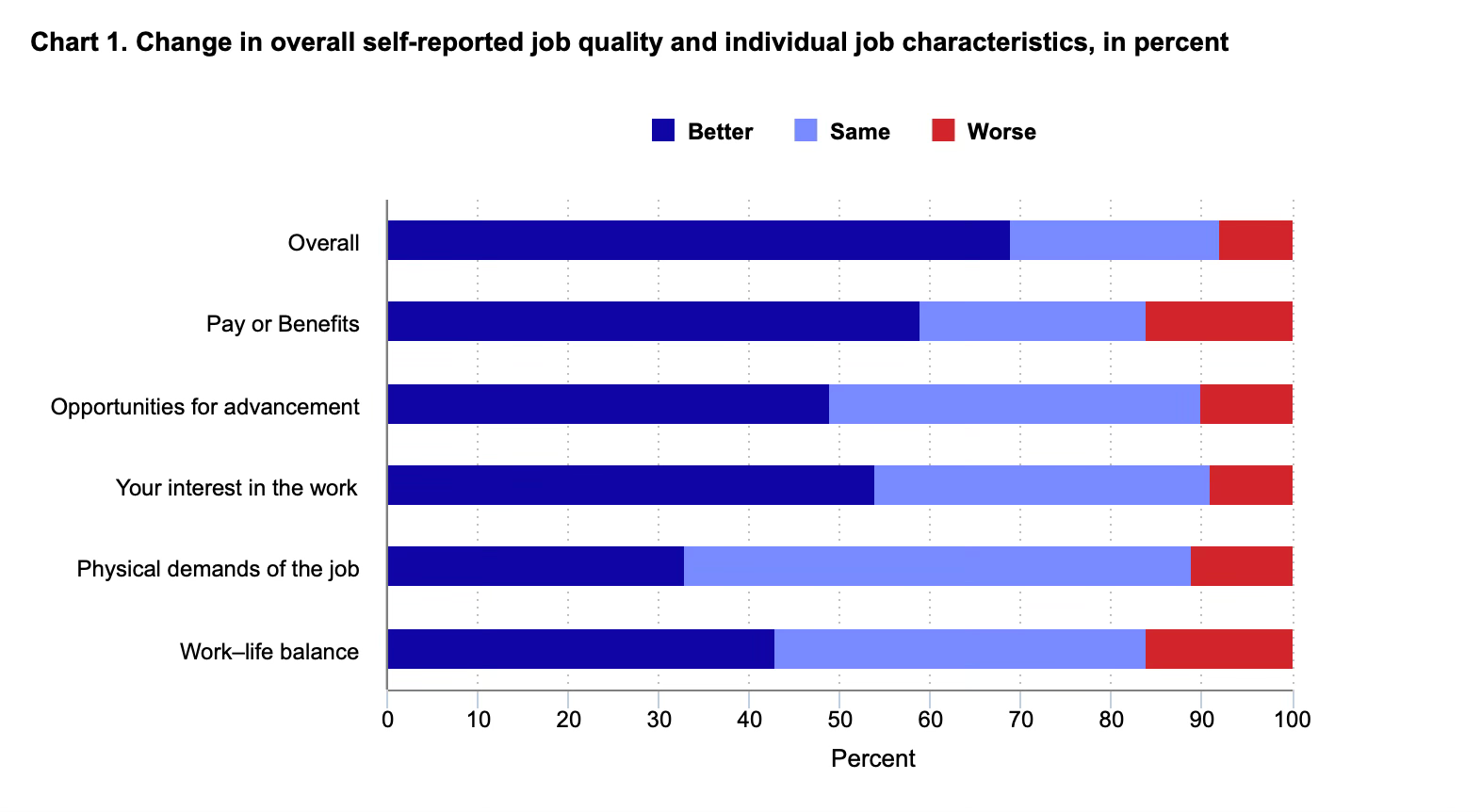
Interesting work drives engagement, can "interesting" be a part of every job?
Controlling for pay and benefits, workers who found their new job more interesting than their last one were 27% more likely to rate it better overall. Better work-life balance made them 18% more likely to prefer the new role. This data from the Bureau of Labor Statistics arrives as Gallup estimates 8 million people have disengaged at work since 2020. If you are losing people and your compensation is competitive, the problem may be that the work itself is boring. If AI is automating the interesting parts of a role while leaving the tedious oversight, you are making this worse.
Jobs are "senioritizating"
Entry-level AI-exposed roles are now seven times more likely to require skills traditionally associated with senior employees, including judgment, leadership, and face-to-face persuasion. Job openings for these newly elevated roles grew 35% since 2019, while traditional entry-level openings shrank 10%. The routine coordination and documentation work that once helped new employees build context is now handled by software. The consequence is that the first rung of the career ladder is structurally disappearing. If you are not deliberately building the judgment layer into early-career roles, you are contributing to a structural problem that will embedded in your org chart in five years.
Getting specific about where AI shouldn't be used in people
Managers are using chatbots to write performance reviews, draft PIPs, and decide who to promote. One sales strategist described her boss consulting ChatGPT like a "Bible," generating constant strategic pivots, monitoring Slack messages for tone, and overriding her judgment with the model's output. The pattern is consistent: the manager already has a decision and uses the tool to validate it. That is corrosive in a specific way. It removes the friction that forces a manager to defend a personnel decision to themselves before making it. If you are tracking AI use in performance reviews, you are measuring the wrong thing. Volume of AI use tells you nothing. Judgment in AI use tells you everything.
Data Point: Feeling the Squeeze
52%
Percentage of US workers are planning staycations this summer as costs rise.
In Other News
CEO of $248 billion cybersecurity company says workers are about to face a ‘Darwinian moment’ thanks to AI: Evolve or get cut. (Fortune)
Remote Work Is Making It Harder for Grads to Find (and Keep) Jobs: New research argues that frustration among employers over remote work may be leading them to cut back on hiring young workers. (Wall Street Journal)
Early career workers’ wages can’t match inflation, Glassdoor finds. (HR Dive)
White-collar America is having a nervous breakdown about AI: “For the first time in at least a generation,” an economist said, “the future is up for grabs, and they might not end up on top”. (Quartz)
Gartner Says CHROs Must Identify Hidden Workforce Costs to Protect AI ROI. (Gartner)
The diminishing political returns of a solid labor market. (Morning Money)