

Welcome back to HCI, your go-to source to keep up with the best insights from over 250 leadership, HR, and people sources. As always, we would love to hear from you at ken@reyvism.com with questions you’d like answered or topics covered.
Sent this by a friend? Sign up here to receive HCI in your inbox every week.
By Ken Stibler; Powered by Reyvism
Invest in your leadership pipeline before the river runs dry

Boards are calling retired CEOs back to work en-masse. Verizon, Boeing, and Cracker Barrel all tapped former executives who had already hung it up to fill their corner offices.
In the first half of 2026, 34% of CEOs appointed by S&P 500 companies previously led a public company, up from 22% a year prior. External hires are up from 18% to 33%. The supply chain for executive leadership is breaking down, and companies are reaching into the past because they didn’t build for the future.
The breakdown starts in the middle. Roughly a quarter of white-collar professionals hit a wall in their careers before their peak earning years, going at least five years without a real boost in pay or position. High-achieving corporate professionals are paying $4,000 for existential midlife retreats to process burnout, disillusionment, and the feeling that they are stuck in toxic environments where good ideas go to die. The people you need to run your organization in five years are currently stalled, exhausted, or looking for an exit.
If leadership is a supply chain, then most organizations have been running it just-in-time for decades, assuming the talent would be there when they needed it. Increasingly though, it isn’t there.
When this for-granted pipeline runs dry, the fix is expensive and usually involves bringing in outsiders who don’t know the culture or retirees who are kicking the can down the road. The time to invest in the people who will run your business is before you are desperate for them. Engagement efforts, mentorship, and ongoing training are known best practices, and while their expense can feel tough to justify quarter by quarter (spending is falling on all non-AI categories), its a lot cheaper than over-paying for outside talent.
Job market numbers are getting wacky
Labor market math just changed. The economy lost 23,000 jobs in July, defying estimates of an 85,000 gain. Something this bad used to signal a recession, yet the unemployment rate actually fell to 4.1%.
The seemingly contradictory (and slightly nerdy) numbers focuses masks a real people ops problem - the labor pool is rapidly shrinking. For years, the economy needed 125,000 to 150,000 new jobs a month just to keep unemployment steady and accommodate new entrants. Oxford Economics estimates that breakeven rate is now around 50,000.
Between restrictive immigration policies slashing the supply of foreign-born labor and the baby boomer retirement tsunami peaking over the next three years, that breakeven rate is heading to zero next year. It will turn negative in 2028. You can have a shrinking number of employed people and a stable unemployment rate at the same time.
For business planners trying to staff up, this is the reality check. The labor shortage is now structural, and the workers needed are not likely waiting on the sidelines for the economy to recover. They are retiring, or they are not entering the country. If you are holding out for the labor market to loosen up and make hiring easy again, you are waiting for a demographic reality that no longer exists.
Quote of the Week: Understanding before Decision
"The best leaders I've worked with do something different. They ask questions. They listen. They seek to understand before they decide."
— Mike Wirth, CEO, Chevron
Reading List:
Companies move away from standard raises towards more performance-based compensation
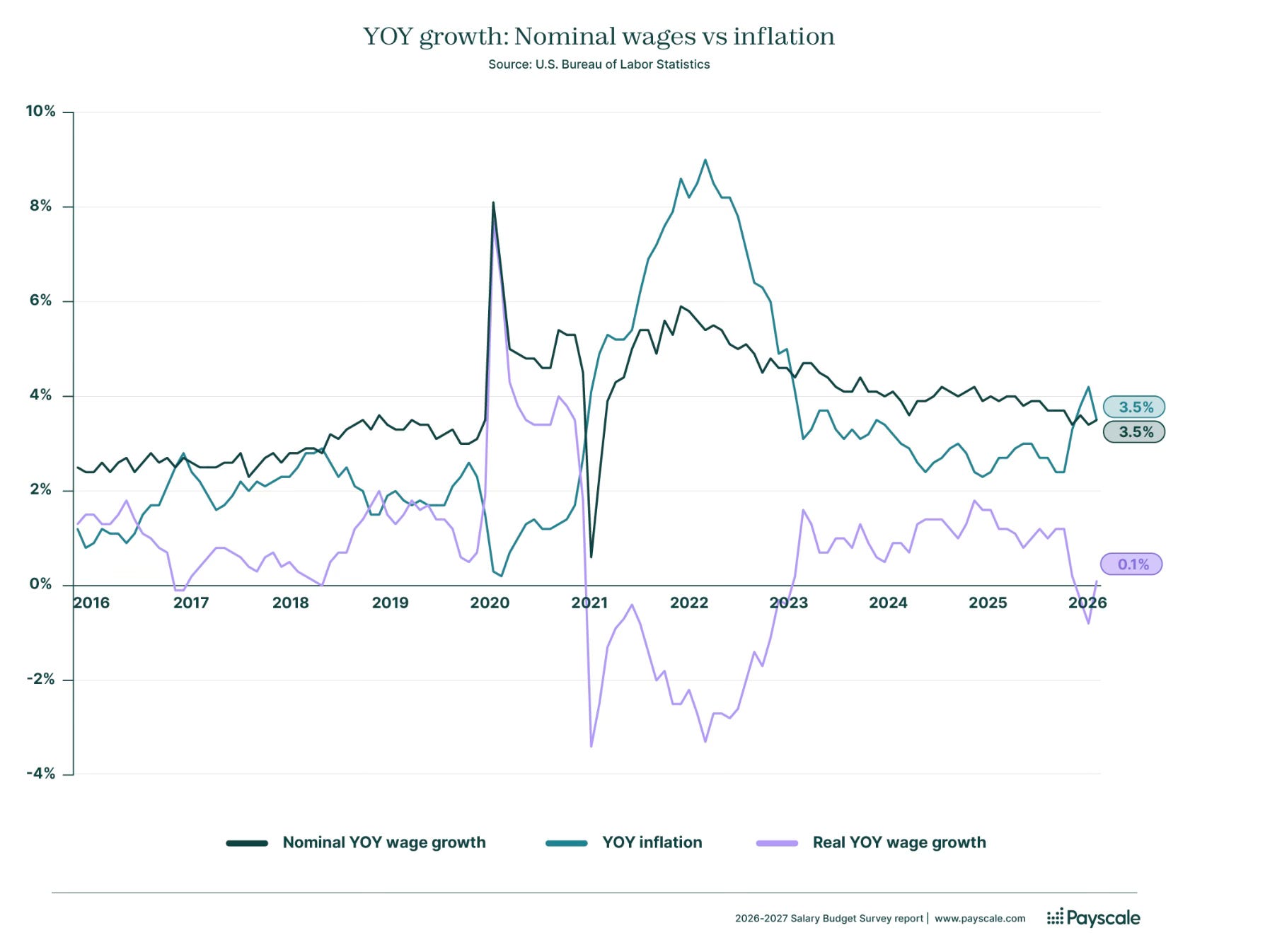
The era of the automatic 3% raise appears to be ending. In 2026, only 36% of U.S. organizations gave across-the-board pay increases. Only 32% plan to do it in 2027, according to Payscale’s Annual Salary Budget Survey. Those “peanut butter raises” (so named because the budget is spread evenly across the org) are actively demotivating high performers. With a quarter of firms losing employees last year due to insufficient pay increases. it seems that merit-based pay will de-facto become the norm even outside of sales.
Why you should lead like Ted Lasso
Last week we looked at why leading like Ted Lasso can backfire, when excessive optimism becomes denial and kindness becomes an inability to make hard calls. Lasso's appeal still rests on a genuine leadership discipline. One specific scene that’s a leadership classic to me is where Lasso playing darts, repeating the quote "be curious, not judgmental." It's easy to assume we already know the answer. but the best leaders ask questions and listen before deciding. Arizona State professor Christopher Neck makes the broader case for “Lasso leadership”: investing in people creates belief, and belief produces business results. Curiosity and kindness can work well, just as long as they come with standards, judgment and the willingness to take difficult actions.
Employees turn to AI-generated salary ranges, here's how to respond
Your employees are bringing ChatGPT-generated salary ranges into compensation talks and treating them like truth. The tool can’t see your internal equity, role scope or budget: an employee may see $95,000 for a role the business/market/niche can only support at $82,000. Rather than dismiss the number out of hand, these AI ranges can be an opportunity to explain how your organization makes pay decisions, how the role is calibrated, what the budget supports and where the employee can grow.
Data Point: Going back to the well
34%
Number of CEOs appointed by S&P 500 companies in the first half of 2026 previously led a public company, up from 22% the year prior according to Russell Reynolds Associates.
In Other News
Who needs consultants in the age of AI? Getting a company to implement recommended changes is a contact sport that only humans can play. (Financial Times)
Can America retrain workers before AI leaves them behind? Success will require investing in employees as seriously as America invests in chips. (The Economist)
Every company has an AI strategy. Very few have a human strategy. (AdaRose)
Return-to-office mandates are killing workplace trust. (The Hill)
Gen X employees say they are burned out from caregiving responsibilities. (HR Dive)
Does outplacement need a makeover? Enter ‘outskilling’. (HR Brew)