

Welcome back to HCI, your go-to source to keep up with the best insights from over 250 leadership, HR, and people sources. As always, we would love to hear from you at ken@reyvism.com with questions you’d like answered or topics covered.
Sent this by a friend? Sign up here to receive HCI in your inbox every week.
By Ken Stibler; Powered by Reyvism
Leadership’s next challenge: saying no to AI madness

Every new AI announcement is starting to feel like a mini crisis. Whether global concerns or rushed conversations about what a competitor is doing, it’s easier than ever to feel always behind, and that immediate action is required.
This condition produces a lot of activity and very little judgment. Given that major change initiatives take more than three months to recover from on average, most leaders are planning around a disruption that shows no sign of ending anytime soon.
Saying no is how leaders give an organization room to think. The problem starts when every task becomes a candidate for automation and every new model triggers even low-grade changes.
While the change budget is being taxes, the real budget is being distorted. Customer-service organizations are among many already moving budget from people to technology: AI spending rose 38% while total service-and-support budgets grew 2%.
As just one anecdote of many such re-allocations, raiding the customer service budget leaves fewer people handling the cases where context, relationships or difficult judgment matter. When we’re moving money from revenue-centric activity to back-office tech, it’s a good bet that things have gone too far.
Leadership is pushing AI, and only leadership can set the boundary. Teams will keep saying yes when a new tool promises speed. Leadership has to decide which work needs a slower process: consequential people decisions, customer escalations, novel strategy questions and the coaching conversations where managers learn to make a call.
Give every deployment a business problem, a human owner, a quality measure and a date to reassess it. Stop the ones that create churn, rework or more supervision than value. Basic quality and competitive advantage may soon come down to the discipline to say no in a world rushing to remove human an equation that doesn’t work without it.
Talent issues throttle company growth while HR is collecting unfunded initiatives
A company cannot outgrow the people doing the work, yet many growth plans assume exactly that. 61% of employers expect revenue growth by 2027, while only half expect to add headcount. At the same time, 63% reported turnover of at least 10% last year. Every departure stretches the people left behind, slows decisions and puts more work on managers carrying adoption, performance and retention.
HR is handed the clean-up work. Retain people. Improve manager capability. Build trust around AI. Redesign performance. Collect feedback. More than half of employers have run an engagement survey since 2024 and still have not acted on it.
Meanwhile, 55% of HR leaders have considered leaving the profession in the past year, driven by feeling undervalued, operating in crisis mode and burnout. Before adding another priority, ask who owns it, what capacity they have, what will stop and which business result will move. If none of those answers exist, HR is collecting requests, not supporting a growth agenda.
Quote of the Week: New Job Descriptions
About 1% of US professional jobs are now “AI jobs,” i.e. jobs that wouldn’t otherwise exist without this technology. The share of AI jobs in computer and life sciences is estimated to be even higher, at 4–5%.
— Data from The Economist
Reading List:
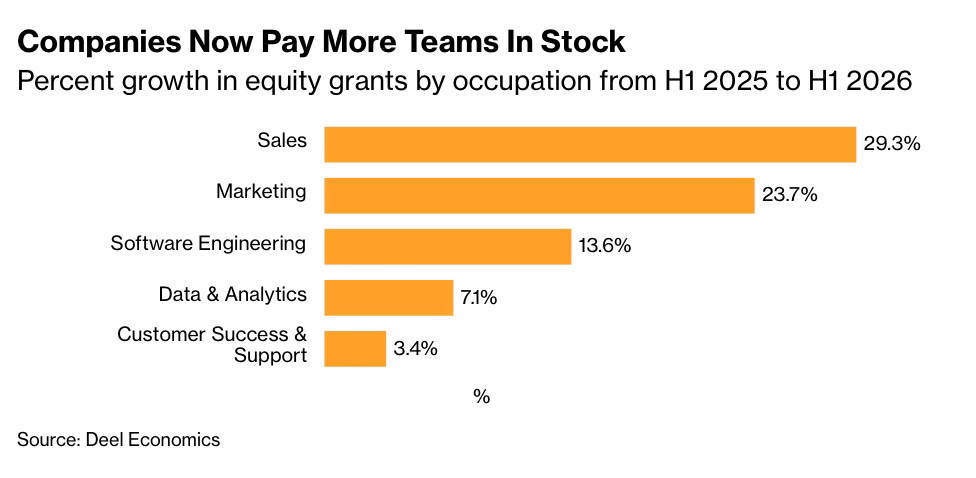
Stock option compensation expands across
More rank-and-file employees are being asked to share the company’s upside and its risk. Sales employees receiving equity grants rose almost 30% since mid-2025, while marketing teams saw a 24% increase, according to Deel’s analysis of 8,000 grants. Equity can make a retention offer more meaningful. It also vests slowly, may be hard to sell and can lose value fast. Explain the strike price, vesting schedule, tax implications and downside in plain English. A stock grant earns trust when people understand what they received.
AI is creating some annoying colleagues
AI colleagues already have some familiar office habits: they need constant supervision, generate questionable work and attract a surprising amount of credit. Office workers are spending upward of six hours a week “botsitting”, providing context, checking output and fixing mistakes. The agent count has become a status metric, even though one person’s “20 agents” may mean 20 narrow automations that need daily maintenance. Ask a simpler question: did the agent remove a real bottleneck, improve quality or shorten a cycle time? If it did not, the digital org chart is just another source of busy work.
New layoff strategy targets expensive “micro-teams”
“Micro-teams” are creating a new spreadsheet target for layoffs, the WSJ reports. Uber plans to cut the number of managers with one or two direct reports by nearly half, part of a broader reduction that will leave it with 20% fewer managers. Google has already reduced managers of small teams by 35%. Some organizations need fewer layers, but small teams also give strong individual contributors a first chance to lead. Before flattening any chart, it’s worth mapping who handles the less visible work of coaching larger teams, where emerging managers will come from, and how employees will get time with a boss responsible for twice as many people.
Data Point: Cost of Change
41%
The share of organizations affected by an unexpectedly disruptive change that needed more than three months to recover according to learning and development company Insights
In Other News
The trades need better training to spot other trades’ jobsite hazards. (Construction Dive)
American Workers Have Slammed the Brakes on Switching Jobs: The country is adding around 80,000 jobs a month, up from last year, but workers are still wary. (Wall Street Journal)
Data centers will create a fraction of the jobs the tech industry promised, think tank finds. (Quartz)
How Meta tried, and failed, to grab its employees’ data for AI. (Business Insider)
Japan eyes employing foreign trainees as airport ground crew: Tokyo aims to provide more long-term support for industry facing labor shortage. (Nikkei)