


Welcome to the latest edition of Human Capital Intelligence. As always, we would love to hear from you at ken@stibler.me with news ideas, feedback and anything else you find interesting.
Sent this by a friend? Sign up here to receive HCI in your inbox every week.
By Ken Stibler; Powered by Reyvism Analytics
What’s Working:
Advanced analytics start make HR more strategically valuable
As HCI has made the case before, modern business requires an update to the sleepy old HR function. It looks like many large companies are beginning to do just that. The data and AI revolution, which HBR reports is a top priority for 70% of CEOs, is beginning to touch the back office.
The implementation of new advanced analytics platforms like Visier, and new AI offerings from players like ADP, HR is moving beyond anecdotal evidence. Such tools can provide real-time insights into employee engagement, productivity, and turnover risks, allowing for more proactive and targeted interventions. The results speak for themselves, a large insurance company reporting to HCI a 25% increase in retention rates and an 8% improvement in engagement scores within a year of implementation.
This shift couldn’t come fast enough as Harvard research found that traditional methods of selecting managers based on personality traits, age, or experience sets organizations up poorly. Instead, their study proposes that companies should focus on two key predictors of managerial success: general intelligence (as measured by IQ tests) and economic decision-making skills. This data-driven approach to leadership selection challenges conventional wisdom, and offers a potentially more effective way to identify and develop top talent.
GenZ headaches create operational complexities
The “Z date” approaches, sometime this year Generation Z workers are expected to overtake the number of baby boomers in the US workforce. Yet despite years of warnings of the generation’s quirks, leaders still seem to be at a loss how to manage the workplace’s future.
HR departments are now tasked with balancing the needs of multiple generations in the workforce, potentially leading to increased costs and management challenges. GenZ is eschewing leadership, and are instead actively working to avoid promotion to management and engaging in "career downsizing," where they opt for less demanding roles to reduce stress. The effect is likely to create talent shortages in higher-level positions in the near future.
For the GenZ workers who are engaged, their approach rubs many other workers the wrong way, with pandemic social hangovers. For many companies, this is requiring corporate communications and manners courses.
Meanwhile, younger workers’ preference for “perks over pay” for have also successfully pushed for more complex and exotic benefits like on-site therapy, to meet the desire for purpose-driven work, mental health support, and rapid career progression.
Quote of the Week: Bad Team-Building
“In what might cause some awkward encounters at the office in the coming days and weeks, one member of their party was left to complete his final summit push alone."
A worker on an office hiking retreat to a national forest in Colorado had to be rescued after 14 of his colleagues allegedly left him stranded on a 14,230-foot mountain.
— Chaffee County, Colorado, Search and Rescue
Reading List:
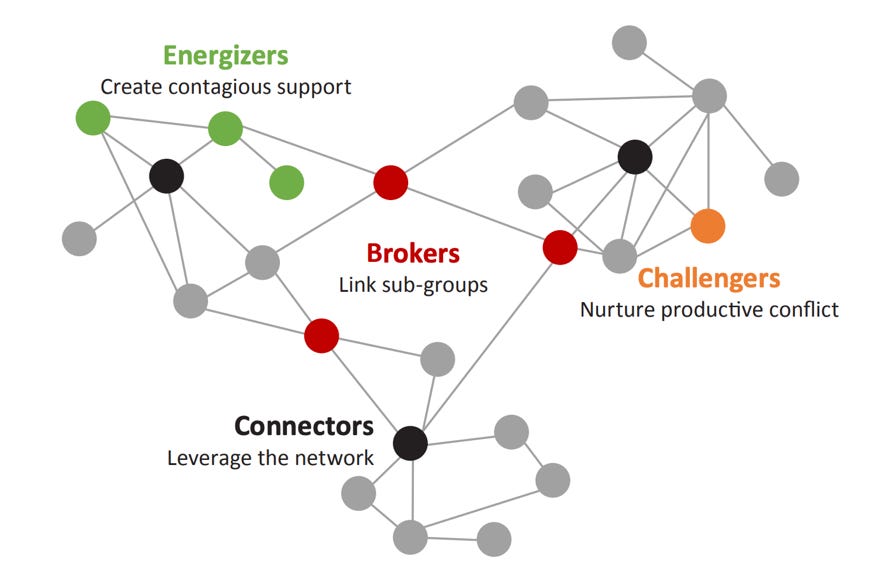
Using network theory to maximize workplace influence
To identify and leverage key employees for organizational change and enhanced productivity, network analysis is emerging as a powerful tool for savvy executives and HR professionals. By mapping the informal connections and information flows within a company, leaders can pinpoint individuals who wield outsized influence, regardless of their formal position in the hierarchy. These "invisible leaders" often serve as critical nodes in the company's social network, acting as conduits for information, catalysts for innovation, and unofficial mentors to their peers.
Read the HCI guide to social network analysis for management at KenStibler.com.
Remote work breeds “fauxductivity”
The combination of remote work and declining institutional trust have created a perfect storm for workplace accountability, leading to a phenomenon dubbed "fauxductivity." Recent surveys reveal a troubling trend where employees, particularly those in leadership positions, are going through the motions rather than engaging in meaningful work. Workhuman's Global Human Workplace Index exposes that 38% of C-suite executives and 37% of managers admit to faking work activity, outpacing non-managerial staff. This erosion of trust and accountability is symptomatic of a broader crisis in workplace culture, where the physical distance of remote work has made it easier for employees at all levels to disengage and avoid scrutiny.
Read more in HR Dive.
Engagement remains allusive despite worker wins
As the dust settles on the pandemic-induced shift to flexible work arrangements, companies are grappling with a paradoxical challenge: despite the widespread adoption of employee-favor hybrid models, employee happiness and satisfaction remain elusive. Recent surveys from Workhuman, Gallup, and BambooHR reveal that burnout rates are similar across remote, hybrid, and in-office workers, with employee happiness hitting a four-year low in May.
Read more in WorkLife.
Post-pandemic workers are more prone to leave, even as the labor market softens
As employee disengagement and turnover intentions still near all time highs, a recent Gallup survey found that 51% of US employees are actively seeking new job opportunities, the highest percentage since 2015. This trend, dubbed "the great detachment" by Gallup, is characterized by record-low levels of job satisfaction, diminished connection to organizational mission, and unclear work expectations. The data suggests that the post-pandemic workforce is more concerned with a profound sense of disengagement, even as economic uncertainties make job transitions riskier.
Read more in HR Brew.
Data Point:
62%
Percentage of workers under 25 who say that they feel uncomfortable talking with coworkers who are not in the same age cohort.
In Other News:
US Jobs Data Return to Center Stage as Fed Mulls Rate-Cut Size. (Bloomberg)
When hiring budgets are tight, reskilling may help HR fill jobs. (HR Dive)
Job market continues to flatten, but no mass layoffs — yet: The “great waiting game” continues for both employees and employers, one ManpowerGroup executive said. (HR Dive)
Kevin O’Leary says ‘right to disconnect’ laws are ‘stupid’—he’d just fire workers who go ‘silent mode’ on him. (Fortune)
Balancing AI tools with human talent remains challenging for most companies, report says. (HR Dive)
Companies are lagging on responsible AI safeguards, PwC report finds. (Emerging Tech Brew)
Laid-Off Workers Gain Influence on Social Media, Raising Concerns for Employers. (Ogletree Deakins)
How companies communicate their AI strategies can influence public opinion. (HR Dive)