

Welcome back to HCI, your go-to source to keep up with the best insights from over 250 leadership, HR, and people sources. As always, we would love to hear from you at ken@reyvism.com with questions you’d like answered or topics covered.
Sent this by a friend? Sign up here to receive HCI in your inbox every week.
By Ken Stibler; Powered by Reyvism
Skills shortages are here to stay. Here’s how you respond

Last week’s issue covered how talent shortages were already hitting companies’ growth plans, which kicked off several interesting conversations with subscribers about how deep the problem really ran. So this week we dove deeper into the demographic data (which has always felt like next decade’s problem) and saw that this condition looks more structural than cyclical. Between aging, immigration, and slowing population growth, the U.S. labor force is set to fall from now for the foreseeable future.
The headline numbers don’t tell the story as well as the loss of that individual contributor with decades of accumulated experience or the odd difficulty hiring for a role despite a down labor market. Most businesses I talk with are starting to have these gaps - and their associated eye-watering recruiting fees - become a regular low-grade headache.
Some of this is labor market efficiency degrading because of AI, as we have written about previously. But there’s another side to the problem: most employers narrow the pool using yesterday’s measuring stick long before they meet a candidate. A title, degree, and uninterrupted experience make screening faster, yet they often tell you less than the work itself.
For example, only 19% of people entering childcare roles came from childcare; people arrived from at least nine other occupations, including education, retail and food service. Nursing, on the other hand, has a more closed pipeline because training and licensing matter and, in turn, much sharper shortages.
Some requirements protect safety, but many others are habits masquerading as standards. Manufacturing has the same problem in another form: people leaving carry shop-floor knowledge that manuals rarely capture, and apprentices need years of supervised practice.
This is where HR starts being a critical strategic partner in the critical process of mapping the supply chain talent: which tasks require a license or deep experience, what are adjacent skills you can teach (because we can’t assume they’re purchasable anymore), what’s the time to build the competence, and who inside the organization can step up if given the support.
Tool of the Week: O*NET OnLine is a great place to start, the free data source allows your HR people to break a role into tasks, knowledge and skills. Easily accessible via their ChatGPT or Claude too.
Once you understand the problem, invest while the work is still covered: apprenticeships, manager-led practice, knowledge transfer and an internal bench. Only four in 10 leaders say they are effectively building that bench and an AI license or untrained 20-something will not close this gap without serious support.
Most of us have had careers where every year there were more people buying more things and looking for more jobs. With the supply of both dwindling every year now, growth targets now need to answer who can do the work, and how will they learn it?
How big is the change cost for getting to “multi-agentic AI”
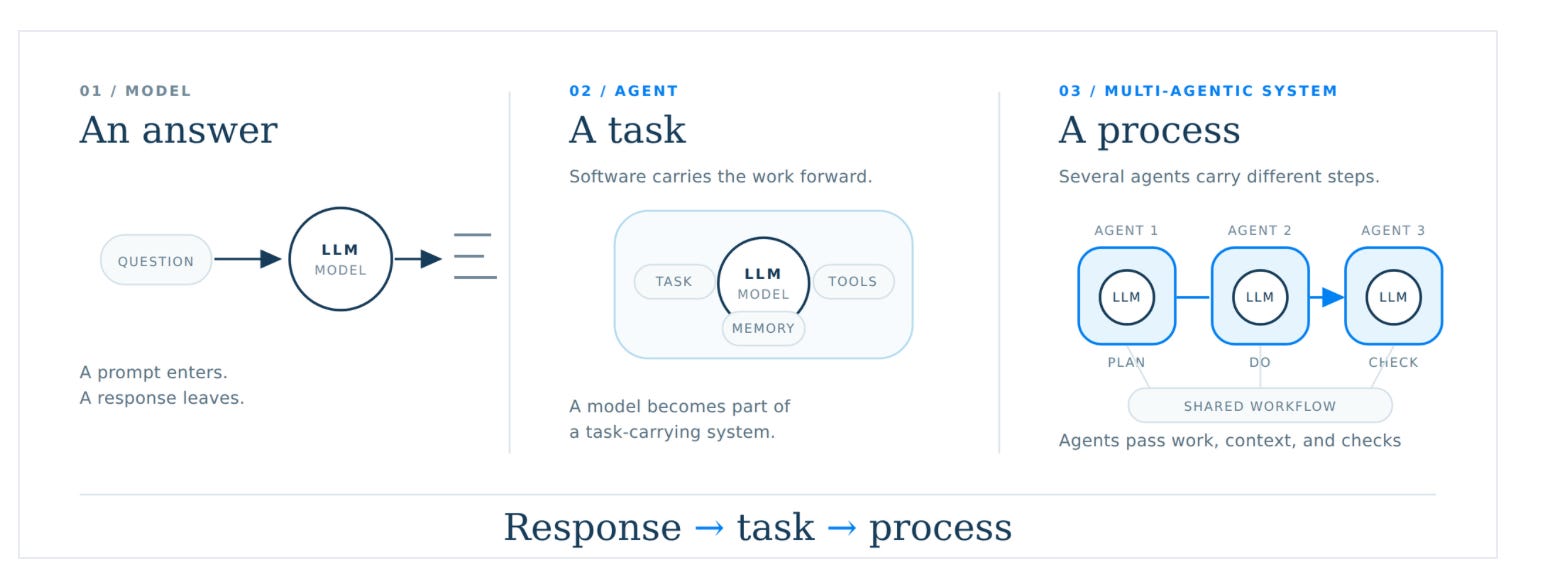
Companies are getting beyond chatbots in the hunt for AI-gains, increasingly looking to multi-agentic AI, or multiple AIs working together to complete tasks (as visualized below). This next class of AI promises to handle the work between functions: verifying information, reconciling constraints and routing routine decisions that consume an estimated 35% to 60% of back-office time, often without a clear owner.
Yet the cost of the change needed to pursue this this sits well outside the software budget. Eighty percent of organizations say AI has improved individual productivity, yet only 37% attribute any financial impact to it.
An agent cannot safely take over that work until someone has decided what the work is. In one manufacturer, the tech team had to spend four months sorting routine verification from constrained reconciliation and genuine exceptions before building the system. The same team has a lot more work that looks more like process design than coding: confidence thresholds, business rules, escalation paths and human accountability.
McKinsey analysis finds that roughly 70% of AI effort is in organizational redesign, rather than technology or model development.
For businesses that are ready for what’s beyond ChatGPT, start with a workflow where slow handoffs cost you money or customers. Measure the delay, then give one cross-functional owner responsibility for its data, decisions and exceptions. Begin with reporting and reconciliation, move to bounded actions once the data and audit trail are reliable. Skipping that time-intensive and slightly annoying redesign just gives you faster output with the same value bottlenecks.
Quote of the Week: Successful succession
“Too many succession conversations still begin with who is next in line, when the more important question is what leadership the future strategy will require. That shift changes the work.”
— Heather Foust-Cummings, co-author of the i4cp report on succession planning
Reading List:
How to channel employees’ frozen anger
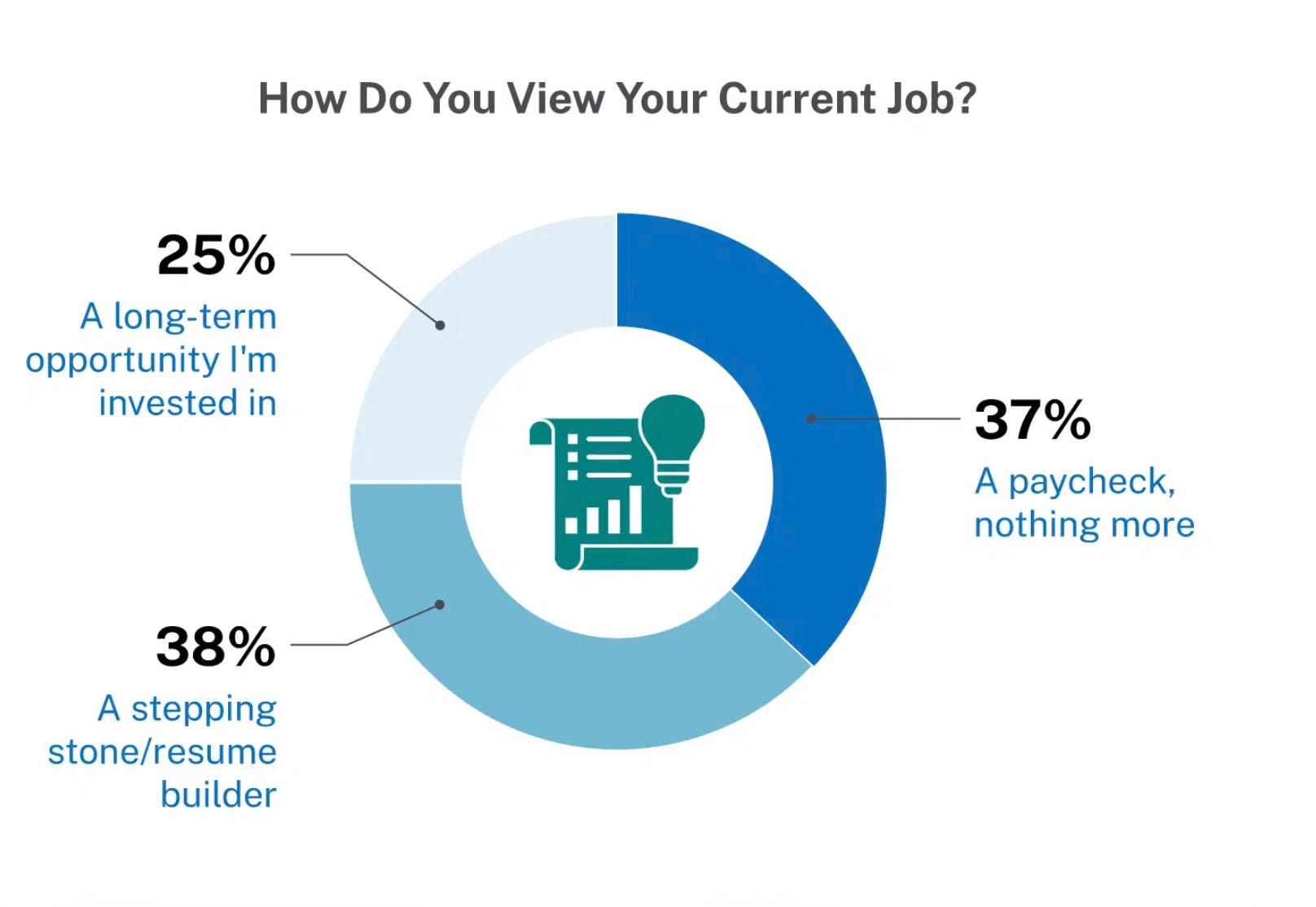
Several surveys this week show Gen Z employees from manufacturing to healthcare (the few sectors actually hiring) reporting 70+ percent intent to quit within a year. Wanting to leave and landing a better role are different things, though, and there’s zero chance of that happening in this job market. Still, this frozen frustration needs an outlet. Give people closest to the work the autonomy to improve their jobs and customer experience while seeing their ideas go somewhere. Deputizing employees to fix the pointless steps, bad handoffs and customer irritants can be a free engagement boost rather than allowing frustration to become a quiet drain on engagement and performance.
Speed of change complicates more types of operations
The speed of change is creating operational confusion across hiring and security. More than half of 1,800-plus AI-labelled job postings bundled skills from at least two distinct roles. At the same time, AI-accelerated cyber risk is pushing teams to need more just to keep up even as overall security budgets rise only modestly. In a world where frenetic effort feels more affordable than any pause, clarity becomes key. The work is changing too quickly to outsource clarity to an AI, employee or vendor.
Minimum wage creeps up as major employers push higher
Amazon became the latest company to boost its minimum wage to $20 in what’s starting to look like the market pricing in a new minimum wage. The company raised pay by $1 an hour for eligible core-operations employees and paired it with grocery discounts and a financial-services benefit. That bundle matters as much as the headline rate when workers are deciding whether a job covers the cost of showing up as inflation erodes each paycheck. With many while-collar starting roles starting to be hourly-comparable to service jobs, it’s worth checking whether you’re paying for talent but buying “butts in seats.” Because your employees are certainly doing the math.
Data Point: Millions short
2.1 million
The number of manufacturing jobs could go unfilled in the U.S. by 2030 according to Deloitte and The Manufacturing Institute.
In Other News
Great to hand to your people - the new rules for succeeding at work. (Wall Street Journal)
Adjusting personality to fit in at work is a key skill, hiring managers say. (HR Dive)
Record high waitlists for childcare assistance have shut women out of work and promotions. (19th the News)
AI summaries leave a paper trail recruiters might not be ready for: “A job seeker’s mistake could be recorded permanently. An interviewer’s insensitive — or even illegal — question could also be captured,” one CEO said. (HR Dive)
Your AI vendor could land you in legal hot water – what business experts say you must do. (ZDNET)
HR must set boundaries as it embraces AI notetakers, experts caution. (HR Dive)
Shopify CEO says employees’ ‘slop grenades’ are making more work for everyone else. (Fortune)