

Welcome to the latest edition of Human Capital Intelligence, your weekly brief synthesizing over 250 leadership, HR, and people sources to filter out the noise. As always, we would love to hear from you at ken@reyvism.com with questions you’d like answered or topics covered.
Sent this by a friend? Sign up here to receive HCI in your inbox every week.
By Ken Stibler; Powered by Reyvism Analytics
The “mid” in middle management: How are you doing more with less?

Middle managers are being squeezed from both sides. Hiring freezes mean more work is falling on existing teams, while executives expect performance to hold steady. Yet most managers say they don’t even have time to participate in training. Without investment in their skills and capacity, the very people holding organizations together risk being left behind.
The cracks are already visible. HR leaders admit they have little confidence in their workforce’s current skills, and surveys show knowledge workers are drowning in low-value ‘maintenance’ tasks. Gen Z employees report a lack of mentorship, while top performers quit when career paths stall in a pernicious feedback loop. All of those pressures ultimately land on managers, who are expected to coach, communicate, and deliver results without the time or tools to succeed.
That gap matters. As companies run lean, middle management becomes the hinge between strategy and execution. They are the ones who translate goals into action, catch early signs of disengagement, and build resilience in teams. Stripping out support or cutting back development may save costs in the short run, but it undermines the very layer that anchors organizational performance.
The path forward is not more slogans about resilience but practical relief. Simplifying reporting lines, pulling busywork off managers’ plates, and giving them protected time for training are not perks; they are business necessities. If organizations want to keep doing more with less, they must start by ensuring the “mid” in middle management has the time, energy, and skills to carry the load.
Should you merge HR and IT?
Companies desperate to wring value from AI are starting to redraw their org charts, Harvard Business Review explores. Moderna went so far as to fold HR and IT into a single role, betting that one leader could unite people and technology strategies. It is a bold move, but one that raises a bigger question: does merging the jobs actually fix the problem, or just rearrange it?
The real answer isn’t mergers but co-leadership. Leaders need to share accountability and build a common North Star. There’s value in at least thinking through what kind of person could credibly run both sides, because it forces executives to confront how messy AI implementation really is.
Some experts are blunter that structure always follows strategy. If companies can’t first define what outcomes they want—efficiency, innovation, or better employee experience—then no org chart will save them. The only certainty is that HR and IT will have to work more closely together. Whether that happens under one leader or two depends less on titles than on priorities.
Quote of the Week:
“Business transformation depends on the strength, adaptability, and skills of the workforce...skills gaps are already impeding growth, and traditional approaches to talent development are only worsening the issue.”
— Ciara Harrington, Chief People Officer, Skillsoft
Reading List:
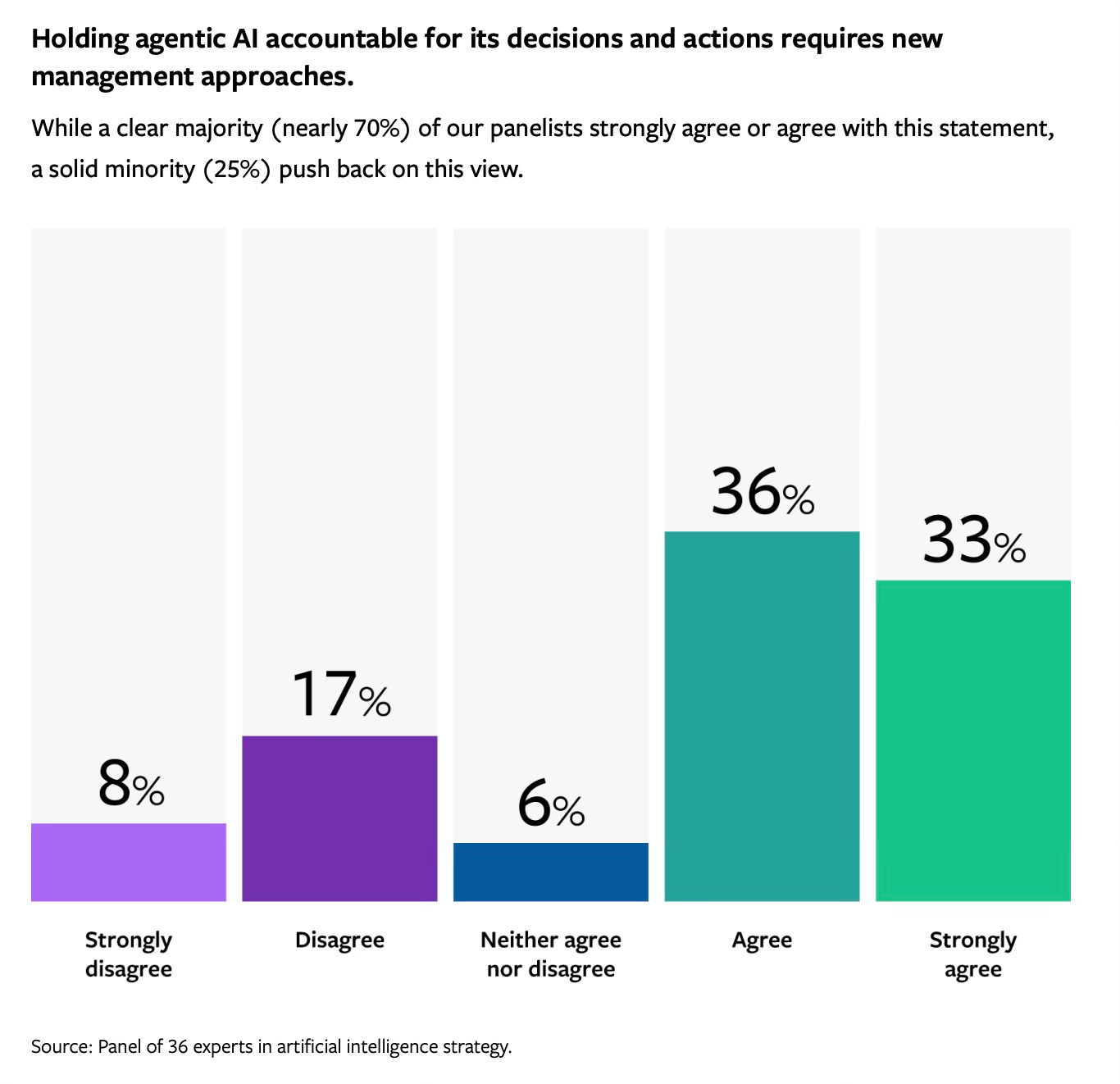
Agentic AI changes the meaning of management
Agentic AI isn’t a chatbot. It’s software that can act on its own, making decisions, using applications, and even credit cards to pursue goals with limited human input. That autonomy is forcing executives to rethink management frameworks. MIT Sloan’s panel of experts says nearly 70% agree new management models are needed, while a quarter argue accountability should stay firmly with humans. Either way, the implication is clear: managers can’t treat AI like an intern. Guardrails, escalation rules, and continuous oversight need to be explicit. Otherwise, accountability gets outsourced along with the work.
How to quell AI-driven job security fears
Nearly half of workers say training and clear communication would ease their anxiety about AI and job security. Yet only a third believe their leadership shares information consistently. L&D leaders themselves are split: many worry AI could replace them, even as budgets for training increases. Such fears thrive in silence. Employers who pair upskilling with transparency build trust and retention while those who leave middle managers to “absorb every scary rumor” invite stress, disengagement, and turnover.
Taking opportunities to do the difficult thing
With his institution and employees under fire, Jay Powell chose to manage rather than lead. Confronted with political attacks on one of his own governors and rising doubts about the Fed’s direction, he stuck to narrow policy language and avoided the bigger issue. It’s a familiar trap: focusing on simpler technical solutions while sidestepping the harder task of showing conviction and protecting your people. The temptation to stick to management is only growing, but the real test is whether they can rise to multiplying leadership challenges that feel faster and cut deeper than before.
Data Point: A clear problem
30%
The percentage of workers who believe their leadership consistently and transparently shares information with employees.
In Other News
Robinhood CEO says just like every company became a tech company, every company will become an AI company—but faster. (Fortune)
Most employees would accept lower salary to work with close friends, KPMG finds. (HR Dive)
Andy Jassy’s crusade against Amazon’s bureaucracy led to 1,500 tip line complaints and 450 process changes—and counting. (Fortune)
BCG to train staff on ‘humanitarian principles’ after Gaza relocation project backlash. (Financial Times)
Move over, breakroom bulletin board: Bespoke employee podcasts are coming to internal comms. (HR Brew)