

Welcome back to HCI, your go-to source to keep up with the best insights from over 250 leadership, HR, and people sources. As always, we would love to hear from you at ken@reyvism.com with questions you’d like answered or topics covered.
Sent this by a friend? Sign up here to receive HCI in your inbox every week.
By Ken Stibler; Powered by Reyvism
Every job can’t be a senior job

Companies are trying to abandon the junior work and the workers that do it. Across millions of job posts, senior employment rose 6.7% over five years while junior employment fell 3%. The study records a broader but quieter workforce shift towards senior level-experience being the starting point for any new hire.
Yet while this “grayer” team of the future solves several common complaints with younger employees, there are real consequences when a company builds a workforce with all ceiling and no floor.
Flat looks efficient until a customer calls - rather than uses the portal - to say an order arrived short. Someone has to check the order, find the missing item, decide whether to expedite a replacement and call the customer back. On a balanced team, a newer account person handles most of the sequence and brings the costly exception to an experienced manager. On a flat team, the manager does all of it because nobody has seen enough cases.
In many cases, without removing broken or inefficient processes, senior time is swallowed by routine work, the customer waits longer and the next person still has not learned enough to own the next call.
While there’s an obvious cost in higher payroll, the hidden bill is service risk as a capable worker gets overwhelmed by volume or change
A generally useful question with current teams of all sizes is: what your most experienced people do all day? If they spent it on the calls nobody else could make, the company has the right mix. If they spent it moving orders, chasing information and cleaning up repeatable problems, experience has become an expensive substitute for a development system.
Judgement trumps skills in the new world of work
An employee can have every skill the job requires and still make the wrong call. A customer is angry, a shipment is late and there are two sensible ways to respond: make good immediately or protect the margin while the facts come in. The useful person knows what to ask, whose view is missing and which consequence carries more weight.
It’s critical, hard to train, and why Adam Grant has argued in a now-viral essay that the currency of success is shifting toward human judgment. Experience stays valuable. So do technical skills. But software, processes and research methods change quickly, while judgment tells a person which new fact changes the answer, when a routine case has become an exception and when somebody needs to escalate. That is increasingly the difference between a person who produces work and one who can carry responsibility for it.
Quote of the Week:
“Human judgment is going to supersede human expertise.”
—Adam Grant, a bestselling author and organizational psychologist, on how AI is changing the skills needed to perform white-collar roles
Reading List:
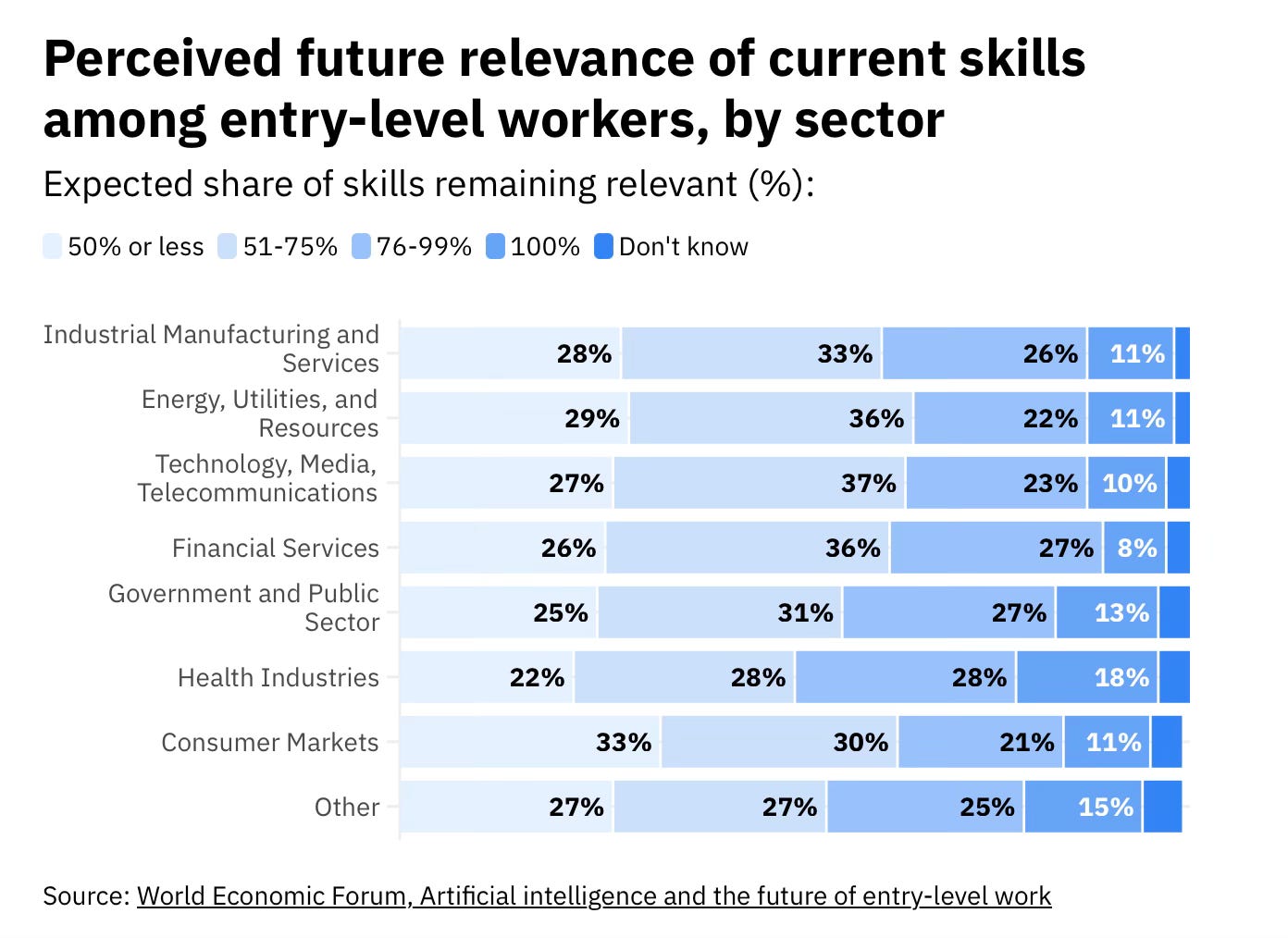
What do we actually want out of young people?
The most AI-exposed junior roles were 7 times more likely to demand skills previously associated with senior work than the least-exposed roles. A JD that asks a fresh hire to arrive with judgment the business has never taught moves cost from a training bill to a longer talent hunt. For the next junior role, separate what must be done safely on day one, what they can learn in year one and what still needs a manager’s call. The missing learning plan gets clear quickly.
Apprentice managers become popular as leadership benches thin
Chipotle has apprentices working toward management in about 75% of its restaurants and plans to place them in all locations by the end of 2027. They provide busy-period coverage and own training and digital operations as the chain opens 350 to 370 locations. Chipotle says restaurants with apprentices have higher operational scores, a company claim. The small-business lesson: choose a recurring decision that cannot wait for the manager, give a named person room to practice it and make the escalation rule obvious.
AI-generated content drowns L&D
AI has made it easier to produce learning material and harder to know what employees should trust. A new study of L&D experts found that nearly 40% saw managing and updating “content” as their biggest barrier to business value, more than twice the share naming content creation. Each course, job aid and policy needs an owner, review date and retirement plan. Let AI speed the draft; but make people accountable for accuracy, approval and the version employees can find. L&D’s scarce resource is content control.
Data Point: AI without the human quotient
46%
Share of organizations that do not bring in the CHRO to help define AI strategy
In Other News
In the AI era, organizations must redesign work in real time, Gartner says. (HR Dive)
AI is already deciding who gets hired and who gets rejected. Recruiting has no standard, no association writing one, and no agreement on where the lines are. (ERE)
Older workers struggle to showcase their true skills on freelancing platforms, study says. (HR Dive)
Amazon is trying to rehire workers it laid off, emails show. (Business Insider)
Feeling Unmotivated at Work? You Might Be Experiencing “Rust Out” Instead of Burnout. (Real Simple)
California’s AI-in-the-Workplace Legislative Blitz: California Legislature Passes Four New Bills That May Affect Employers. (National Law Review)