

Welcome to the latest edition of Human Capital Intelligence, your weekly brief synthesizing over 250 leadership, HR, and people sources to filter out the noise. As always, we would love to hear from you at ken@reyvism.com with questions you’d like answered or topics covered.
Sent this by a friend? Sign up here to receive HCI in your inbox every week.
By Ken Stibler; Powered by Reyvism Analytics
CEOs bring the weather, now more than ever

Being a CEO has never been easy, but today the spotlight is hotter than ever. Social media can turn a small misstep into a viral firestorm, boards expect flawless delivery, and employees take their cues directly from the top. The chief executive is no longer just the strategist in chief; they are the public face, the cultural anchor, and the emotional tone-setter for the entire organization.
That visibility cuts both ways. Done right, it builds enormous credibility. Done wrong, the fallout is immediate. Nestlé’s chief executive lost his job after concealing a relationship with a subordinate, rattling investors in the process. Manufacturing CEO Piotr Szczerek went viral for grabbing a signed tennis cap from a child at the U.S. Open; a moment of poor judgment that quickly became a corporate headache. In both cases, personal behavior translated instantly into organizational crisis.
The bar is rising everywhere. A NORC survey shows Americans now trust CEOs more than most public figures, from politicians to university leaders. That trust is a powerful asset, but it also raises the stakes. Employees, customers, and investors increasingly see the CEO not as separate from the company but as its stand-in. That level of dependence creates a structural vulnerability: the health, judgment, and resilience of one individual have become a direct source of key person risk for business value and continuity.
Which is why investing in CEO wellbeing and sustainability is not a luxury but a strategic safeguard. Vistage data finds nearly one in four CEOs report daily or frequent burnout. Treating leadership health as high-ROI risk management means protecting against the very real possibility that the leader’s exhaustion or misstep cascades into organizational instability. In a landscape where CEOs bring the weather, resilience at the top is one of the cheapest and highest-return investments a business can make.
Companies move towards flatter hierarchies, fewer managers, and more points of failure
Companies are stripping out managers at an accelerating pace. Google cut 35% of its small-team managers, Amazon is raising its employee-to-manager ratio, and Intel eliminated half its management layers, the Wall Street Journal reports. The goal is agility. But leaner hierarchies also mean bosses stretched thin, sometimes overseeing 20–30 direct reports with little capacity for coaching or career development.
This shift is a warning for smaller firms too. Mid-sized companies are often tempted to flatten to save costs, but delayering too far risks brittle systems. Autonomy can energize strong performers, but weaker ones fall through the cracks. Without clear guardrails, culture and accountability can erode faster than payrolls shrink.
Boards may reward efficiency, but leaders should weigh the trade-offs carefully. Flatter structures demand new muscles: clarity in communication, scalable coaching, and trust built across wider spans of control. Without them, cost-cutting can undermine performance rather than accelerate it.
Quote of the Week: Managers Diverge
“I can’t be a manager of this many people and also still be the go-to person for every single need.” — Stephen Condor, customer-service manager
“My mantra is simple: I don’t ask about their personal stuff at all. There is a boundary, and I do not cross it.” — Harsha Sanagaram, Microsoft engineering manager
Reading List:
Labor market buckles
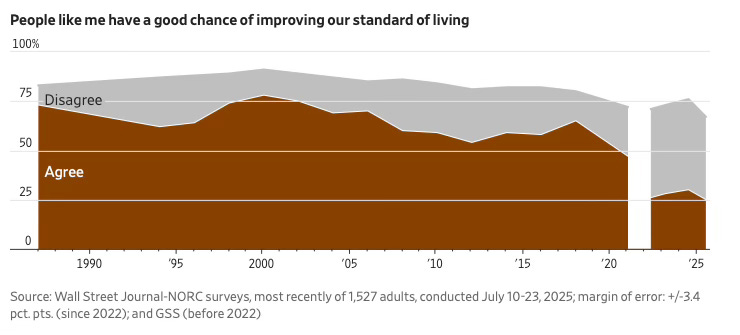
Hiring rose by just 22,000 in August, while a benchmark revision cut prior growth by 911,000 jobs, the steepest downward adjustment on record, a signal the market is far weaker than previously thought. Workforce participation has stalled, job switching is down, mobility is at record lows, and workers are rapidly losing faith in the benefits of working hard. Bank of America estimates nearly 289 million people globally are out of work or training, and U.S. quits have fallen to pre-pandemic levels.
Meaning tops the list of GenZ motivators
To older leaders, the language of “purpose” can sound like entitlement. But there are structural reasons why meaning now ranks higher than money for many younger workers. Rising costs, weaker career ladders, and burnout at earlier stages of life have left them searching for stability through mission, rather than more “stuff”. For employers, the practical next step is clear: pair competitive pay with visible investments in culture and development. Meaning is not a substitute for compensation, but without it, retention will continue to erode.
Getting AI ethics policies right for rapid change
Fewer than one in five employees say their company has clear guidance on how AI should be used. That gap isn’t just a compliance issue, it’s a leadership one. Policies built for today’s tools may feel obsolete tomorrow, yet the absence of guardrails undermines trust and increases risk. The most effective leaders are setting principles rather than rigid rules (disclosure, fairness, and human oversight) and then updating them continuously as the technology evolves.
Data Point: Frozen
22k
Number of jobs created in August - a multi-year low still almost entirely concentrated in healthcare.
In Other News
Amazon's hardcore culture reset: CEO Andy Jassy is yanking the company back to its roots, from RTO to monitoring employee phone use. (Business Insider)
Why? - CFOs play an increasing role in managing CRM implementation. (Deloitte)
Companies are adopting a new, harder-line playbook for dealing with political debate at work. (Wall Street Journal)
‘Enshittification’ is our fault. (12 Grams of Carbon)
Fostering a learning culture helps the bottom line and keeps employees happy. (Cape Cod Times)
Performance management reviews are ticking off top talent. Here's why. (Quartz)
More Fentanyl Shows Up in Random Workplace Tests: The positive rate in urine tests has doubled since 2020, lab firm Quest Diagnostics says. (Wall Street Journal)