

Welcome to the latest edition of Human Capital Intelligence, your weekly brief synthesizing over 250 leadership, HR, and people sources to filter out the noise. As always, we would love to hear from you at ken@reyvism.com with questions you’d like answered or topics covered.
Sent this by a friend? Sign up here to receive HCI in your inbox every week.
By Ken Stibler; Powered by Reyvism Analytics
Return to office fight implicates structural leadership struggles
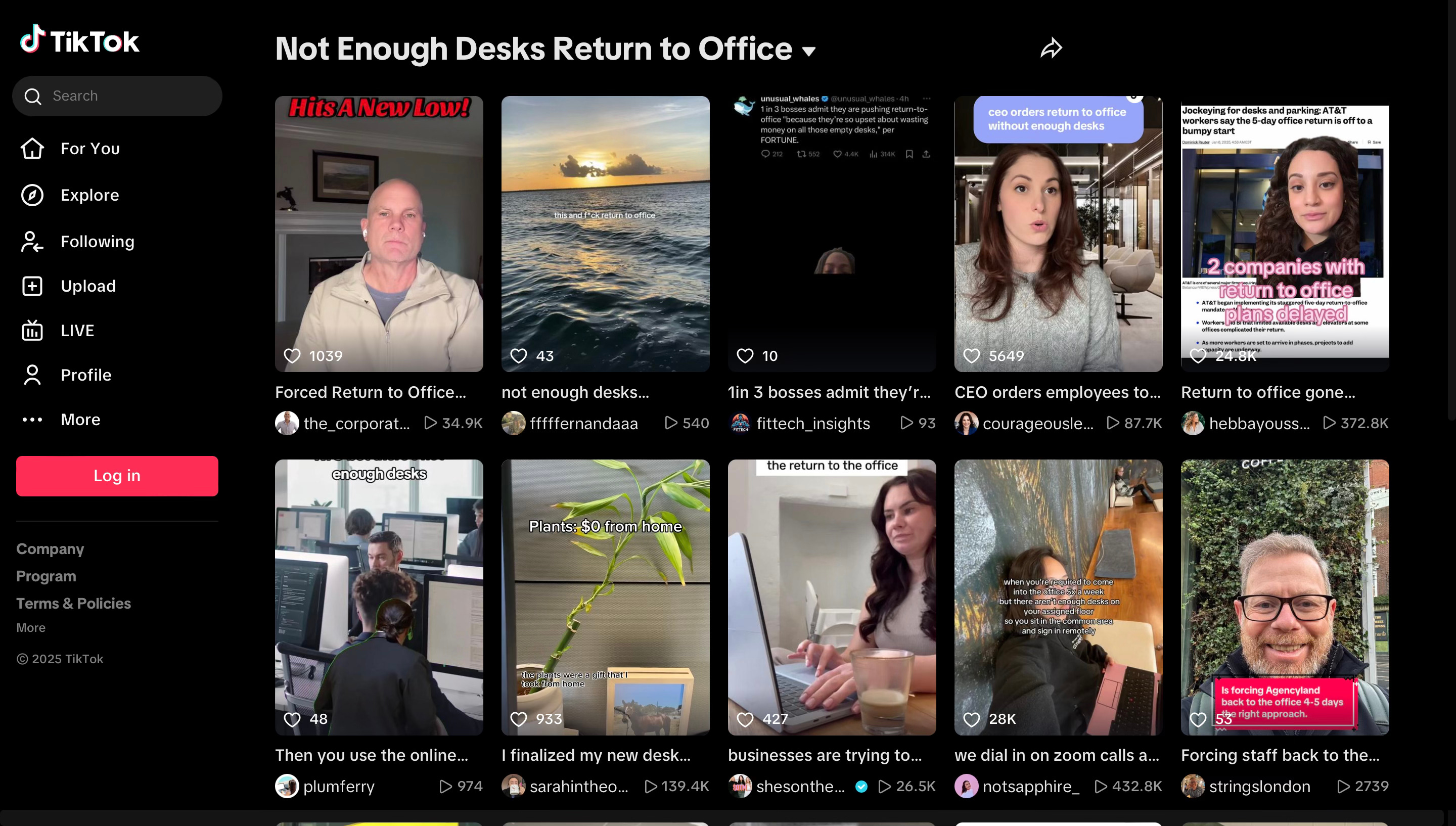
The softening labor market - with unemployment rising to 4.1% and layoffs surging 245% month-over-month - is giving executives the leverage to push forward with rigid return-to-office mandates. "There's low tolerance for disgruntled employees," notes Talentfoot CEO Camille Fetter, as workers recognize their diminished leverage. Yet persistent RTO conflicts at Amazon, JPMorgan, and AT&T serve as proxy wars for deeper organizational dysfunction. These battles aren't merely about workplace location but expose fundamental leadership deficiencies where controlling employee presence substitutes for addressing organizational inadequacies:
Stale Leadership and Vision: Rather than developing flexible workplace models that acknowledge the successful WFM experiment 2020 forced, executives are attempting to "jam the toothpaste back in the tube." Whether to regain abstract “innovation” or “collaboration”, RTO is often explicitly an attempt to regain the lost pre-2020 magic. Yet the tough market conditions, complex operating environments, and rising internal barriers to value creation make RTO a form of nostalgia rather than a functional strategy.
Patchy Communications: Most RTO communications have lacked substantive rationale for the policy beyond executive preference. Ankura's John Frehse describes these directives as "culturally and intellectually lazy," focusing on enforcement rather than articulating benefits for professional growth. The lack of dialogue or clear business rationale means even pro-office employees have ended up fighting their companies RTO policies.
Poor Execution: From Amazon to the FBI, RTO-ing organizations have found that they lack the desk space all employees to come back, leaving workers taking zoom calls from the cafeteria or lobby. Not only does this feel ridiculous, RTO’s entire justification for productivity and collaboration looks shaky when workers end up doing the same thing they would at home - sitting on zoom calls - as top performers and leadership still often work from home.
Lack of Empathy: In the end, the RTO fight is more about leadership’s perceived lack of empathy and attempts to ‘go backwards’ than it is about back to the office - which many employees increasingly long for as a social third space. Yet whether it’s longer commutes because of rising housing prices or general flexibility around schedules, workers don’t want to loose the freedom they feel was earned as productivity metrics rose during covid.
What’s Next: The list of failed, or failing, RTO efforts makes two things clear: 1. RTO is a not a silver bullet for strategic malaise; and 2. Execute well or not at all, half-efforts will win you “butts in seats” at the costs of engagement.
Burned-out people executives struggle to steer the ship
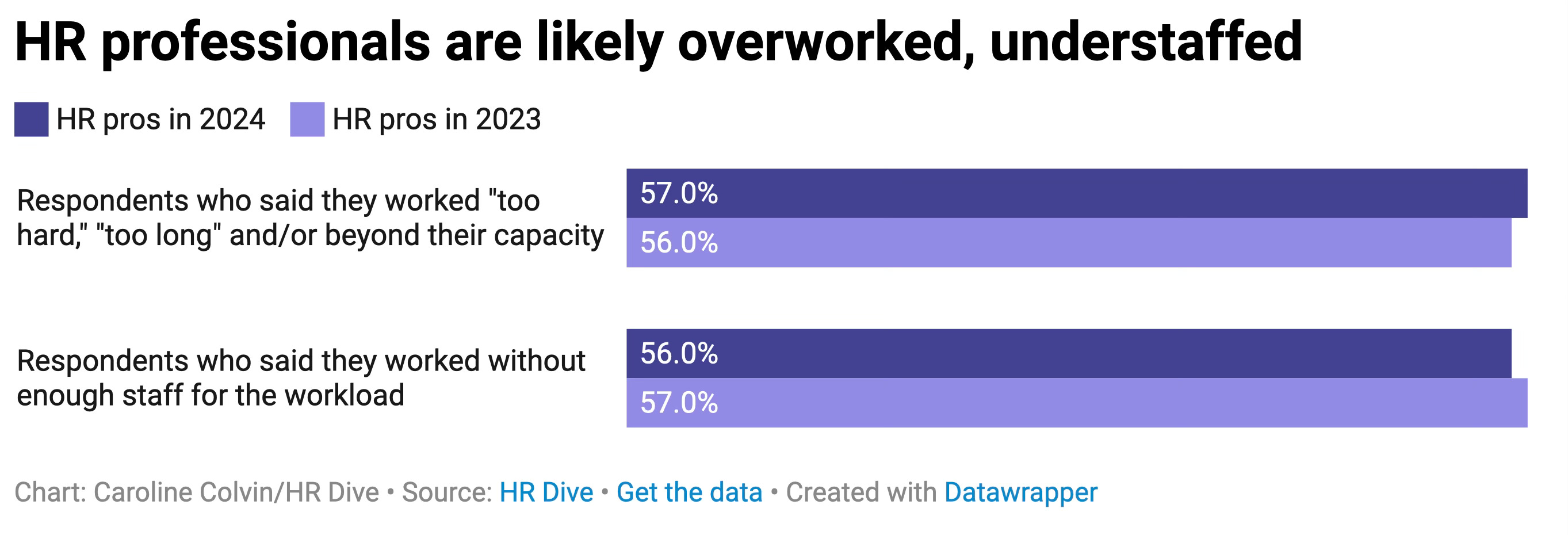
People leadership is crumbling, with SHRM reporting the majority of HR functions are taking on more work with a steadily eroding number of employees, and in turn a third of people leaders are looking at career exits. This executive burnout creates a dangerous perception gap: while 70% of HR leaders rate their function effective, only 41% of employees agree. The crisis isn't merely one of optics—it directly threatens organizational performance as exhausted HR executives attempt to navigate increasingly complex workforce demands with diminishing resources.
Burnout can cost companies up to $21K per employee annually. (HR Dive)
This leadership fatigue has crippled HR's ability to drive change, with confidence in feedback programs delivering business outcomes plummeting from 43% to 27% year-over-year. Overwhelmed teams cite their own excessive workloads as the primary barrier to action, creating a vicious cycle where burned-out executives lack capacity to implement solutions that could alleviate their burden.
This implementation paralysis carries significant costs, as organizations effectively responding to feedback are six times more likely to exceed financial targets. Meanwhile, valuable efficiency innovations go unharvested as 63% of companies lack the time to implement feedback.
What’s Next: With management insubordination on the rise and a host of strategic people issues around technology and training coming down the pipeline, cutting fat in HR is likely to take muscle with it.
Quote of the Week: AI isn’t tomorrow’s problem
“AI proficiency is no longer a niche skill — it’s becoming as essential as computer skills were 30 years ago. Companies can’t afford to wait. Automation is reshaping industries, labor shortages are increasing, and businesses need AI-driven efficiencies to stay competitive.”
— Mischa Fisher, economist at the online learning platform Udemy
Reading List:

Demand for AI skills surges in a rush to catch up with evolving tech
Employers across sectors are scrambling to secure AI talent, with nearly one in four U.S. tech job listings now requiring artificial intelligence skills, according to recent data. This represents a 68% increase in AI-related postings since ChatGPT's late-2022 debut. The surge extends beyond traditional tech companies, with financial services increasing AI training by 75% in Q4 alone, while manufacturing (50%), transportation (11%), and government (8%) also show significant growth.
AI skills now command a 23% wage premium, outpacing the value of education credentials below the PhD level. This skills pivot coincides with growing anxiety among employees about being left behind professionally, with 70% seeking to develop AI capabilities to remain competitive and nearly 40% wishing their employers would make AI tools more readily available.
What’s Next: Luckily, while AI usage is ambiguous and complex, it is fundamentally easy. Getting started with these no-code tools looks like playing around and asking ChatGPT where you could use it internally rather than teaching your people how to code.
Half of CEOs trust AI more than their peers
C-suite executives now trust artificial intelligence more than human colleagues, with 74% placing greater confidence in AI for business advice than friends or family, according to SAP's survey of 300 corporate leaders. This technological deference extends further as 44% would override their own decisions based on AI insights and 38% would allow AI to make business decisions on their behalf.
Executives leverage AI primarily for data analysis (52%), risk identification (48%), and alternative planning (47%), with nearly half using generative AI tools daily. Beyond operational efficiencies, the technology delivers personal benefits, with 39% reporting improved work-life balance. Despite this growing reliance, SAP's Chief AI Officer cautions that human oversight remains essential for the C-suite's most significant strategic choices.
What’s Next: This is dangerous territory, a Microsoft study three weeks ago found that as people outsource tasks to GenAi, their confidence in those skills goes down. And with LLMs advice only as good as the data it’s trained on, off the shelf models are likely to give generic strategies, at best.
The new dilemma of doing - when is inefficiency necessary for skill resilience?
Deciding which inefficient tasks to preserve for skill development and minimized risk is becoming a subtly important decision amid real adoption. On Wall Street, junior bankers are resisting automation of tedious financial modeling despite grueling hours, in part due to fears about imminent automation and in part given the tasks’ role in learning fundamental competencies. Like the "IKEA effect," where effort creates disproportionate value attachment, inefficient manual work often creates a sense of pride and a deeper appreciation for the work.
Organizations that reflexively automate all routine tasks risk cultivating professionals without foundational skills for complex scenarios. The question isn't simply what can be delegated to technology, but what should be retained as essential experiential learning.
What’s Next: A small, but important, step in any AI adoption initiative would be an hour meeting with people leaders to identify which tasks you need to have the brainpower to do internally. — If ChatGPT went down tomorrow, would automating X just mean we go back to manual? Or would we have difficulties remembering how to do this?
Data Point:
In Other News:
Why it might get worse for US stocks: Uncertainty over Trump policy will soon hit the economy [Falling consumption and capex] with few short-term catalysts for a turnaround. (Financial Times)
CEOs Don’t Plan to Openly Question Trump. Ask Again If the Market Crashes 20%. (Wall Street Journal)
Quiet quitting or quiet learning? How to reignite employee motivation through development. (Training Journal)
The traditional approach to applying for jobs no longer works. The world has evolved, and so must you. (Medium)
Parents in Tech Want Their Kids to Go Into the Arts Instead: Hands-on jobs that demand creativity are seen as less vulnerable to artificial intelligence. (Wall Street Journal)
Managers Can Help Their Gen Z Employees Unlock the Power of Meaningful Work − Work relationships matter, especially for Gen Z. (UConn)
California senator introduces ‘No Robo Bosses Act’ in bid to regulate AI at work: States will likely take the lead on AI regulation “for the foreseeable future,” a law firm said. (HR Dive)