


Welcome to the latest edition of Human Capital Intelligence. As always, we would love to hear from you at ken@stibler.me with news ideas, feedback and anything else you find interesting.
Sent this by a friend? Sign up here to receive HCI in your inbox every week.
By Ken Stibler; Powered by Reyvisum Analytics
What’s Working

Immigration functions as life support for the US labor market, but structural labor shortages are around the corner
As the United States grapples with an aging population and a shrinking labor force, the recent surge in immigration has served as a lifeline for the economy, helping to fill critical gaps in the job market and maintain growth. However, this influx of foreign-born workers is not a long-term solution to the structural labor shortages that loom on the horizon, particularly in industries such as manufacturing, where the talent gap could leave 1.9 million positions unfilled by 2033 if left unaddressed.
While immigrants have played a crucial role in boosting job growth and staving off a recession, the current wave of immigration has also strained local resources and drawn political backlash. As the country faces the challenges of an aging population, with states like Maine offering a glimpse into the future, policymakers and businesses must work together to develop sustainable strategies for attracting, integrating, and upskilling immigrant workers.
The United States is uniquely ill-suited to handle a falling population, with many regions already experiencing the effects of demographic decline. To mitigate the impact of labor shortages and maintain economic vitality, the country must embrace immigration as a key component of its long-term growth strategy. This will require a concerted effort to reform the immigration system, create pathways for legal entry, and invest in programs that support the integration of foreign-born workers into the workforce.
Leaving the employee out of AI adoption risks subpar results
As AI continues to permeate the workplace, employees are increasingly turning to these tools for assistance with their daily tasks. A recent study by UKG found that 56% of employees use AI on a daily basis, with writing-related tasks being the most common application. According to an analysis by Plus Docs, terms such as "AI writer," "AI content writer," and "AI email generator" were among the most searched-for terms related to using AI for work tasks.
While AI can help boost employee productivity by streamlining certain processes, it is crucial for workers to strike a balance between relying on these tools and maintaining their own critical thinking skills. Employees must still fact-check the information provided by AI, as it may not always have access to the most up-to-date data. Finding this equilibrium ensures that employees have clarity while the the company still benefits from tech-driven efficiency gains.
However, a new report by The Adecco Group and Oxford Economics reveals that more than half of companies in leading economies plan to recruit new talent to handle AI adoption rather than upskilling their existing workers. This approach could prove problematic in the long run, as 57% of C-suite executives admit they lack confidence in their own ability to understand AI-related risks and opportunities. Moreover, only 43% of companies have formal training programs in place to improve AI skills, and just 50% provide guidance to staff on how to use AI at work.
Reading List
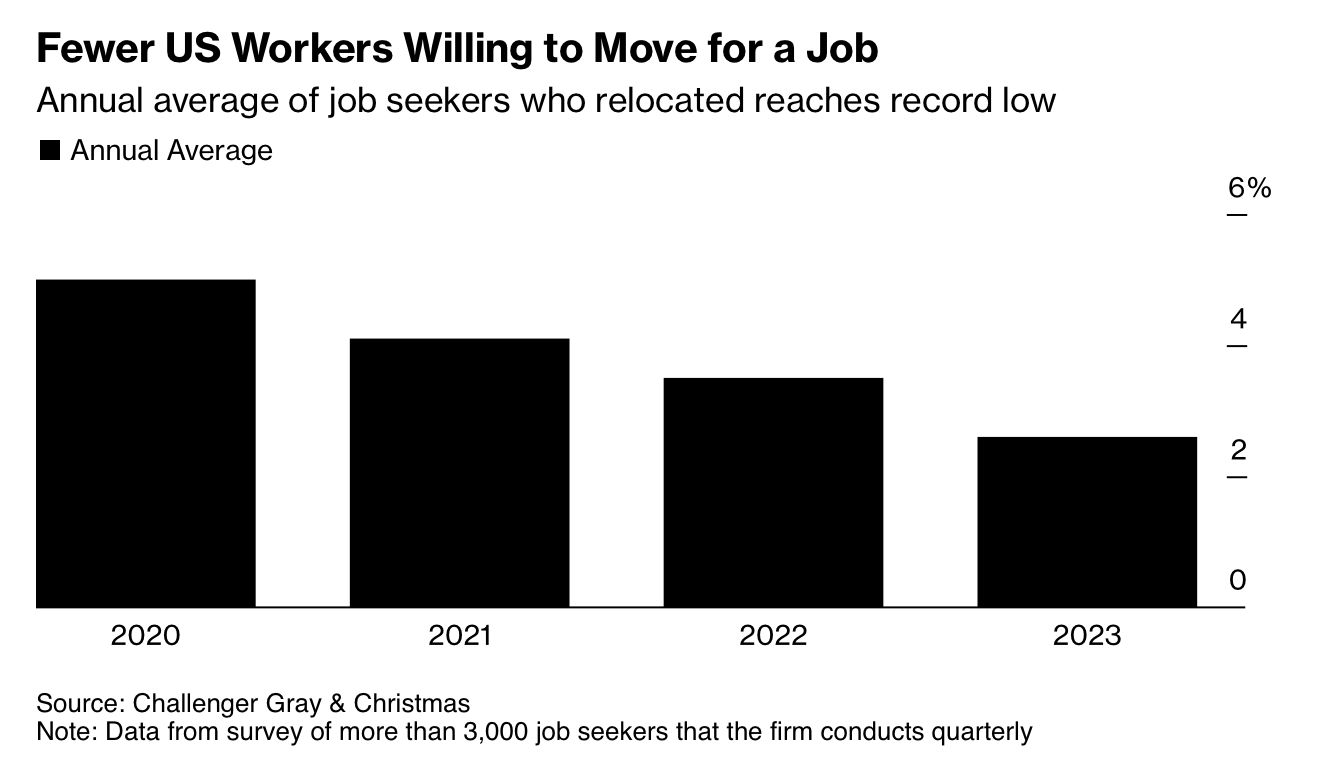
Difficult economic backdrop makes workers less mobile
The current economic landscape, characterized by a tight labor market, rising housing costs, and a shift towards remote work, is undermining employee relocation. According to a recent survey by Challenger, Gray & Christmas Inc, the number of US job seekers who relocated for a new position hit a record low of 1.5% in Q4 2023, indicating a growing reluctance among workers to uproot their lives for employment opportunities.
Read more about how employees have become less mobile.
Age pay gap continues to widen
The wage disparity between younger and older workers in high-income countries has been steadily increasing over the past few decades. In the United States, the pay gap between workers aged 55 and over and those under 35 has surged by 61% in the last four decades. Similarly, in Italy, the probability of young workers reaching the top of the pay scale has dropped by more than 30% since 1985, while it has risen by over 30% for older workers.
Read more why the wage the age-wage gap matters..
People managers struggle to stay grounded amid uncertainty
Managers have been rocked by rapid change, with 91% facing significant challenges with technology, while 45.1% report that their teams spend over half their time on administrative tasks. As uncertainty continues to plague the labor market, people managers are struggling to maintain their footing, according to the State of the People Leader report.
Read more about the emerging tactics for adapting to structural shortages.
‘Activation’ emerges as the next level of employee productivity as ‘engagement’ struggles
As a raft of changes affect businesses, employers need workers who are independent, proactive, and creative at solving novel problems. However, such needs leave merely ‘engaged’ employees a step behind. Leaders are finding that activity and engagement does not necessarily equate to genuine productivity or outcomes. Instead, a new paradigm is emerging: employee activation.
Read more about why activated employees outperform.
Stat of the Week
In Other News
Ikea embarks on companywide AI literacy initiative. (HR Dive)
5 Learning And Development Insights For Employee Equity And Growth. (Forbes)
Employee productivity is top priority but comes at a cost. (TechTarget)
2024 U.S. CEO Outlook Pulse Survey. (KPMG)
From the editor: Becoming a talent pipeline powerhouse. (Chief Learning Officer)
Bracing for AI disruption? Learn how to ask good questions, panel advises. (HR Dive)
Employers say they struggle to find talent for AI-related roles. (HR Dive)
The lowest salary Americans will accept at a new job reached a record high. (CNBC)
Next week, the feds will vote on whether to ban most noncompetes. (The Employee Handbook)
Rise and grind? Working late, volatile hours may lead to depression, illness by 50. (NPR)
A Sneak Preview: How Gen Alpha Will Disrupt the Workplace. (Linkedin)
How much does cell phone use zap workplace productivity? (WorkLife)
Nike CEO blames remote work for innovation slowdown, saying it’s hard to build disruptive products on Zoom. (CNBC)
The workplace of the future: Monster reveals a 30 year look-ahead at work trends. (Employee Benefits News)