

Welcome to the latest edition of Human Capital Intelligence. As always, we would love to hear from you at ken@stibler.me with news ideas, feedback and anything else you find interesting.
Sent this by a friend? Sign up here to receive HCI in your inbox every week.
By Ken Stibler; Powered by Reyvism Analytics
What’s Working:

Amazon’s RTO rush set to backfire as new CEO struggles to follow Bezos
Amazon's recent mandate for a five-day return to office (RTO) policy, announced by CEO Andy Jassy, appears to be a desperate attempt to recapture the company's fading corporate culture. However, this move is likely to backfire, potentially exacerbating the very issues it aims to address. The tech giant's insistence on full-time office presence, without providing concrete data to support its claims of enhanced collaboration and innovation, has already sparked significant employee backlash and could lead to a talent exodus.
The RTO push comes at a critical juncture for Amazon, as it grapples with the dilution of its renowned corporate culture following the departures of key veterans, including founder Jeff Bezos. Jassy's decision to double down on in-office work seems more reflective of management's desire for control rather than a data-driven strategy to boost productivity. This approach stands in stark contrast to the company's traditionally metrics-obsessed culture, raising questions about the new leadership's alignment with Amazon's core principles.
“We want to operate like the world’s largest startup.”
—Andy Jassy, Amazon, CEO in a memo calling employees back to the office
Furthermore, the mandate appears tone-deaf to the evolving workplace landscape and employee preferences. Research suggests that the pros and cons of remote work result in a broadly neutral effect on worker productivity, according to Stanford economist Nick Bloom. By forcing a one-size-fits-all approach, Amazon risks alienating a significant portion of its workforce. While they may not quit as in past years, engagement and culture are sure to take a hit while the story generates investor and journalist scrutiny alike.
The company's simultaneous push to flatten the organization by increasing the ratio of individual contributors to managers by 15% further complicates the situation. While aimed at reducing bureaucracy and speeding up decision-making, this initiative, coupled with the RTO mandate, has fueled speculation about layoffs and overwhelmed managers. Such uncertainty is likely to create an atmosphere of anxiety and distrust, further eroding the company culture Jassy claims to be protecting.
The five types of AI adopters in your organization
Based on a survey of 5,000 desk workers across six countries, Slack has identified five distinct personas: Maximalists, Underground users, Rebels, Superfans, and Observers. This segmentation aims to provide business leaders with insights to optimize AI implementation strategies, and address the growing disconnect between executive enthusiasm and employee adoption rates.
The survey reveals a stark divide in AI utilization, with approximately half of respondents actively using AI tools at work. Maximalists, comprising 30% of those surveyed, are frequent and vocal AI advocates, while Underground users (20%) employ AI regularly but discreetly. The non-user segment is divided among Rebels (19%) who resist AI adoption, Superfans (16%) who admire AI but don't use it, and Observers (16%) who maintain a cautious stance. Notably, demographic patterns emerged, with women and older workers more likely to fall into the Rebel category, potentially due to trust issues and concerns about job displacement.
These findings come amid a broader context of rapid AI integration in enterprise platforms and a potential cooling of initial AI enthusiasm among some companies. Slack's research underscores the importance of tailoring AI implementation strategies to accommodate diverse employee attitudes and behaviors. As businesses navigate the AI landscape, understanding and addressing these varied personas could be crucial in fostering widespread adoption and maximizing the potential benefits of AI in the workplace.
Reading List:
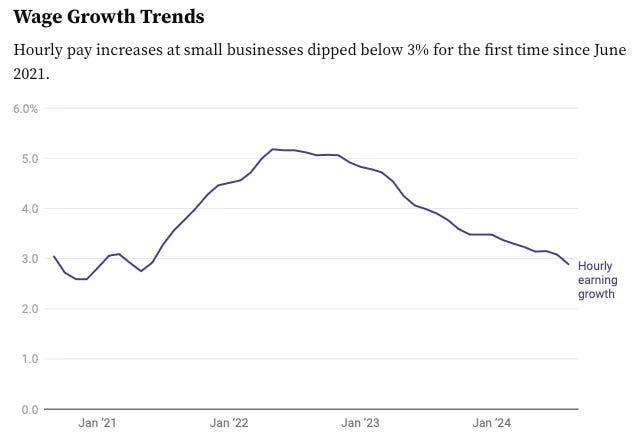
Small business optimism declines as real effects of interest rates hit
The latest National Federation of Independent Business (NFIB) report paints a sobering picture with optimism plummeting in August by the largest margin since the pandemic. The NFIB optimism index dropped 2.5 points to 91.2, erasing nearly half of the gains made over the previous four months. This downturn is largely attributed to tumbling earnings and a gloomy outlook on sales and economic prospects, as the effects of elevated interest rates continue to ripple through the economy.
Read more in Bloomberg.
Rising complexity forces new approaches to leadership
The tech industry is buzzing with a new management philosophy dubbed "founder mode," championed by Y Combinator's Paul Graham. This approach, contrasting with traditional "manager mode," emphasizes hands-on leadership and deep operational involvement, reminiscent of how company founders typically operate. This approach allows leaders to balance a deep understanding of operational intricacies while maintaining a high-level strategic view. With rapid decision-making informed by on-the-ground information, executives can be proactive about leadership, rather than waiting for the next fire to hit their inbox.
Read more in Fortune.
Think automation, not AI
AI’s abstraction means that many executives approach it with the fear of a new technology, rather than curiosity or the competitiveness of a new approach to business. A recent report by Deutsche Bank highlights just how much automation can save businesses - whatever the underlying technology might be. The bank projects that Tesla’s automation efforts could save the company $57,550 for every worker it replaces resulting in a $500 million per year cost savings. While most businesses’ “ automation dividend” won’t be so large, the per-worker savings potential of automated manual workflows certainly is more than enough to warrant curiosity rather than fear.
Read more in Quartz.
Younger workers are increasingly open to RTO as social costs of working from home mount
The pendulum of workplace preferences is swinging back towards in-office work, particularly among younger professionals experiencing "RTO FOMO" - the fear of missing out on the relationships and mentorship that are more readily available in office. Nearly half of Gen Z respondents now believe that working in an office best supports their quality of life, significantly higher than older generations.
Read more in Work Life.
Data Point:
10%
Number of employees to receive promotions in 2025, up from 8% this year according to benefits consultancy Mercy
In Other News:
Managing up: When Your New Boss Won’t Stop Making Hasty Decisions. (Harvard Business Review)
Career development plays key role in employee engagement, Gallagher says. (HR Dive)
FTC: It may be more than a year before a court greenlights our non-compete rule — if at all. (The Employee Handbook)
AI Agents, The New Workforce We’re Not Quite Ready For (Agentic AI). (Josh Bersin)
DEI Retreat Signals ‘Great Quieting’ in Corporate America. (Bloomberg)
Bracket busters: Workers vote on the worst workplace jargon. (Glassdoor)
Online job scams continue to rise, with AI playing a larger role. (HR Dive)