


Welcome to the latest edition of Human Capital Intelligence. As always, we would love to hear from you at ken@stibler.me with news ideas, feedback and anything else you find interesting.
Sent this by a friend? Sign up here to receive HCI in your inbox every Monday morning at 6am sharp.
By Ken Stibler; Powered by Reyvisum Analytics
What’s Working
Dissatisfaction rises despite wage gains and resilient flexibility

Despite widespread wage increases, augmented paid time off, and purportedly enhanced control over work environments, an escalating number of U.S. workers are reporting heightened levels of anger, stress, and disengagement, according to Gallup's 2023 workplace report. Job satisfaction has slumped to its lowest point since early 2020, with a stark 10% regression witnessed in the current year alone.
The grim reality is that despite corporate endeavors to align with the shifting dynamics of work, employees appear increasingly discontented, with a myriad of factors contributing to their disillusionment, ranging from the erosive impact of inflation on recent pay hikes, to the persisting ambiguity surrounding the structure of the workday.
The response from companies, ostensibly attempting to reconcile with the evolving work milieu by offering financial incentives, flexibility, and support, has proven insufficient. The chasm between management and the workforce persists, leaving business leaders frustrated.
Despite a 20% surge in spending on employee benefits by several Fortune 100 companies, the correlation between increased expenditure and heightened employee satisfaction remains elusive, with a 34% rise in ‘reading coming to work’ from 2020. Rising mental health claims and escalating turnover costs serve as tangible markers of the widening gulf between management rhetoric and employee reality.
The discontent pervading the workforce represents a recalibration of expectation. The experience of being tethered back to the office, despite prior concessions, exposes the palpable consequences on both professional performance and personal well-being. This dissatisfaction, however, transcends new hires, as even experienced hires report diminished levels of engagement.
The prevailing narrative, marked by increased disillusionment and a reevaluation of work-life dynamics, requires a critical examination of the bottom-line impacts, existing strategies, and underlying drivers of employee discontent.
Small businesses catch up on hiring, but retention remains a concern
Small businesses (fewer than 50 employees) have added 95,000 employees in the second half of 2023, constraining with large companies which have cut around 83,000 jobs according to ADP. This dichotomy suggests that small businesses are finally catching up after a bruising three years for talent attraction. This group is using the rush of talent to go after growth opportunities while larger corporations may be streamlining to counteract inflationary pressures. However, the job market for small businesses may not translate into competitive wages and benefits for jobseekers. Only 18% of small businesses are planning to adjust wages in the next three months, highlighting the need for alternative retention strategies.
Despite limitations in offering competitive compensation, small businesses can focus on employee connection and culture. ADP recommends small employers engage in transparent communication with employees about wage limitations and involve them in discussions about growth strategies. Improving the employee experience, upskilling current employees, and expanding benefits are identified as workforce priorities for small businesses in the coming months.
Emphasizing benefits related to flexibility and mental health is seen as crucial for establishing a healthy work culture. Small businesses, given their size, can also leverage the advantage of upskilling, encouraging employees to acquire diverse skills that align with the multi-role demands of smaller operations. As larger corporations grapple with layoffs and return-to-office concerns, small businesses have the opportunity to position themselves as people-first employers by investing in talent development and well-being.
AI begins to offer a tangible solution to labor shortages
Amid persistent labor cost, quality, and availability issues, U.S. business leaders are increasingly turning automation initiatives into real cost savings. Recent polling by Chief Executive found that 59% of CEOs see automation and technology as their primary strategy to counter rising labor costs in 2024, surpassing alternatives like price increases, revenue diversification, and reskilling existing workers.
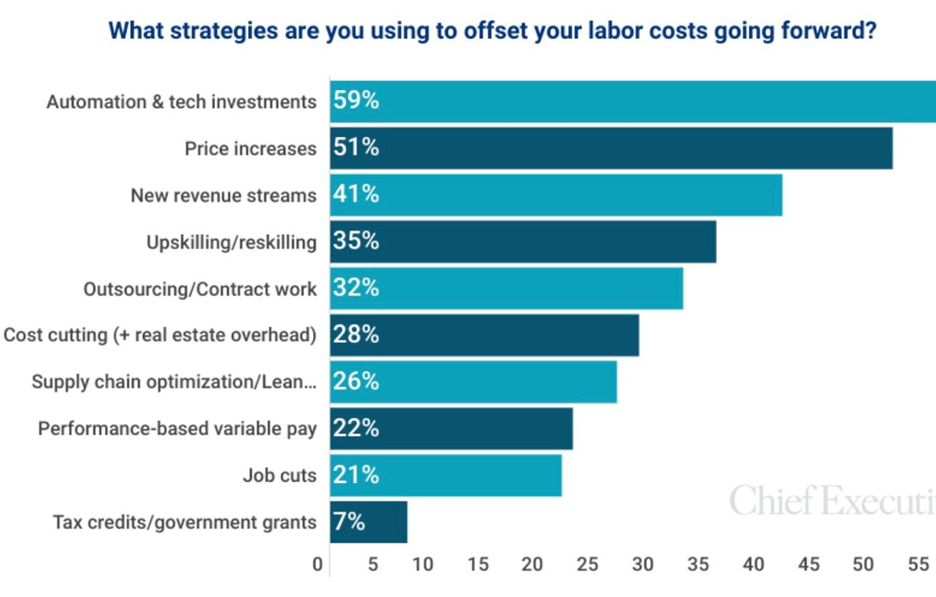
Despite this, the survey indicates that 88% of CEOs expect automation to displace less than 5% of their workforce in the coming year. However, distinctions emerge based on company size, with 62% of smaller firms expecting no workplace displacement compared to just 9% of larger companies. This pattern could exacerbate existing productivity gaps between larger and smaller organizations, with the former potentially leveraging automation to curtail workforce growth more effectively.
As the adoption of automation accelerates, the focus is shifting beyond traditional roles at the bottom pyramid, raising concerns about the vulnerability of top-level 'white collar' jobs. Experts, note that the higher return on investment in automating top-level roles poses potential risks to these positions. Meanwhile, recent studies highlight the nuanced impact of AI on jobs, revealing varying productivity outcomes based on task complexity.
HR Reading List

The term "The Great Betrayal" has gained traction, portraying a shift in worker mindset from prioritizing stability and loyalty in traditional employment to favoring freelancing for increased freedom and flexibility. Highly publicized mass layoffs, occurring despite recent record profits, contribute to a widespread disillusionment with full-time employment, fueled by a tight labor market where workers, despite economic concerns, remain in high demand. The effects of this perceived betrayal include a significant erosion of trust between employers and employees. Layoffs after promising growth opportunities lead to a loss of faith in company loyalty, fostering a sense of betrayal. (WorkLife)
Amidst a broader economic downturn in the U.S., the healthcare sector is presenting itself as a relative bastion of job growth, countering weakening trends elsewhere. Labor Department data reveals a disproportionate contribution by healthcare providers, constituting 30% of U.S. job gains over the last six months, while comprising only 11% of total employment. In contrast to a tight market for healthcare workers which drags overall metrics of labor availability lower, general white-collar labor markets have been rapidly loosening. (WSJ)
The failure of one of the world’s biggest banks, Credit Suisse, has been attributed to a number of complex reasons. On deeper review though, a decade of cultural dominance by the group’s chair, turned a historically solid institution into a vulnerable one, according to insiders and investors. The bank's charismatic chairman has been blamed for creating a concentrated and flawed culture which critics argue led to resistance to make changes at lower levels of the organization and sabotages goes the efficacy of successive leaders, the $119 billion failure thus serves as a warning to the risks to adaptability and stability that comes with deep dependence on any individual, at the team, division, and organizational levels alike. (WSJ)
Companies are starting to get rid of annual performance reviews as data on employee preferences and effectiveness shows that they are ineffective and fear inducing. Instead, Block, the Fintech giant led by Jack Dorsey is moving to a scorecard model where all employees get pre-defined grades. While the model would certainly require managers to step up with more communication, this approach can work for younger workers that can struggle as success moves from a school based system to the workplace, especially as the type of informal onboarding that has aided this process is next-to non-existent in remote and hybrid environments. (Business Insider)
As the cost of college rises and the return on investment from higher education falls amid educational overproduction, high school graduates are increasingly opting out of college in favor of non-degree opportunities. Despite pushes in large firms and governments to move from education to skills based higher - dropping degree requirements in turn, over 3/4 of 2023 job postings still required a bachelor's degree despite only 38% of the population possessing those degrees. The changing nature of post-high school paths will likely lower the costs of labor and open up new pools of talent, effective learning and development programs and new strategies for hiring will be critical to avoid dependence on thinning and competitiveness. (Employee Benefits News)
Quote of the Week
“It's not that [young people] don't want to get to work — they want to have freedom and flexibility. They want credential pathways that give them real skills and jobs."
Earl Martin Phalen, founder of Great Jobs KC, a nonprofit that provides workforce training to help young adults get full-time employment in IT, manufacturing, and logistics
In Other News
Amazon tells employees who refuse to RTO: No promotion for you! This type of strategy could make it hard to recruit and retain employees, HR expert warns. (HR Brew)
How to Become an Agile Learner. (HBR)
Time to upskill? Employers may pay 77% more for AI roles. (Employee Benefits News)
Companies are looking into redeployment programs to lessen the sting of layoffs. (HR Brew)
Want better performance reviews in 2024? Focus on soft skills first. (Employee Benefits News)
Avoid politics, support working parents: What works with recruiting right now. (Employe Benefits News)
Pay Thousands to Quit Your Job? Some Employers Say So: Some U.S. businesses are forcing workers to sign contracts that demand steep “reimbursements” if they leave. (NYT)
How AI is reshaping job security in the tech world. (Employee Benefits News)
How can HR pros escape the hire-layoff cycle in tech? (HR Brew)
HR reacts: What people pros really think of LinkedIn’s #OpentoWork banner. (HR Brew)
A new age of the worker will overturn conventional thinking: Around the rich world, wage gaps are shrinking. (The Economist)
Integration problem/xenophobia in the countries that can least afford it: As Migration to Europe Rises, a Backlash Grows. (WSJ)
‘Girlbosses’ are becoming snail girls—and this HR exec approves: Employees want to spend less time working, according to TikTok (HR Brew)
How HR can promote belonging in the workplace: Some 75% of workers feel excluded at work—HR can play a pivotal role in changing that. (HR Brew)
Proof That Positive Work Cultures Are More Productive (HBR)
New incentives could boost satisfaction with in-person work, but few employers are making changes (AP)
Why employer misunderstanding of psychological safety is hurting teams’ performance (WorkLife)
Is gamification the answer to boosting employee engagement? (WorkLife)
Corporate America Is Rethinking Diversity Hiring (Bloomberg)
Legislative lowdown: Chicago expands paid leave (HR Brew)
Navigating the Jagged Technological Frontier: Field Experimental Evidence of the Effects of AI on Knowledge Worker Productivity and Quality. (HBS Technology and Operations Management Unit)
6 ways to harness AI for organizational success (Employee Benefits News)
The Path to Generative AI Value Begins with a Workforce Diagnostic (BCG)
'Authentic' Named Word of the Year as AI Blurs Line Between Real and Fake (Bloomberg)