


Welcome to the latest edition of Human Capital Intelligence. As always, we would love to hear from you at ken@stibler.me with news ideas, feedback and anything else you find interesting.
Sent this by a friend? Sign up here to receive HCI in your inbox every week.
By Ken Stibler; Powered by Reyvisum Analytics
What’s Working

AI is more expensive than people, for now, finds MIT
Fears of AI automating jobs en masse are overblown, according to an MIT study on computer vision technology. By modeling costs, researchers found just 23% of US worker wages could be effectively replaced currently. In most cases, humans still do tasks more affordably than AI. Retail, transportation and healthcare are most ripe for automation. But sectors like construction remain far costlier to automate.
MIT examined nearly 1000 visual tasks across 800 occupations. Only 3% can be automated in a cost-effective manner today. By 2030, 40% of tasks could be viable as data and accuracy improve. But upfront outlays for most companies still outweigh potential savings.
A hypothetical bakery case showed quality control inspection by AI is still too expensive. The time savings don't offset the system's price tag. AI adoption accelerated after ChatGPT demonstrated new potential. For now, humans remain more economical for most visual jobs. But continued innovation could eventually tip the scales.
Employee engagement remains top issue despite high profile layoffs
Recent prominent layoffs might suggest the balance of power has shifted back to employers. But most CEOs say retaining and engaging staff is still their top priority for 2024, according to a new survey by Chief Executive: 60% of CEOs ranked it number one, even higher than 2 years ago. With skilled talent still scarce, employee focus remains critical.
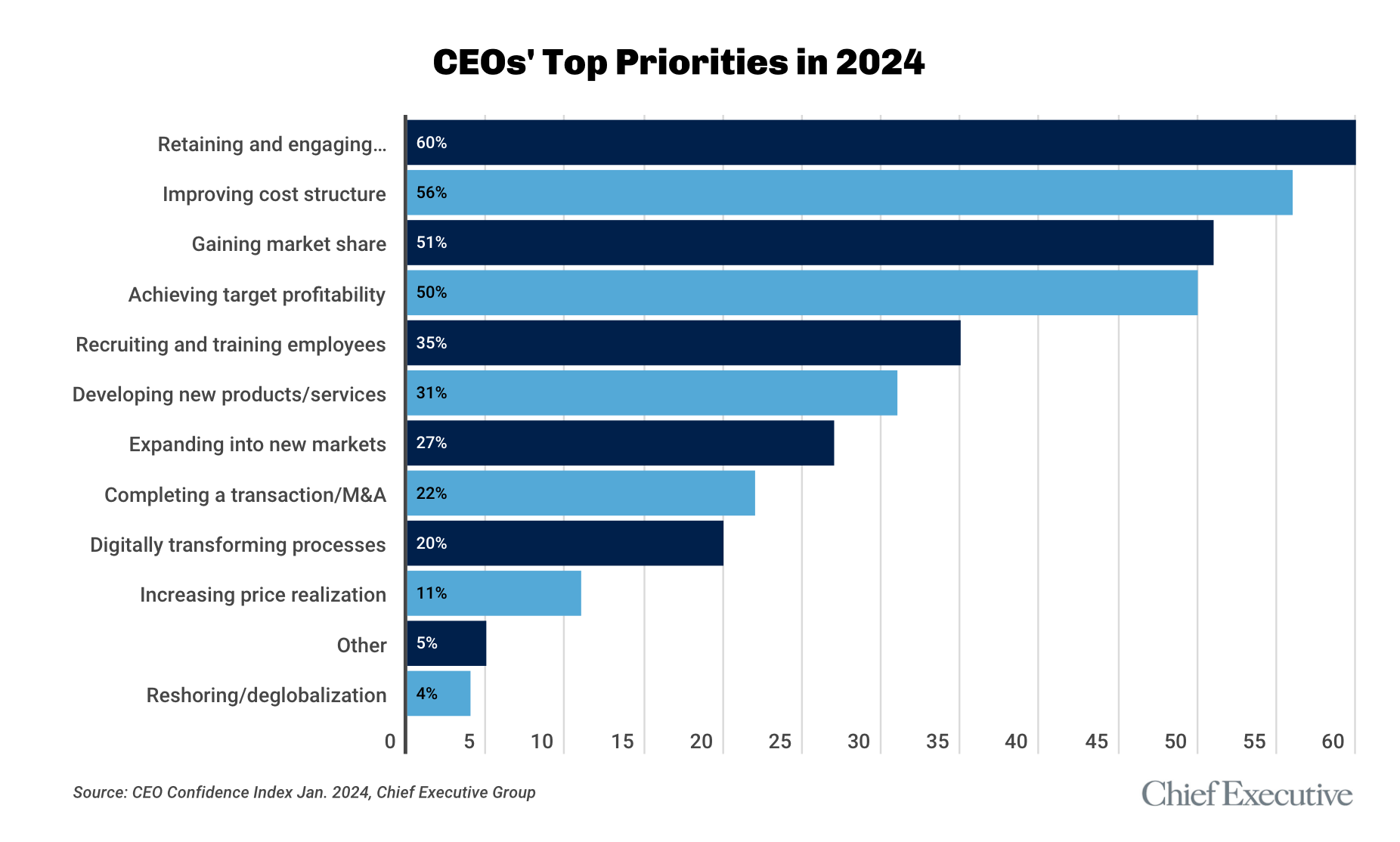
Improving cost structure ranked second at 56%. Inflation tops the list of challenges at 59%, unchanged from 2022. But employee retention and recruitment still pose major hurdles. This holds across company sizes and nearly all industries.
Tech CEOs diverge, prioritizing market share over engagement. But for most sectors, workers stay vital. Despite some headline-grabbing job cuts, tight labor markets persist. So CEOs can't afford to lose focus on their people. Employee experience remains mission critical.
Compliance gets critical as modern layoffs get trickier
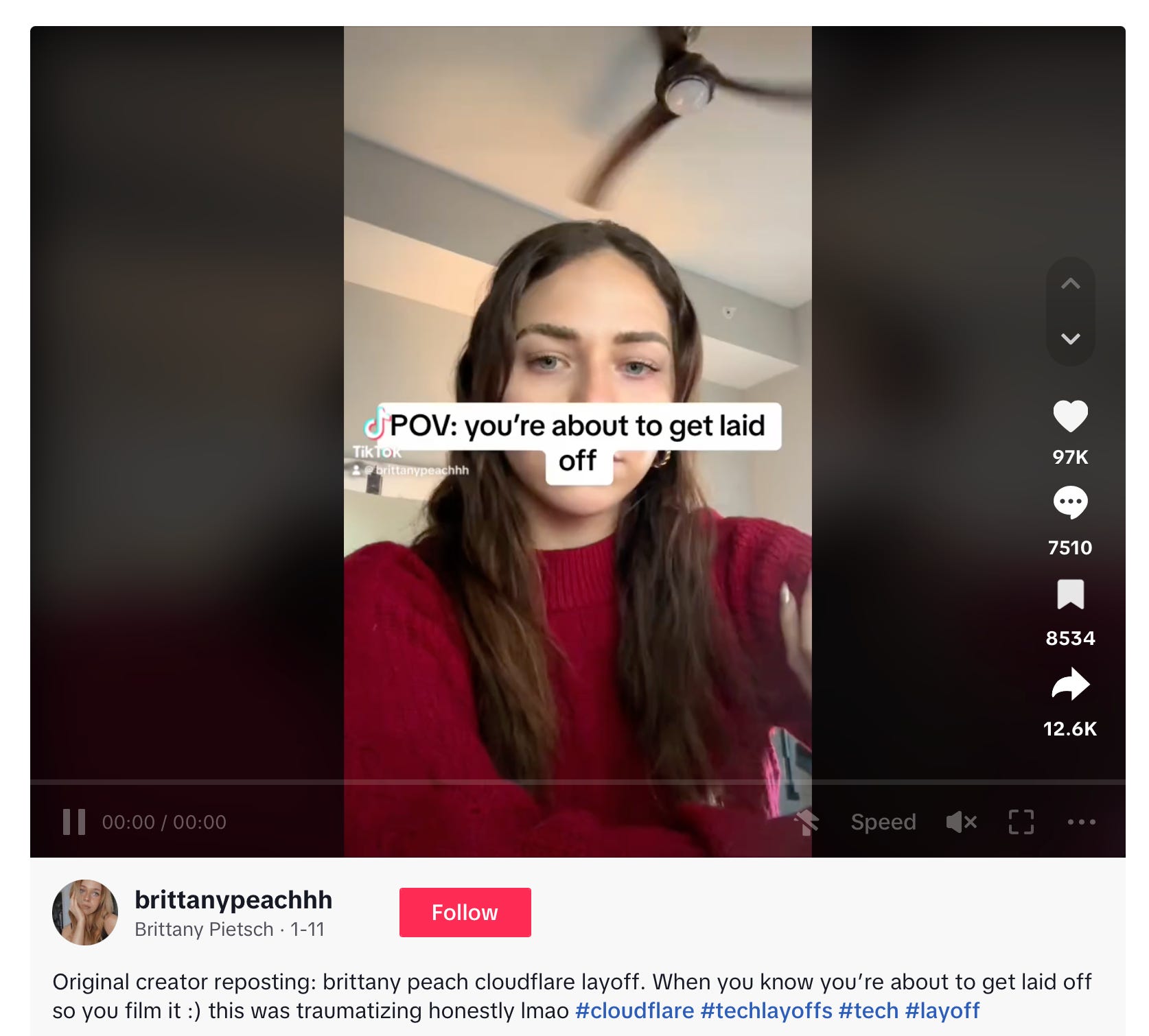
As layoffs become a subject of public discourse through social media, the approach to internal communications takes on a new level of scrutiny. The trend of employees sharing their layoff experiences online, sometimes garnering significant public attention, necessitates a conservative, yet sensitive, approach to communicating during employee transitions.
The act of employees recording and publicizing their layoff experiences presents a complex dilemma. On virtual calls employers are unlikely to stop such recording, yet these videos can become a PR nightmare as several businesses have recently seen.
This scenario demands a nuanced approach to narrative management during layoffs, focusing on authenticity and empathy rather than attempting to control the flow of information - which is no longer possible. This shift is as annoying as it is important in an era where the boundaries between private corporate decisions and public perception are increasingly blurred.
The recent layoffs across various industries warrants a revisit of basic compliance standards like adhering to the 60-day rule under the Worker Adjustment and Retraining Notification Act (WARN), ensuring fairness and non-discrimination through disparate impact analyses, revising severance agreements in accordance with legal standards, and guaranteeing the timely issuance of final paychecks.
In a digital age where employee voices have significant reach, the manner in which companies handle layoffs not only reflects their compliance with legal standards but also shapes their public image and internal culture.
Reading List

Alcohol comes under fire for office fun
Companies are rethinking the role of alcohol in work-related events, aligning with changing preferences, particularly among younger employees. Current trends indicate a decreased interest in alcohol among younger adults, as highlighted by recent Pew Research data. This shift is prompting organizations to move away from traditional alcohol-centric gatherings like happy hours in favor of healthier and less risky options.
Read more about how to have office fun without alcohol.
Workers are suffering from a lack of clarity
A recent Gallup survey found fewer employees today can clearly articulate their roles and responsibilities compared to before the pandemic. Major workplace changes like remote work transitions have muddled job expectations. Unclear roles lead to lower engagement and productivity.
Read more about employees’ lack of clarity.
Remote workers disproportionately hit by recent layoffs
Fully remote workers were 35% more likely to be laid off, with 10% of them losing their jobs versus 7% of office-based or hybrid employees according to an analysis of two million white-collar workers by Live Data Technologies. HR analysts attribute this disparity to the weaker personal connections that develop with remote workers, making it easier for managers to let them go. This trend is exemplified by companies like Wayfair, which openly prioritized remote workers for layoffs and advocated for an office-centric workforce.
Read more about why remote workers are at risk.
Employees are happier being underpaid but remote as post-covid office offers no upside
Remote workers get fewer promotions and lower raises than on-site colleagues, per a ResumeBuilder report. But they're more content despite less pay. In-office employees have worse mental health, more stress and poorer work-life balance. Only 35% like their work arrangement, versus 92% of remote staff.
Dive below the surface stereotypes of remote work preferences.
Disengagement costs American businesses trillions
Disengaged employees cost US companies a staggering $1.9 trillion last year in lost productivity, per Gallup research. This massive price tag stems from declining workplace satisfaction post-pandemic. Gallup's engagement measure peaked in 2020, but RTO disruption has since eroded staff morale. Unclear expectations and poor connection to purpose drive the effect.
Read more about the costs of disengage and how to respond.
Stat of the Week
In Other News
Upskilling Is Investing In Your Team—And There’s No Better Growth Strategy. (Chief Executive)
Understand SECURE 2.0's student loan provision to help employees with debt. (Employee Benefits News)
Unionization Stalls at Amazon as Turnover, Company Efforts Stymie Activism. (WSJ)
Goldman Sachs sees 3 threats to a strong labor market. (Business Insider)
Labor Supply Helped Tame Inflation. It Might Not Have Much More to Give. (WSJ)
Year-End Bonuses Shrink 21% in Sign of Turbulent US Economy. (Bloomberg)
More Workers Want to Change Jobs, but the Market Is Getting Tougher: Job dissatisfaction is colliding with shrinking opportunities for white-collar professionals. (WSJ)
Google Trims Hundreds of Jobs as It Marshals Resources for AI. (WSJ)
What is quiet firing? (and how it embodies passive-aggressive work culture). (WorkLife)
White collar workers became more emboldened to ask for raises and promotions last year. (HR Brew)
4 in 10 frontline workers have quit in the last year. (Beekeeper)
Are you being ‘quietly cut’ with a performance improvement plan? (Employee Benefits News)
What HR needs to know about earned wage access and its effect on retention. (HR Brew)
Well Into Adulthood Nearly 60% of Kids Still Receive Money From Their Parents. (WSJ)
Tech execs say a type of AI that can outdo humans is coming, but have no idea what it looks like. (CNBC)
SAP to Launch Restructuring Program Affecting 8,000 Jobs in AI Push. (WSJ)
Approaching Generative AI Adoption with Strong Change Management Practices. (Wellspark Health)
‘Develop a varied routine’: How to make the best of slower work months. (WorkLife)
RTO? WFH? Why Post-Covid Work Norms Are So Confusing. (Bloomberg)