


Welcome to the latest edition of Human Capital Intelligence. As always, we would love to hear from you at ken@stibler.me with news ideas, feedback and anything else you find interesting.
Sent this by a friend? Sign up here to receive HCI in your inbox every week.
By Ken Stibler; Powered by Reyvisum Analytics
What’s Working

Rounding up 2024 Workforce Forecasts
Strategic planning is to leaders as New Year forecast articles are to journalists - always attempted, but rarely as effective as you’d wish. Just a year ago most of the wall street banks were projecting 80-100% chance of a recession for 2023. So HCI read all the 2024 prediction articles so you don't have to.
At the macro level, uncertainty continues to abound as nobody really understands why the economy is performing as well as it is, few people really understand AI but nearly everyone will continue talking about it, and an election year promises more political noise and regulatory headaches alike. Labor markets will happily be less of a focus in 2024, although employee engagement will still struggle as younger workers become the largest cohort and middle managers continue to languish without targeted help.
Human Capital, Training, and Leadership: Acceleration means universities are struggling to produce the skills businesses needs, which will continue to make training a core concern and rare point of alignment for employers and employees. Training programs are pivoting to develop managerial skills in empathy, active listening, and team motivation. Meanwhile, technological upskilling will require new skills from both groups, as poorly managed tech adoption is ineffective at best, and destructive at worst. Executives are increasingly recognizing that traditional ‘command and control’ management is not working, so coaching will become a greater focus.
Labor Markets and Talent Retention: The labor market has a much better rebalance of supply and demand, however economic uncertainties will drive attrition lower (branded the “Big Stay”) than some companies' needs. Labor availability problems will be completely replaced by labor quality issues in the white collar space, and white collar wages might go into reverse in some areas given oversupply and large declines in job creation and availability in certain job classes.
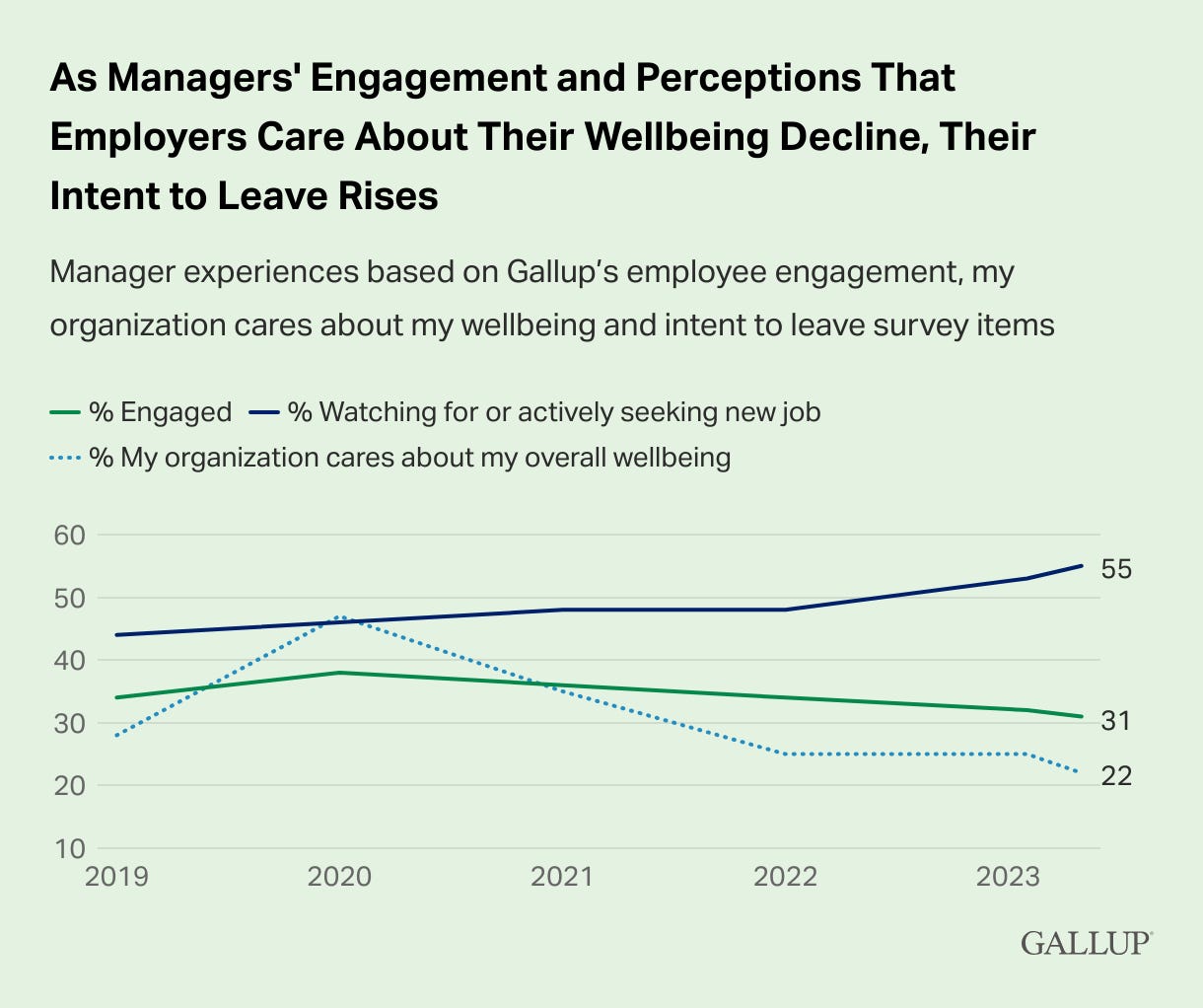
Culture, Engagement, and Performance: Organizational culture is not going away as the number one factor driving employee disengagement and unsatisfactory performance. Companies are placing greater emphasis on employee wellbeing and inclusivity via mental health support and ensuring diversity in hiring. However, a myopic focus on benefits under-emphasizes the leadership and structural drivers of disengagement that fuel “quiet quitting,” while out of the spotlight will certainly be continuing behind the scenes. Middle managers are also still bearing the brunt of a disrupted workplace, with quit rates still elevated and rising.
HR Law and Compliance: The legal landscape is fragmenting and accelerating at the same time. HR, operations and the lawyers will have a busy year as state, federal, judicial, and municipal rulemaking all kick into overdrive. 2024 alone is guaranteed to have new laws around pay transparency, union activities, non-competes, and what data is legal to use in hiring decisions. Numerous new vendors offer regulatory tracking solutions and there’s no sign that the regulatory onslaught and compliance catch up will abate this year
Technology and Disrupted Workplaces: Technological advancements, particularly AI, are creating acceleration which paired with slow internal adaptation leaves growing pains. Old workplace models are breaking down as leaders face the dual challenge of leveraging these technologies to enhance efficiency and retain competitive advantages. There are thousands of new tools released every month, and keeping up with this space will be exhausting for organizations and impossible for leaders alone.
AI quickly becomes ubiquitous, but business risks are materializing
AI is likely to move further from hype to headache in 2024 as boring data infrastructure and establishing policies turn the magic into just another organization-wide software adoption. Nonetheless, AI is expected to impact 40% of jobs within three years, with skills like ChatGPT - which is just critical thinking applied as inquisition - are becoming as essential as Excel for job seekers, and Forrester predicts 60% of employees will use AI daily by 2024.
However, growing reliance on AI combined with rapid, bottom-up adoption in businesses has led to various issues, from reputational damage and intellectual property leaks. These incidents underscore the need for a structured approach to AI integration within companies. Additionally, as AI becomes more prevalent, HR departments must navigate an evolving compliance landscape, ensuring their AI deployments align with new legal standards.
The regulatory landscape for AI deployment in the workplace is becoming increasingly intricate with overlapping federal, state, and city regulations. New York City - a leading indicator of emerging regulations - passed a law which requires annual audits and clear disclosures for automated recruitment tools, and guidance from the Equal Employment Opportunity Commission (EEOC) emphasizing that AI-induced discrimination in hiring and performance management is not exempt from legal repercussions. State-specific regulations and judicial decisions are also likely to abound in 2024, with hundreds of cases making their way through the courts and major states in the drafting process.
Prepare for a nasty year for office political strife
2023 saw DEI and ESG movements falter for a number of economic and legal reasons amid a broader backlash against identity politics. As companies start focusing on “value, not values”, DEI roles and functions within HR are increasingly under fire with many programs being scaled down or eliminated altogether in the wake of several supreme court decisions.
In response, such roles are pivoting to current topics like religious awareness, inclusion for the sake of engagement, and AI’s impact on workers. Such apparent shifts and DEI roles falling out of favor marks somewhat of a normalization of boardroom political pressures after a complex and charged three years.
While politics is no longer in vogue in the boardroom, employees’ push for executive stances and uncomfortable water-cooler conversation is unlikely to cool down. The November presidential election - currently projected as a Trump-Biden rematch - is likely to exasperate social-media-fed tensions that many businesses saw during the onset of the Israel-Hamas conflict.
Not only are such topics a distraction from work, workplace trust is already thin. Managers should at least dedicate one meeting before election season to create, update, or standardize policy and procedures for dealing with any wars at the watercooler.
HR Reading List

“Total rewards” replaces narrower compensation in many companies
"Total rewards" is shifting beyond traditional compensation and benefits, with many companies diversifying benefits to tackle continued employee dissatisfaction. A recent Mercer survey reveals a growing focus among employers on mental and emotional wellness, career progression, and skill development. Many large firms are adopting preventative care and mental health benefits.
Bottom Line: As Fortune 500 companies expand and diversify their benefits, aggregate employee expectations are raised. In an era when social media makes pay and benefits experiences available for all employees, pressure for more exotic benefits are likely to trickle down to small firms faster than in the past.
Lying to candidates during interviews becomes all-too common
In a recent Resume Builder survey, it was found that about 40% of hiring managers admitted to misleading candidates during interviews. Common areas of misrepresentation include job responsibilities, career growth prospects, and the company's financial health, often to mask less appealing aspects or attract stronger candidates. Notably, these deceptions are successful, with a high acceptance rate of job offers by candidates.
Bottom Line: While the survey suggested that lying works, in the long run such misrepresentations erode employee trust and engagement which are both scarce assets in the workplace these days. Lying takes mental energy to do and sustain, being transparent when possible boosts engagement, provides employees clarity, and means leaders have less to manage.
Middle managers struggle as they handle more leadership tasks
Middle managers face increasing challenges as their responsibilities shift from purely overseeing tasks to more holistic people leadership. Surveys indicate most feel senior leadership provides inadequate support to succeed as talent coaches rather than just executors; a concerning prospect given the critical role of mentorship in talent retention. With growing direct reports post-layoffs, middle managers must balance strategy expectations against burnout risks. However, ingrained stresses persist, from communicating leadership decisions to guiding teams through hybrid models.
“What we’re seeing is that when you look at it 360, managers are getting very mixed messages about what their manager is telling them to focus on.”
— Fresia Jackson, lead research people scientist at Culture Amp.
Bottom Line: Middle manager’s effectiveness enables organizations to thrive amidst disruption, meaning that elevating them is becoming imperative in disrupted times. Experts advise organizations should re-center middle management duties on employee engagement over solely task completion. Excessive bureaucracy and output focus leave minimal time for essentials like providing feedback and development. As artificial intelligence automates certain tasks, managers require latitude to cultivate trust and empathy.
22 states raise minimum wage floors
This week, 22 states will raise minimum wages, boosting pay for nearly 10 million workers. However, robust wage growth during the tight labor market has rendered many increases irrelevant. To attract and retain staff, employers are raising pay well beyond mandates, with low-wage workers now making around 50% above state minimums, the widest gap in a decade.
Bottom Line: While the minimum wage increases are more noise the signal, they solidify the “stickiness” of wages, essentially just the reality that wages never come down after increasing. Despite this fact, the increases will contribute to higher consumer and labor costs in some parts of the country as the raises prompt price increases.
‘Hustle’ tries to reestablish its hold, but employees and researchers push back
Facing economic headwinds and a weakening labor market, some CEOs are attempting to revive the so-called "hustle culture”, Bloomberg reports. The CEO of Wayfair received substantial online pushback when he commented “Working long hours, being responsive, blending work and life, is not anything to shy away from,” he said, according to Business Insider. “Hard work is essential for success, and a key part of getting things done,” adding that the suggestion that he doesn’t want people to work late is “laughably false.” However, extensive research demonstrates how insufficient sleep and rest systematically undermine creativity, motivation, and other qualities that managers prize.
Bottom Line: At one level, trying to raise employers time input without commensurate compensation would be considered an unsavory business practice if it was with a supplier. However, many CEOs agree with the WayFair sentiment, as knowledge worker output proves difficult to measure, many managers use prolonged hours as an indicator of commitment. Simply telling workers to sacrifice work-life balance, though, is unlikely to achieve anything other than aggravating employees.
With worker’s expectations and bargaining power still elevated, leaders have to carefully identify the ROI and risks of forcing unpaid overtime. Additionally, identifying the right behavioral levers to motivate, rather than force, employees can help avoid the burnout, resentment and turnover that has remained common post-pandemic.
December jobs data hits a ‘goldilocks’ zone
December’s 216,000 job creations were stronger than analysts had projected, with the unemployment rate remaining near record lows at 3.7%. And yet the overall picture shows the job market is not heating up again, but maintaining a healthy tempo. With October and November revised down, private payrolls growth averaged just 115,000 jobs in the last three months. That’s tied for the lowest since mid-2020, and while healthcare, government, leisure and hospitality again accounted for the lion’s share of job growth, 59.6% of all private industries added workers, a relatively healthy breadth.
Bottom Line: While a sanguine indicator of labor market, strong jobs reports complicates the job of the Fed and delays the widely hoped for rate cuts this year.
Stat of the Week
In Other News
40% of student loan borrowers are missing payments. 3 ways employers can help. (Employe Benefits News)
Finding a New Job Is Getting Harder: Postings fell in 2023 but were still up from prepandemic levels, data from job-listing site Indeed show. (WSJ)
Why some HR departments consider fractional execs when filling leadership positions. (HR Brew)
Unemployed Americans are still struggling in a strong job market. (Employee Benefits News)
Here are the top jobs for 2024 — by the numbers. (WorkLife)
HR strategy and employee behavior are shifting post-pay transparency, Indeed surveys suggest. (HR Brew)
Blue-collar workers defied bleak predictions, winning on big in 2023 with substantial wage growth and record union contracts for hundreds of thousands of workers. (Washington Post)
How to design inclusive benefit plans for today's aging workforce. (Employee Benefits News)
Report: What to Know About Gen Z’s Engagement with Social Media, Entertainment and Technology. (Morning Consult)
Pandemic rewrite’s HR’s role as function finally take the spotlight. (Employee Benefits News)
The Formula to Get More Time Off Using Your Vacation Days: Piggybacking on public holidays to create longer breaks, taking off Mondays are among the tricks. (Wall Street Journal)
NYC law bans rejecting applications based on height, weight, or body type. (HR Brew)
Get video meetings right: Body language dos and don'ts. (Employee Benefits News)