


Welcome to the latest edition of Human Capital Intelligence. As always, we would love to hear from you at ken@stibler.me with news ideas, feedback and anything else you find interesting.
Sent this by a friend? Sign up here to receive HCI in your inbox every week.
By Ken Stibler; Powered by Reyvisum Analytics
What’s Working

Power shifts back to employers in US white collar labor market
The power dynamic in the job market is shifting back to employers, at least for white collar workers hit by automation and overproduction. While overall job growth remains, companies are finding it easier to replace and retain office workers. This allows them to be more selective and demanding with staffing decisions.
Firms are mandating office returns, laying off employees, and taking a harder line in hiring. Job quitting has declined 25% from its peak as workers' confidence wavers. The number working multiple gigs is rising too, suggesting some struggle to land full-time roles.
Applications per job opening have tripled in 2024. Across ~14M job applications we noticed a massive rise in weekly applications per job opening across both business and technical roles. From the average in January 2021 to the average in January 2024, the data reveals a 3x growth in job applications per business role at 207%
— Ashby HR
While not a full "employers' market" yet, momentum has clearly swung from employees back to companies. Tech sector layoffs are one sign of this change. As economic uncertainty grows, workers seem more willing to accept employer demands around remote work and office attendance. For now, help wanted signs still dot the landscape. But leverage has tilted back toward bosses. The "battle for talent" appears to be winding down.
Financial stress affecting the majority of US employees
Financial stress is reaching alarming levels among the American workforce. According to a new report from SoFi at Work, 86% of employees say they are stressed about their finances, up 10% from last year. The increased cost of living is causing many to struggle with debt, student loans, and saving for retirement simultaneously. As a result, nearly half of employees report issues with sleep, motivation, and mental health.
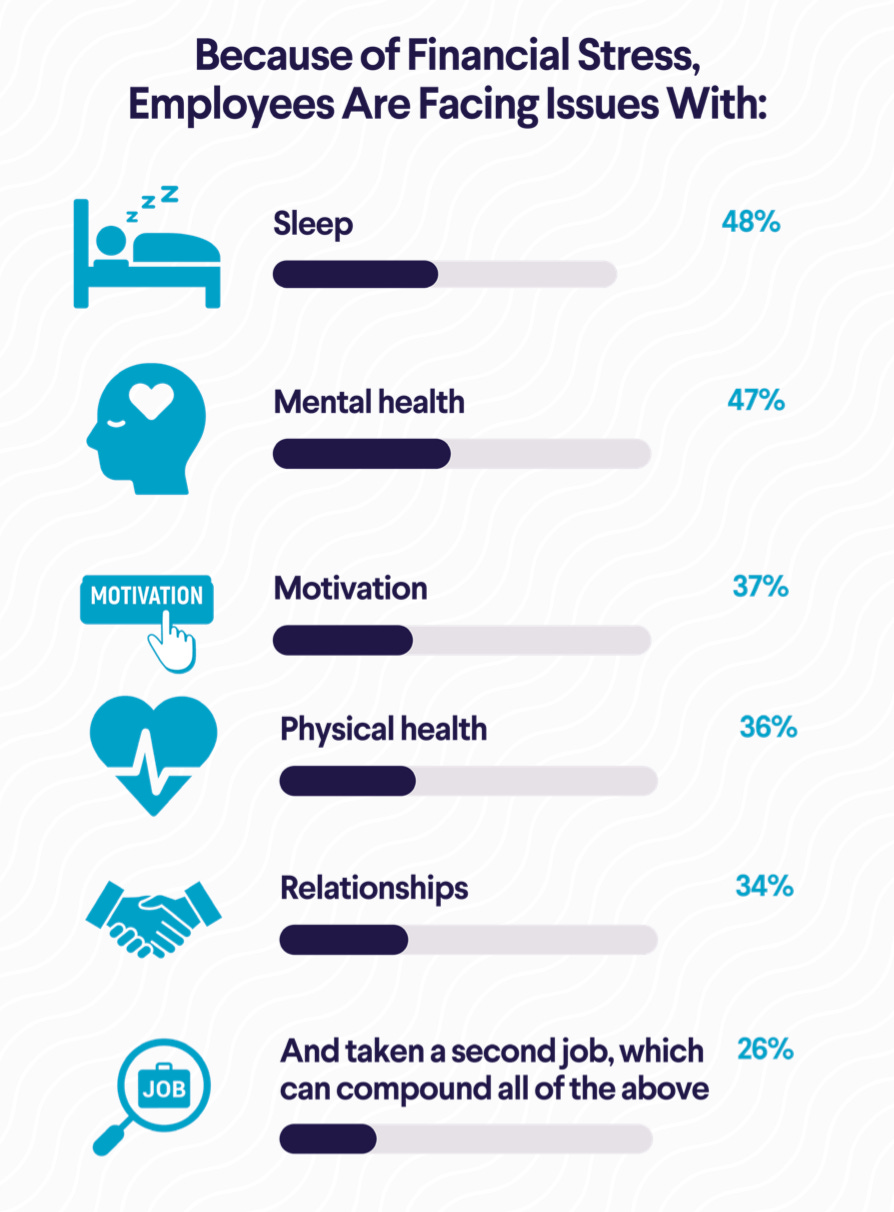
With finances dominating mindshare, productivity takes a hit. Employees spend an average of 14 hours per week dealing with money matters. As financial anxiety mounts, nearly 40% of employers have observed a negative impact on output. Still, most HR leaders don't fully grasp how to help. Only half of companies offer emergency savings benefits, while just 20% have implemented student loan matching.
Clearly, the time has come for employers to make financial wellness a top priority. With 60% of HR leaders looking to increase financial benefits budgets next year, change is on the horizon. But truly supporting employees requires more than just offering new perks. It means meeting people where they are and providing tailored resources at pivotal financial moments. Employees' financial fitness can no longer be ignored. The data shows it has become an imperative for recruitment, retention, and productivity.
Employers turn to more exotic benefits to retain top talent
With the job market still tight, companies are getting creative with the extra perks and incentives they offer employees. More employers are now providing on-site childcare, a rare but growing benefit aimed at retaining working parents. The number of businesses with on-site care rose 47% since 2019, per a survey. While costly to implement, government credits can assist, and the payoff in loyalty and retention is high.
Equity compensation, once the domain of top executives, is another increasingly common retention tool down the line. Bank of America recently announced $800 million in stock grants for employees. Walmart is now giving store managers up to $20,000 in annual stock awards. Equity gives workers ownership, motivating them to stay.
As competition persists, firms are thinking outside the box on benefits. Childcare support and stock incentives show the value of meeting specific workforce needs. While traditional offerings like health insurance remain essential, smart companies are customizing their compensation packages to attract and anchor talent.
Reading List

Layoffs have become routine, but they shouldn't be
Mass layoffs were once rare, seen as a sign of corporate distress. But they have now become a routine management practice at even healthy companies, Bloomberg argues. In 2022, 58% of Fortune 100 firms announced job cuts. The ubiquity of downsizing has made managers numb to its harmful effects.
Read more about how normalizing layoffs is harmful.
Amid immigration debates, political noise drowns out economic necessity
The Congressional Budget Office (CBO) projects immigration will deliver a massive $7 trillion boost to the US economy over the next decade. The influx of workers will expand the labor force and stoke consumer demand. This will lift GDP growth by 0.2 percentage points per year on average.
Read more about how immigration is supporting US labor availability.
Japanese recruitment offers lessons for US companies facing tomorrow’s labor shortages
Japan is experiencing a dire shortage of skilled technology workers, even as it pursues digital transformation and jumpstarts its semiconductor industry. Per a Morgan McKinley report, 75% of tech hiring managers called recruitment very, or quite, competitive last year due to limited qualified candidates.
Explore how Japanese businesses offer lessons for recruiting amid structural labor shortages.
Non-competes face threat as FTC seeks ban
The FTC is proposing a ban on non-compete agreements, arguing they restrict competition. This could have major implications for Wall Street, where non-competes are commonly used to retain talent with proprietary knowledge. Industry groups oppose the ban, but California already restricts non-competes and New York recently tried.
Read more about the effort to ban non-competes.
Employee mental health in crisis; leaders have an opportunity to respond
A recent viral twitter post where Elmo - you read that right, the Sesame Street character - casually asked how people were doing proved a reminder of the prolific and dire state of mental health today. Over 20,000 followers responded, citing anxiety, fear and existential dread, much resulting from their work situation. This reflects data showing 3 in 4 working adults have mental health symptoms. Yet only half feel comfortable discussing it at work.
Read more about how managers can fill a vacuum to respond to increasing complexity.
Stat of the Week
In Other News
CEOs turn positive on US economy for first time in 2 years. (Employee Benefit News)
Japanese Firms Boosting Pay for Young Workers Is Good News for BOJ. (Bloomberg)
‘A massive reporting challenge’: Employers brace for California’s new climate emissions law. (WorkLife)
Employers Want to Fire Workers Without Getting Shamed on TikTok. (Bloomberg)
How HR can prepare for the biggest business risks of 2024. (HR Brew)
New Australia law to allow workers to ignore after-hours calls from bosses. (Reuters)
Companies being sued for alleged WARN Act violations amid layoffs. (HR Brew)
ADP reveals what an ideal HR team looks like. (Employee Benefits News)
Work Shift: Will the UPS Return-to-Office Plan Deliver? (Bloomberg)
How the AI boom could influence wage growth. (WorkLife)
Companies Brought in Robots. Now They Need Human ‘Robot Wranglers.’ (WSJ)