


Welcome to the latest edition of Human Capital Intelligence. As always, we would love to hear from you at ken@stibler.me with news ideas, feedback and anything else you find interesting.
Sent this by a friend? Sign up here to receive HCI in your inbox every week.
By Ken Stibler; Powered by Reyvisum Analytics
What’s Working

Worker frustration remains palpable despite strong labor market
While headline employment figures remain strong, worker frustration is mounting below the surface. A majority say they would accept a 20% pay cut for better work-life balance, especially younger generations. But opportunities to switch jobs are dwindling - quit rates are at a 3-year low. While headline labor markets paint a rosy picture, educated white collar employees are seeing a different reality on the ground.
Many people now work multiple jobs to get by, with women taking on side gigs at the highest rate since the 1990s. College graduates are also increasingly taking any gigs they can find, with some school administrators HCI has interviewed admitting sub-60% full-time employment rates for new grads. Job searches have also lengthened as ghost positions proliferate, applications per job triple, and markets try to absorb waves of qualified employees from blue chip layoffs.
“People hear that wages are going up, people hear that it’s really easy to get a job, and yet that’s not what they’re finding—themselves, their children, their neighbors.”
— Jane Oates, a senior policy adviser at the workforce development nonprofit WorkingNation, on the state of the US labor markets
So while the job market hasn't crashed as feared, workers feel squeezed by fewer chances to advance and inflexible demands. The veneer of a hot labor market glosses over their daily struggles. Strong macro statistics provide cold comfort to those facing increasingly long odds just to find a suitable job.
‘Stunning’ January hiring figures shows strong labor market
The January jobs report revealed a labor market still running hot, with 353,000 positions added - the strongest hiring in a year. The figures stunned economists who had forecasted slowed hiring from higher interest rates. The job growth also makes it unlikely the Fed will deliver desired rate cuts until late in the spring or early in the summer. Comments by Fed Chair Jerome Powell also suggest that the central bank would only pursue 3 rate cuts this year compared to the 6 previously expected.
Read more: Rate-Cut Pivot Can’t Come Soon Enough for Debt-Strapped Companies. (Bloomberg)
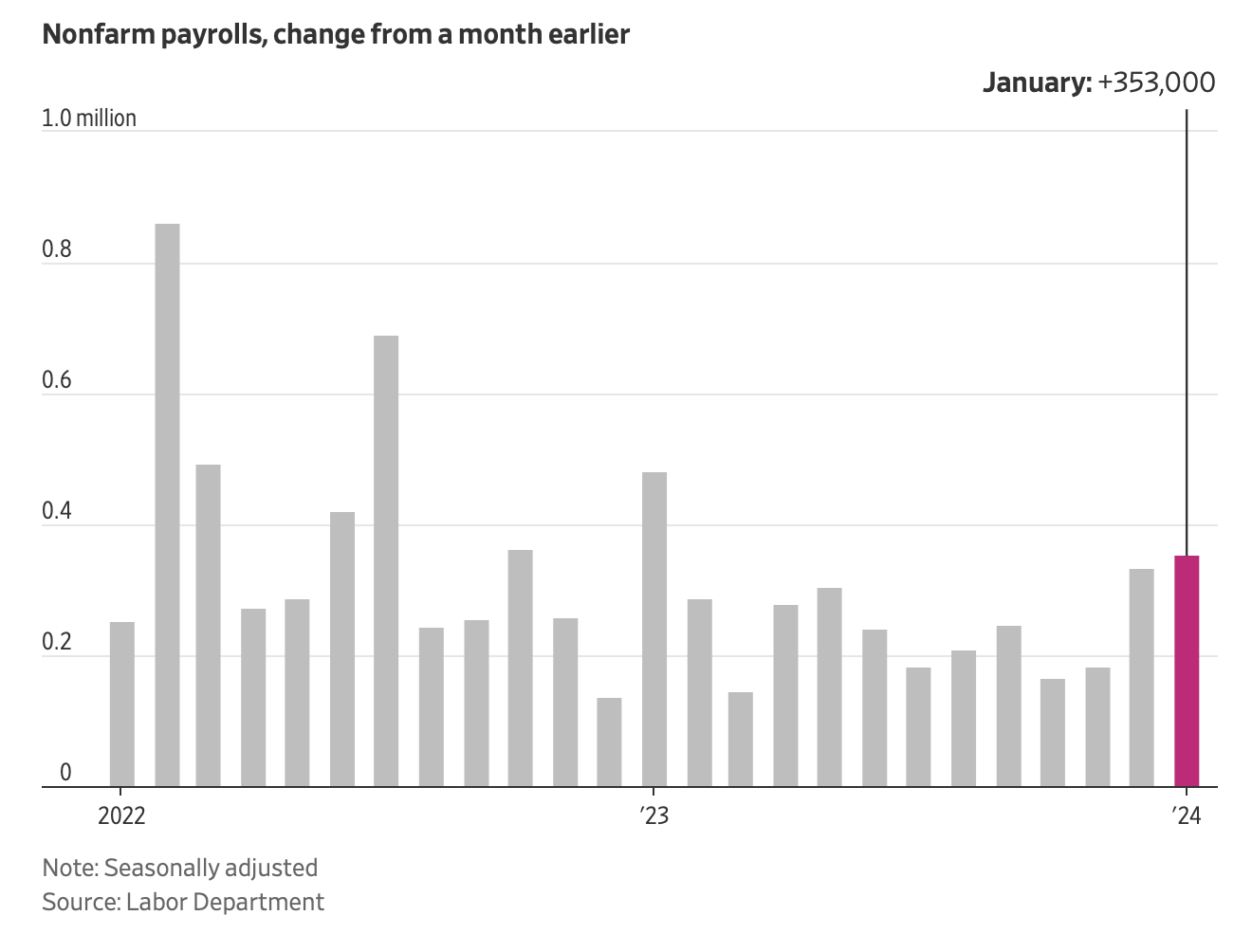
Underneath the otherwise healthy gauge of the US economy lies a deeper concern though: why has job growth remained strong despite tighter interest rates pouring cold water on US firms? January’s unexpected figures cast doubt on the standard explanation that firms are just ‘hoarding’ labor. Layoffs doubled, and multiple surveys show most are struggling with labor quality, not availability.
Rapid immigration might explain it, supplying workers not captured in data. But with job cuts surging 136% in January, there is real concern that a tight labor market from decelerating US population growth may lead to longer-term tightness, and higher competition for employees.
Nonetheless, small businesses remain optimistic. A Goldman Sachs survey found 57% of small firms plan to add jobs this year given upbeat financial prospects. January's broad job gains, across nearly two-thirds of industries, shows the labor market's underlying strength. So while the Fed may delay rate cuts, it seems workers and firms are, on average, both benefiting from a goldilocks zone of opportunities.
Lessons of how not to RTO from corporate America
As layoffs become a subject of public discourse on social media, the approach to The remote office war is entering what feels like its final phase. Layoffs and rumors of layoffs have put workers on the backfoot and employees have pounced with RTO mandates, reduced remote hiring, and remote-focused layoffs. Now corporate America - already dealing with a worker disengagement crisis - is putting on a show of how to effectively get employees back to office.
EY has received a wave of backlash for changing privacy policies to use employee turnstile data to track attendance while Bank of America’s “letters of education” to employees have been decried across the political spectrum. Meanwhile, IBM pursued a more simple “report to the office or be fired” policy, despite having closed offices in several major cities to save on rent costs.
Despite these policies, internal data reflects many teams at the RTO-ing firms still have less than 50% attendance records. Research also shows that forced RTO breeds resentment, based on a University of Pittsburgh study showing 99% of firms mandating office work saw job satisfaction fall, with no performance gain.
Read More: These fresh RTO tactics are helping attract people back to the office. (WorkLife)
Companies may feel that an extremely weak white collar labor market gives them the power to pursue no-holds-barred RTO; an estimated 16% of top performers leave following strict enforcement. With the costs of rigid returns clear, businesses should make sure they have a clear internal rationale behind RTO, beyond platitudes about collaboration and teamwork.
Reading List

Demographics and workplace disruption drive refocus on ‘productivity’
Measuring efficiency has never been more critical as hybrid work models raise questions about remote productivity and AI's impact on workers’ potential, Bloomberg reports. But measuring productivity is notoriously volatile and misleading.
Read more about the critical quest to figure out what employees do all day, and how to help them do it better.
Low hanging fruit for efficiency gains: making meetings less useless
Meetings are a huge time sink for companies, with workers spending around two days a week in them. Yet research shows most lack clear purpose and fail to engage employees. This wastes critical talent resources amid mounting business pressures. The problem is especially acute in 1-on-1 between managers and direct reports. Despite their talent impact, managers often poorly structure these meetings when they are not ‘pushed’ out of convenience.
Read more about how to fix 1-on-1s.
Labor shortages call for creative hiring and operational maturity
A tide of retirees is returning to the workforce, lured back by inflation, debt and boredom. This year, 12% of retirees are expected to re-enter the office, adding to the 25% who already came out of retirement, per a Resume Builder survey. With 9.6 million open jobs and just 6.4 million unemployed, their return could help fill talent gaps, says Stacie Haller of Resume Builder.
Read more about how grey collar workers can boost businesses if included effectively.
Businesses strive for more compassionate (and less risky) layoffs
Botched layoff announcements like viral Zoom terminations come with PR and cultural consequences, leading employers to seek kinder, less traumatic ways to fire employees. Simple best practices include in-person meetings with managers, not HR, and thoughtful explanation of the business context. Advanced notice and retention bonuses help, when feasible.
Explore how businesses are de-risking layoffs.
Minors, Migrants, and Mondays Off: Business around the world brace for demographic deficits
Facing acute labor shortages, businesses worldwide are adopting unorthodox strategies to fill open roles. In Germany, more companies are shifting to four-day workweeks to attract talent. Florida just joined efforts to relax child labor laws so minors can work more hours. Though the US has higher immigration, talent gaps loom as populations age.
Read more about the future of labor shortages and how companies are coping.
Stat of the Week
In Other News
How workaholism impacts your health and your career. (Fast Company)
Businesses and Consumers Are Borrowing Again, in 8 Charts. (Wall Street Journal)
Focused Cuts and Fewer Layers: Tech Layoffs Enter a New Phase. (New York Times)
Job Quitting Fell 12% Last Year—and That’s Bad News for the Economy. (Wall Street Journal)
U.S. workers are getting scooped up by international companies hiring remote roles. (CNBC)
Viral layoff videos reflect a sea change in work culture. (Axios)
Empowering managers to be more human will impact corporate culture. (HR Brew)
In an ‘always on’ work culture, employees feel shame about taking time off, even if company policies purport to encourage it. (Wall Street Journal)
Utah Bans D.E.I. Programs, Joining Other States. (New York Times)
Employers are enhancing their leave benefits to boost recruiting and retention. (HR Brew)
66% of analysts believe a retirement crisis is looming. (Employee Benefits News)
Companies increasingly are creating formal ‘reboarding’ programs to help new parents transition back to work more easily. (WSJ)
Most HR leaders surveyed believe employees are breaking cybersecurity rules. (HR Brew)
90% of employers have open enrollment errors — and it's costing them billions. (Employee Benefits News)
Trader Joe’s Follows SpaceX in Arguing US Labor Relations Board Is Unconstitutional. (Bloomberg)
Effects of remote working in US extend to Japan. (Financial Times)
How one startup uses chatbots to onboard employees. (HR Brew)
Is It Better to Select a CEO Who Is an Outsider or an Insider? New research says its a little bit of both during disrupted times. (Wall Street Journal)
Why Introverted Leaders Are Ideal for the Postpandemic Workplace. (Wall Street Journal)
Searches for “retirement ages around the world” spiked +1,450% in the past week in the US. (Google Trends)
Why you should never retire: Research find that pleasure cruises, golf and tracing the family tree are not that fulfilling. (The Economist)