


Welcome to the latest edition of Human Capital Intelligence. As always, we would love to hear from you at ken@stibler.me with news ideas, feedback and anything else you find interesting.
Sent this by a friend? Sign up here to receive HCI in your inbox every week.
By Ken Stibler; Powered by Reyvisum Analytics
What’s Working

Surprisingly strong labor data creates complications for input markets
The March jobs report released by the Bureau of Labor Statistics has blown past forecasts, continuing to defy predictions of a slowdown. The economy added 303,000 jobs last month, surpassing the 200,000 forecasted by economists and marking the largest gain since May 2022.
The strong labor market performance has raised concerns among investors and economists about the potential for prolonged inflationary pressures. While wage growth in March was relatively mild, with average hourly earnings up 4.1% from a year earlier, the consistent demand for workers suggests that companies may face increased pressure to raise pay in order to attract and retain talent.
This robust hiring spree complicates the Federal Reserve's path to lower interest rates. Chair Powell has communicated data-decency to lower the cost of capital, and March’s figures push the expected start of rate cuts later in 2024, or early 2025, if the market remains strong.
“The economy is functioning unevenly, as some industries are hiring, while others are shedding jobs. There are ‘nuggets of gold’ in the industries that are cutting jobs and HR can scoop up unique talent by looking outside their sector.
— Scott Hamilton, global chairman of HR and compensation for Gallagher
Employers in healthcare, private education, leisure, hospitality, government construction and manufacturing, are seeing continued vacancies despite repeatedly raising wages. March’s numbers suggest that employers will likely need to contend with concurrent labor shortages, while borrowing remains expensive - an unusual situation given their traditionally inverse relationship.
Rapid change and a falling value prop force a college rethink
The once-unquestioned consensus that a college degree is essential for success in America is crumbling, as mounting student debt and underemployment erodes confidence in higher education, the WSJ reports. The percentage of Americans expressing strong confidence in universities has fallen from 57% to 36% over the past decade, while undergraduate enrollment has declined by 3 million students since 2011.
The pandemic has exposed the flaws in the "college for all" model, particularly for middle-class families who are increasingly questioning the value of a four-year degree in the face of skyrocketing costs and inconsistent economic returns. The misalignment between university curricula and rapidly changing industry needs has left many graduates ill-prepared for the job market. The slow pace of change in academia has hindered institutions' ability to adapt to the needs of students and employers alike.
Keeping reading for implications of GenZ’s growing shift towards trades.
L&D not fit for purpose in a rush to meet AI upskilling needs
The demand for employees with AI skills is surging. However, current corporate learning and development (L&D) programs are struggling to keep pace with this rapid shift, leaving many organizations ill-prepared to meet the challenges and opportunities presented by AI.
Read More:
A disconnect between employer perceptions and worker realities around advancement points to an opportunity for worker upskilling. (HR Dive)
Why L&D Pros Have Got Measurement All Wrong. (Linkedin)
The shortcomings of traditional L&D approaches are becoming more apparent as employees seek AI training outside of their workplaces. A joint Gallup-Amazon survey reveals that while nearly 60% of employees are interested in upskilling programs, 57% are already pursuing training on their own. This disconnect highlights the need for L&D programs to evolve and incorporate creative, engaging, and relevant AI training to better serve the needs of the modern workforce.
Reading List
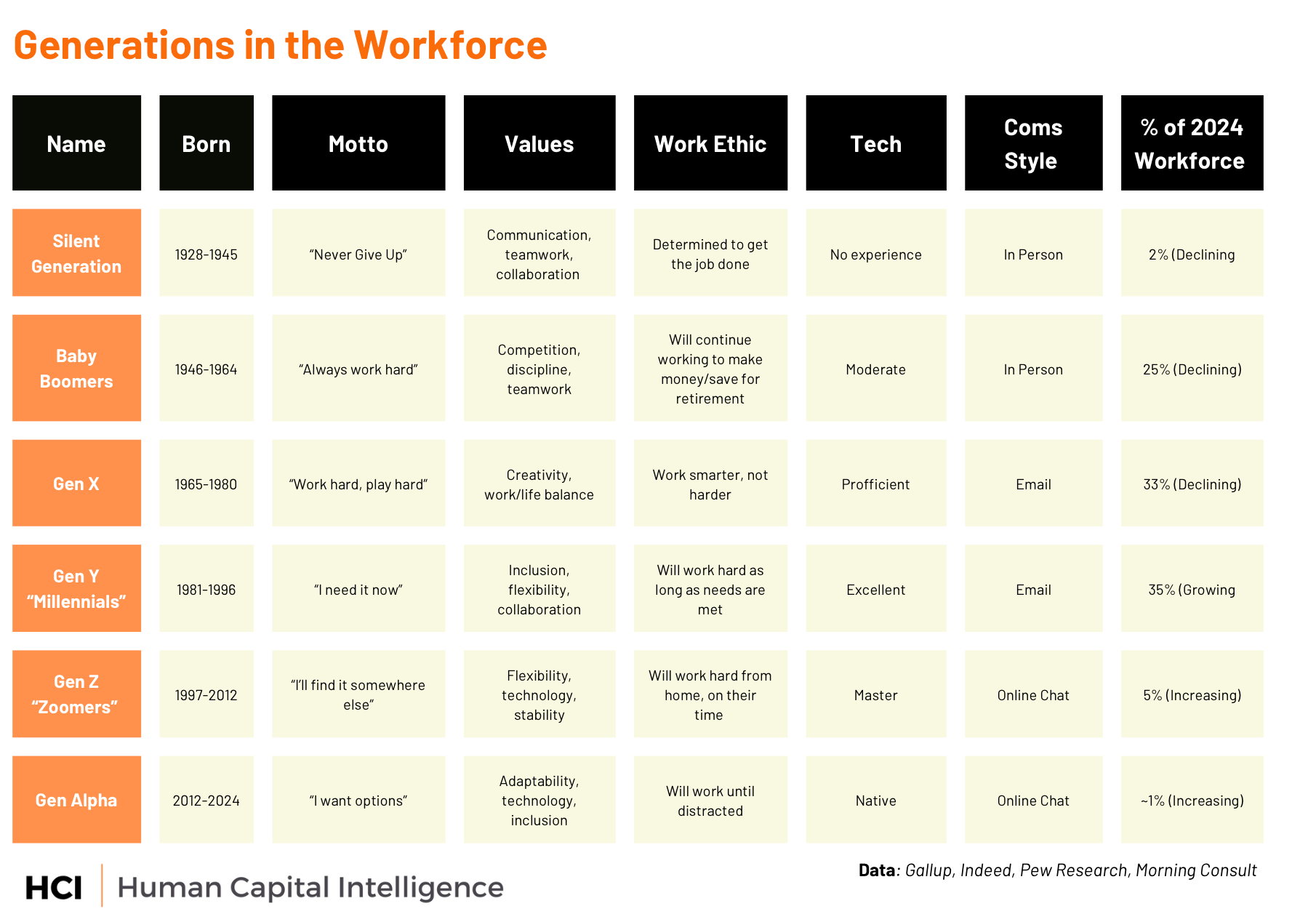
Leading the 6-generation workforce
Amid rising longevity and delayed retirement, the workforce is now home to an unprecedented six generations, forcing leaders to adapt their strategies to ensure sustainable integration of vastly different cohorts. Failure to engage this new 6G reality effectively could lead to organizational chaos and decline, Harvard Business Review argues.
Read more for how to align all generations behind a common goal.
HR executives command higher salaries as function becomes more strategic and data-driven
HR has evolved from an administrative function to a strategic powerhouse over the past three decades pushing the compensation of HR executives up. According to a recent report by Stanford University economist Nick Bloom, the share of companies in the S&P 1500 whose HR leaders are among the top-five highest-compensated executives has increased from just 0.5% in 1992 to 13% in 2022. This comes after a challenging half-decade for HR through the pandemic, the #MeToo movement, and the shift towards remote work.
Read more about HR data-driven shift.
Employees are hiring reps of their own amid falling trust in HR
A growing number of workers are turning to independent HR consulting firms to advocate on their behalf, as trust in traditional corporate human resources departments wanes, the Guardian reports. The rise of these third-party HR services highlights a growing perception among employees that in-house HR is neither impartial, nor effective, at protecting workers. Well-publicized acceptance of programs like worker surveillance and AI labor automation stands to further erode trust as well.
Read more on the costs and consequences of eroding trust in HR.
US companies quietly get closer to four-day work weeks
American workers are increasingly clocking out early on Fridays, with many using the day to transition into the weekend rather than putting in a full day's work, WSJ reports. Data from workforce analytics firm ActivTrak shows that the average sign-off time on Fridays has shifted from around 5 p.m. in early 2021 to 4 p.m. now, a full hour earlier than the Monday-Thursday average.
Read more about the quasi-four day work as an indicator of employee disengagement.
Stat of the Week
In Other News
Four reasons why leaders are drowning, damaging a CEO pipeline. (WorkLife)
Where Have All The Good Leaders Gone? (Brian Dodd)
Number of unemployed people per job opening unchanged in February for tenth consecutive month. (Bureau of Labor Statistics)
Indeed launches new tool helping TA pros match candidates to job openings. (HR Brew)
Freelance platforms see even more of an increase in supply and demand for AI skills. (WorkLife)
Glassdoor Employee Confidence Index: Entry-Level Sentiment Sours. (Glassdoor)
Recognition is key to employee retention. (HR Brew)
‘More energized by their work’: How Shopify’s dual-track promotion plan is working out. (WorkLife)
Legislative lowdown: Utah law makes NDAs regarding sexual misconduct unenforceable. (HR Brew)
RTW, EOD and TIA: 10 workplace acronyms employees still don't know. (Employee Benefits News)
Following the Supreme Court’s decision on religious accommodations, more requests have found their way into the courts. (HR Brew)
Child care benefits ‘pay for themselves,’ analysis finds. (HR Dive)
6 Ways to Reduce Cybersecurity Risks With Employee Onboarding. (TalentCulture)
How AI Features Can Change Team Dynamics. (Harvard Business Review)
What HR should know about the TikTok workplace trend ‘QuitTok’. (HR Brew)
What is a chief AI officer — and do you need one? (HR Dive)
Trust Erosion: Deepfakes Are Coming for the Financial Sector: Companies using photos or audio to verify customers’ identities are preparing for bad actors gaming the system with generative AI. (Wall Street Journal)