


Welcome to the latest edition of Human Capital Intelligence. As always, we would love to hear from you at ken@stibler.me with news ideas, feedback and anything else you find interesting.
Sent this by a friend? Sign up here to receive HCI in your inbox every weekend.
By Ken Stibler; Powered by Reyvisum Analytics
What’s Driving the Week

Employee Engagement Efforts Fall Short According to Employees
A recent report by Gartner, Inc. reveals that only 31% of employees feel engaged and enthusiastic about their work, with energized employees being 31% more likely to stay with their organization and contribute more. Despite ongoing efforts to boost engagement, nearly 70% of workers don't feel as engaged as they should be, emphasizing the need to address this issue.
Dissatisfaction with how organizations handle employee feedback is a significant factor affecting engagement, with only a third of employees believing their feedback is acted upon. Additionally, 60% of employees are unclear about their organization's engagement efforts, as the term "engagement" may not resonate with them. Implementing more relevant initiatives can boost engagement by 49%. Contrary to employers' perceptions, a recent Gallagher report suggests that only 29% of workers are thriving at work, highlighting the importance of improving worker engagement in the face of declining employee satisfaction since 2020.
Skills Shortage Risings in Importance for CEOs
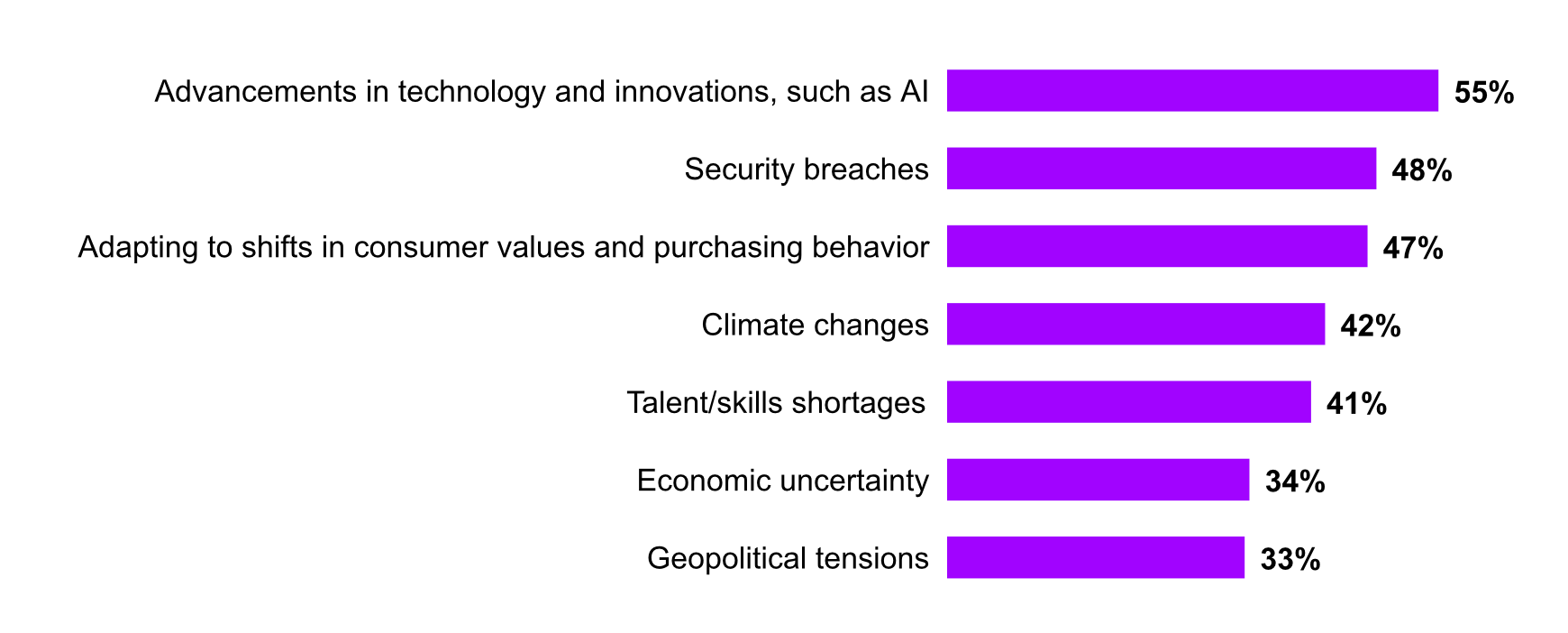
A recent survey by Accenture has revealed that 41% of executives are concerned about a skills shortage in 2024, highlighting the pressing need for organizations to proactively invest in learning and development. As technology evolves rapidly and reshapes the job landscape, traditional educational institutions may struggle to keep up with the dynamic needs of the job market. Corporate learning and development teams are well-positioned to address these gaps, tailoring programs to the specific demands of their organizations and delivering scalable learning experiences. In addition to technical skills, the development of uniquely human capabilities, such as empathy, curiosity, and resilience, is becoming increasingly important for future success.
To meet the changing expectations of the workforce, personalized learning delivery vehicles, experiential learning, and advanced technologies like virtual simulations are emerging as crucial tools. Such an approach not only equips individuals with the skills required for a rapidly evolving job market but also creates opportunities for those who might not have traditional credentials. By linking learning and development activities to the organization's business strategy and outcomes, C-suite leaders can ensure that these initiatives serve as catalysts for achieving growth objectives and enhancing engagement, retention, and overall purpose within the workforce.
Promotions Increasing Raise Resignation Risk
Almost a third of newly promoted managers in the United States leave their roles within the first month of their internal promotion, according to new research from ADP. This exodus is driven by various factors, including inappropriate pay adjustments, as some employers elevate employees to managerial positions without matching salary increases to new responsibilities. A lack of support and training during the crucial first 90 days in the new role contributes to the problem, with impostor syndrome and the risk of burnout adding to the challenges.
To address this issue and retain newly promoted employees, organizations should focus on aligning pay with roles, providing comprehensive support and training, addressing impostor syndrome, and considering the well-being and work-life balance of younger professionals. By taking these steps, both employees and employers can increase the likelihood of successful transitions to new managerial roles and reduce the high turnover rate among freshly promoted individuals.
HR Reading List

HR compliance is rising to a never-before-seen level of complexity. This has involved hundreds of new regulations associated with reopening, distributed and remote work, vaccination, and labor relations , as well as those associated with human-capital disclosures, pay transparency and the increasing use of AI in organizations. (Wall Street Journal)
77% of global employers say they are already struggling to find workers with the right mix of technical skills and human capabilities. However, talent intelligence, internal talent mobility, skills-based hiring and the rise of short-term, rapidly assembled teams composed of contract workers and the first permanent work-from-home employees—can alleviate the squeeze. (Manpower Group 2023 Talent Shortage Survey)
A backlash against Tik Tok parent company ByteDance this week over the company tellings its managers to give more employees poor performance reviews is highlighting how not to crack down on . Events like this which your employees are likely aware of can also become great opportunities to community core values and build trust on issues like management’s commitment to fair reviews.
Government data showed that the labor market substantially weakened in October with payrolls increasingly by only 150,000. Moderating pay gains help explain why Fed policymakers are projected to again hold rates steady on Wednesday following their two-day meeting. The strong but not too strong jobs report suggests a ‘goldilocks’ scenario where labor supply shortages abate without the Fed needing to force a recession may still be possible.
Quote of the Week
“We’re just not going to stay at companies where we don’t interact with our managers on a regular basis, we’re just not going to do it,”...“Gen Z has put a nail in the coffin for that kind of ad-hoc management and way to deal with your team.”
Mark Seemann, CEO at StaffCircle discussing GenZ’s demands for more feedback
In Other News
3 in 4 Gen Zers will reportedly resign if they don’t get feedback from managers. (WorkLife)
How can a rebalance of labor market power help re-energize your workforce? (EY Work Reimagined Survey)
Gen Z aren’t taking to apprenticeships like millennials did—despite CEOs like Tim Cook and Richard Branson praising university alternatives. (Fortune)
Job openings rise even as quits, layoffs decline. (Construction Dive)
Job seekers are on the hunt, focused on AI roles, LinkedIn says. (HR Dive)
Need for skilled AI talent is driving up salaries. (CIO Dive)
Traditional tech hubs still have the most future-ready workforces, but a new wave of cities is on the rise. (WSJ)
98% of Gen Z is ‘burned out’. How can employers respond? (Employee Benefits News)
Narrow the Gap Between Company and Employee Purpose. (Harvard Business Review)
Employee happiness is at a 3-year low: Which industries are suffering the most? (Employee Benefits News)
5 Leadership Tips For Increasing Employee Engagement. (Forbes)
4 Phrases That Build a Culture of Curiosity. (Harvard Business Review)
Middle managers don’t like managing - Study finds 4 red flags tanking middle managers’ job satisfaction. Here’s what you can do about it. (HR Dive Publication)
What Would Your ‘Culture Map’ Reveal About Your Organization? (TalentCulture)
Legislative lowdown: NLRB lowers bar for joint-employer status. (HR Brew)
How employers are making performance review data actionable. (Employee Benefits News)
What did I do Wrong and Am I being fired? HR reacts to Gen Z workers’ perception on the HR function. (HR Brew)
'Mismatched workers' are derailing your hybrid work plans. (Employee Benefits News)
From AI and remote work to dress codes and salary transparency - What explains generation divides with the C-suite? (Employee Benefits News)
HR meets data compliance: 45% of HR pros have shared employee information with family or friends. (HR Brew)
62% of workers think salaries should be kept a secret. (Employee Benefits News)
Generative AI will change how we work and what skills we need—and it’s happening faster than we expect. (IBM)
AI in HR: Biden’s executive order builds on AI regulation. (HR Dive)